Introduction
Jewellery shopping is a highly personal experience. Customers often compare designs, check prices, ask questions, and discuss their options with family before making a purchase. Therefore, jewellery stores need fast, relevant, and consistent communication throughout the buying journey.
However, managing every customer conversation manually can become difficult as enquiries increase. Sales teams may spend hours answering the same questions, sharing product images, checking availability, and following up with potential buyers.
This is where the WhatsApp API for jewellery stores can make a difference.
With the WhatsApp Business Platform, jewellery businesses can create structured communication workflows for product enquiries, catalogues, festive offers, customer support, and follow-ups. In addition, businesses can connect WhatsApp with chatbots, CRMs, advertising campaigns, and other marketing tools.
For example, a customer may discover a jewellery collection through Instagram and start a WhatsApp conversation. The business can then share relevant products, answer basic questions, collect customer requirements, and connect the enquiry with a sales representative.
Moreover, the same customer can receive a timely follow-up if they do not purchase immediately. Consequently, the business can maintain the conversation without relying completely on manual reminders.
At Trending Bulb, businesses can explore digital marketing and content strategies designed around customer engagement and online growth. Meanwhile, Campaign Plus provides WhatsApp automation, chatbot and more to make business growth. Similarly, Step4Growth can support broader digital growth strategies that connect marketing, lead generation, engagement, and conversion.
As a result, WhatsApp can become more than a simple messaging channel. Instead, it can become an important part of a jewellery store’s digital marketing and sales journey.
So, how can jewellery stores use WhatsApp API effectively?
Let’s explore the key strategies step by step.
Why Should Jewellery Stores Use WhatsApp API?
Jewellery customers usually have several questions before making a purchase. They may want to know about designs, prices, availability, purity, weight, customisation, delivery, or showroom locations.
As a result, sales teams often spend considerable time responding to repetitive enquiries.
With WhatsApp automation, businesses can organise many of these conversations more efficiently. Moreover, automation allows sales teams to focus their time on customers who need personal assistance.
Faster Customer Responses
Customers can enquire about jewellery at any time. For instance, someone may discover a new collection late in the evening and immediately send a WhatsApp message.
Instead of leaving the customer without a response, an automated workflow can acknowledge the enquiry. Consequently, the customer knows that the business has received the message.
Easier Product Discovery
Finding the right jewellery can take time. Therefore, businesses can organise their products into categories such as gold jewellery, diamond jewellery, bridal collections, rings, earrings, necklaces, and festive designs.
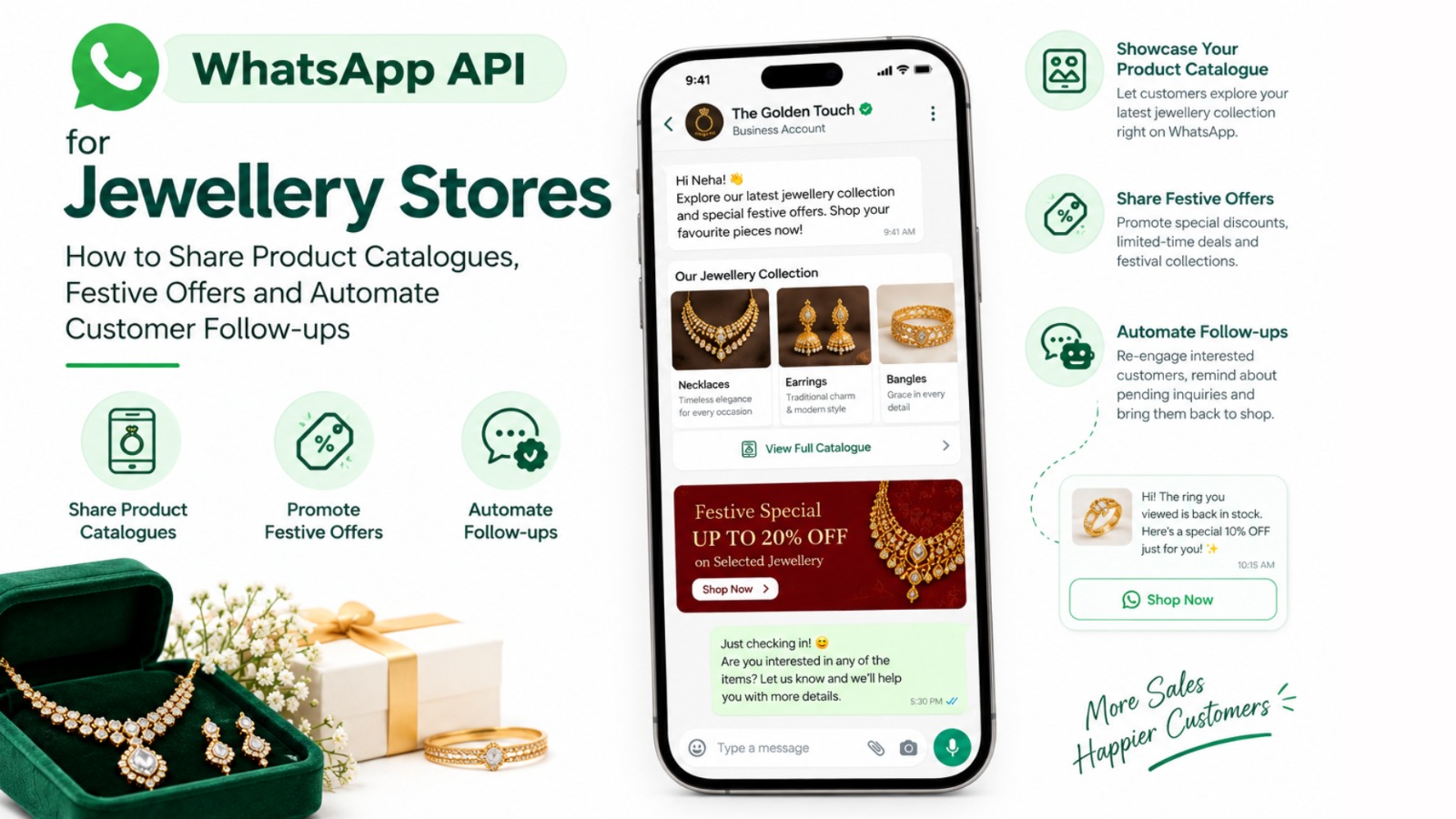
Once a customer selects a category, the business can guide them toward relevant products. This approach makes product discovery more organised and reduces unnecessary messages.
Consistent Communication
Different sales representatives may communicate with customers in different ways. However, automated workflows can provide consistent basic information.
For example, businesses can create standard responses for store timings, locations, frequently asked questions, and enquiry processes. Meanwhile, sales representatives can handle conversations that require personal attention.
More Organised Follow-Ups
A customer may show interest today but decide to purchase later. Therefore, businesses should have a structured follow-up process.
With WhatsApp automation, jewellery stores can create timely follow-up workflows. As a result, sales teams can stay connected with potential customers without manually remembering every enquiry.
How to Share Jewellery Product Catalogues on WhatsApp
Product discovery plays an important role in jewellery shopping. Customers often want to explore designs, compare options, and understand product details before visiting a showroom.
Therefore, WhatsApp can become a convenient channel for presenting relevant jewellery collections.
1. Start With Customer Intent
First, identify what the customer is actually looking for.
For example, a jewellery store can ask:
“What type of jewellery are you looking for?”
The customer can then choose from options such as:
Gold Jewellery | Diamond Jewellery | Bridal Jewellery | Daily Wear | Festive Collection
Once the customer selects a category, the business can provide relevant product information. Consequently, customers do not have to search through unrelated designs.
2. Create Category-Based Collections
A well-organised catalogue makes product discovery easier. For instance, a jewellery store can divide its products into different categories.
Gold Jewellery
- Gold rings
- Gold earrings
- Gold chains
- Gold bangles
- Gold necklaces
- Gold pendants
Diamond Jewellery
- Diamond rings
- Diamond earrings
- Diamond necklaces
- Diamond bracelets
Bridal Jewellery
- Bridal necklaces
- Bridal bangles
- Bridal earrings
- Complete bridal sets
Festive Jewellery
- Lightweight gold jewellery
- Traditional designs
- Contemporary designs
- Gift jewellery
- Festival collections
Moreover, businesses can update their collections when new designs become available. This helps customers discover fresh products without requiring the sales team to send every image manually.
Automate Customer Follow-Ups With WhatsApp API
Customer follow-up is one of the most useful applications of WhatsApp API for jewellery stores.
Consider a simple example. A customer enquires about a diamond ring and receives the product details. However, the customer does not purchase immediately.
Without a follow-up, the conversation may eventually become inactive.
With a structured WhatsApp workflow, the business can continue the conversation at an appropriate time. For example, the journey could look like this:
Day 1: Share product information.
Day 2: Ask whether the customer needs additional details.
Day 4: Share relevant designs or available alternatives.
Day 7: Invite the customer to visit the showroom.
The exact timing should depend on the customer journey and the business’s communication strategy. Nevertheless, the key advantage is that sales teams do not have to remember every follow-up manually.
Furthermore, businesses can connect these workflows with CRM systems to maintain better visibility of customer enquiries.
As a result, sales representatives can identify which customers need immediate attention and which conversations are still being nurtured.
Use WhatsApp to Promote Festive Jewellery Offers
Festive seasons can create important opportunities for jewellery businesses. Customers may purchase jewellery for themselves, family members, weddings, gifting, or special celebrations.
Therefore, jewellery brands can use WhatsApp to communicate relevant festive collections and promotional campaigns.
For example, a jewellery business could introduce a campaign with the message:
“Celebrate the Festive Season With Our New Jewellery Collection.”
The campaign can include:
- Collection highlights
- Product images
- Offer details
- Offer validity
- Store location
- WhatsApp enquiry option
However, businesses should avoid sending the same promotional message to every customer.
Instead, audience segmentation can make festive communication more relevant. For example, customers who previously showed interest in bridal jewellery could receive bridal collection updates. Meanwhile, customers interested in lightweight gold jewellery could receive relevant festive designs.
As a result, segmentation can make WhatsApp marketing more focused and customer-friendly.
Conclusion
For jewellery stores, effective customer communication can play an important role throughout the buying journey.
A customer may discover a jewellery brand through Instagram, Facebook, Google, or another digital channel. Later, that customer may move to WhatsApp to ask questions, explore designs, compare products, or request pricing.
Therefore, businesses need a communication system that can support customers at different stages of their journey.
The WhatsApp API for jewellery stores can help businesses automate repetitive conversations, share product information, promote festive collections, qualify enquiries, and manage customer follow-ups.
Moreover, WhatsApp can work alongside a broader digital marketing strategy.
Trending Bulb can support content and digital marketing communication, while Campaign Plus provides WhatsApp automation, chatbot and more to make business growth. At the same time, Step4Growth can fit into a broader growth strategy connecting marketing, lead generation, customer engagement, and conversion.
Instead of simply sending more messages, businesses should focus on sending relevant information at the appropriate stage of the customer journey.
For example, a new customer may need a catalogue, while an interested buyer may need product details. Similarly, an existing customer may be interested in a new festive collection.
Consequently, the combination of WhatsApp API, product catalogues, festive campaigns, automation, and customer follow-ups can create a more organised communication process for jewellery businesses.
For jewellery brands looking to strengthen customer engagement and streamline WhatsApp communication, automation can become an important part of their digital growth strategy.