Introduction.
Businesses today communicate with customers across multiple channels. However, WhatsApp has become one of the most important channels for customer conversations, lead generation, sales follow-ups, and support. As customer interactions increase, businesses need a reliable way to manage these conversations. That is where a CRM with WhatsApp API integration becomes valuable.
A CRM helps businesses organize customer information, track leads, manage sales activities, and monitor customer interactions. Meanwhile, the WhatsApp API enables businesses to communicate with customers through structured and scalable messaging workflows.
However, simply connecting WhatsApp API with a CRM is not enough. The CRM should offer the right features to make conversations useful for sales, marketing, and customer support.
Therefore, businesses should carefully evaluate CRM capabilities before choosing a WhatsApp API integration.
In this guide, Trending Bulb explains the best CRM features to look for when integrating WhatsApp API. We will also explore how platforms such as Campaign Plus can support WhatsApp automation, chatbots, and business communication, while Step4Growth can help businesses understand digital growth strategies and customer engagement opportunities.
What Is WhatsApp API and Why Does CRM Integration Matter?
WhatsApp API allows businesses to connect WhatsApp communication with business systems and applications. Unlike a regular WhatsApp account, an API-based setup can support structured business communication, automation, integrations, and larger-scale customer interactions.
When WhatsApp API connects with a CRM, customer conversations can become part of the overall customer journey.
For example, a customer may send a WhatsApp message after seeing a Facebook or Instagram advertisement. The business can capture the enquiry, save customer information in the CRM, assign the lead to a sales representative, and continue the follow-up from the same system.
As a result, teams do not have to manage customer information across multiple disconnected tools.
A good WhatsApp CRM integration can help businesses:
- Capture leads from WhatsApp
- Store customer information
- Track conversations
- Assign leads to sales teams
- Automate follow-ups
- Monitor sales pipelines
- Improve customer support
- Track campaign performance
- Personalize customer communication
- Reduce manual work
Therefore, choosing the right CRM features is an important part of a successful WhatsApp API strategy.
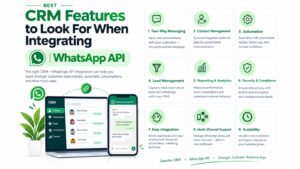
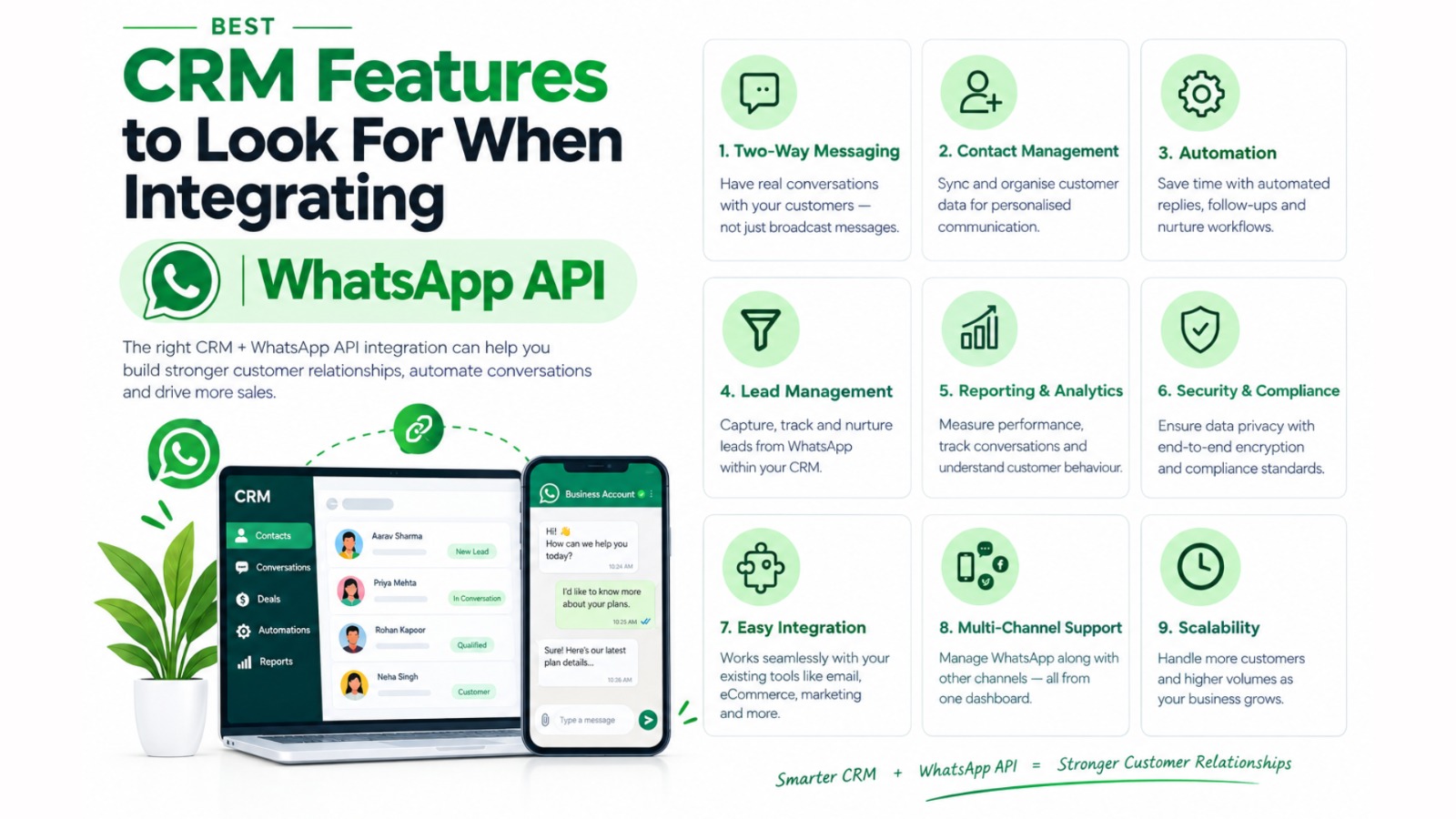
10 Best CRM Features to Look for When Integrating WhatsApp API
Different businesses have different requirements. Nevertheless, several CRM features can make WhatsApp API integration more effective.
Let us explore the most important ones.
1. Centralized Customer Data
The first feature to look for is centralized customer information.
A CRM should allow businesses to store important customer details in one place. This information can include names, phone numbers, email addresses, purchase history, lead status, previous conversations, preferences, and other relevant information.
With WhatsApp API integration, customer conversations can become part of this profile.
For instance, when a customer contacts a business on WhatsApp, the sales team should be able to understand who the customer is and where they are in the buying journey.
As a result, employees can provide more relevant responses.
Without centralized data, employees may need to search through spreadsheets, WhatsApp conversations, emails, and other systems. Consequently, valuable time can be lost.
A CRM with centralized customer data creates a more organized workflow.
2. WhatsApp Conversation Management
Managing conversations is another important CRM feature.
Businesses can receive multiple WhatsApp enquiries every day. Therefore, the CRM should make it easy to view, organize, and track customer conversations.
A useful system should help teams identify:
- New conversations
- Active leads
- Follow-up requirements
- Resolved queries
- Sales conversations
- Support requests
- Returning customers
Moreover, conversation history should remain accessible to authorized team members.
This becomes especially useful when a customer moves from one sales representative to another. The new representative can review previous interactions before responding.
Consequently, customers do not have to repeat the same information.
3. Lead Management and Lead Tracking
Lead management is one of the biggest reasons businesses integrate WhatsApp with CRM systems.
Customers often use WhatsApp to ask questions before making a purchase. Therefore, businesses should be able to convert those conversations into trackable leads.
A CRM should allow businesses to create and manage lead records from WhatsApp conversations.
For example, a lead could move through stages such as:
New Lead → Contacted → Qualified → Follow-Up → Proposal → Converted
The exact stages can vary depending on the business.
For example, a real estate company may track property enquiries differently from a jewellery store. Similarly, a dental clinic may track patient enquiries differently from an e-commerce company.
However, the basic principle remains the same: every important WhatsApp enquiry should have a clear status.
This helps sales teams identify which leads require immediate attention.
4. Automated Lead Assignment
When several employees handle WhatsApp enquiries, manual lead assignment can become difficult.
Therefore, businesses should look for CRM systems that support automated lead assignment.
For example, a new WhatsApp enquiry could automatically be assigned based on:
- Location
- Product category
- Lead source
- Sales team
- Customer requirement
- Availability of sales representatives
This feature can reduce response delays.
Furthermore, automated assignment can prevent leads from being ignored because nobody knows who should handle them.
Platforms such as Campaign Plus can complement this workflow by supporting WhatsApp automation and chatbot-based customer interactions.
As a result, businesses can create a smoother journey from the first WhatsApp message to the sales follow-up.
5. WhatsApp Chatbot Integration
Chatbots are becoming increasingly important for businesses that receive repetitive customer questions.
Therefore, chatbot compatibility should be an important consideration when selecting a CRM for WhatsApp API integration.
A WhatsApp chatbot can help answer common questions about:
- Products
- Services
- Pricing
- Business hours
- Locations
- Appointments
- Order status
- Frequently asked questions
For example, a dental clinic could use a WhatsApp chatbot to collect basic patient enquiries before sending qualified conversations to its team.
Similarly, a jewellery business could use a chatbot to help customers explore products, request prices, or connect with a sales representative.
However, chatbots should not replace human support in every situation. Instead, businesses can use automation for repetitive tasks and allow employees to handle complex conversations.
This combination can improve efficiency while maintaining human interaction.
6. Automated Follow-Ups
Many potential customers do not purchase immediately after their first enquiry.
Therefore, follow-up automation is another important feature to look for.
A CRM integrated with WhatsApp API should support workflows that remind teams or trigger appropriate messages after specific actions.
For example:
Day 1: Customer asks about a product.
Day 2: Business sends additional product information.
Day 4: Business sends a helpful follow-up.
Day 7: Sales representative checks whether the customer needs assistance.
These workflows can reduce the chances of leads being forgotten.
Moreover, automation allows businesses to maintain consistent communication without requiring employees to manually remember every follow-up.
Businesses should also ensure that their messaging workflows follow applicable WhatsApp and business communication requirements.
7. CRM Segmentation and Customer Tags
Not every customer has the same needs.
Therefore, customer segmentation is essential for personalized WhatsApp communication.
A CRM should allow businesses to create tags or segments based on useful information.
For example:
- New customer
- Existing customer
- High-value customer
- Interested in jewellery
- Interested in healthcare services
- Repeat buyer
- Website lead
- Facebook lead
- Instagram lead
- WhatsApp lead
Once customers are segmented, businesses can create more relevant communication.
For example, a jewellery business could send product updates to customers who previously showed interest in jewellery collections. Similarly, an education company could separate students based on courses or enquiry types.
Consequently, segmentation can make WhatsApp communication more relevant and organized.
8. Sales Pipeline Integration
Another important feature is sales pipeline management.
A CRM should allow businesses to connect WhatsApp conversations with different stages of the sales process.
For example:
WhatsApp Enquiry → Qualified Lead → Product Discussion → Follow-Up → Negotiation → Purchase
This provides sales teams with a visual overview of their opportunities.
Moreover, managers can identify where leads are getting delayed.
For instance, if many WhatsApp leads remain stuck at the follow-up stage, the business may need to improve its follow-up process.
Therefore, CRM pipeline visibility can help businesses identify operational gaps.
9. Analytics and Reporting
Data is essential for understanding whether WhatsApp communication is actually contributing to business growth.
Therefore, businesses should look for CRM systems with strong reporting capabilities.
Useful reports may include:
- Number of WhatsApp leads
- Response time
- Lead conversion rate
- Follow-up performance
- Sales generated from leads
- Customer source
- Conversation volume
- Agent performance
- Campaign performance
- Customer engagement
These insights can help businesses understand which activities generate results.
For example, a company may discover that WhatsApp leads from a particular advertising campaign generate more qualified enquiries than leads from another source.
As a result, the company can use its marketing budget and sales resources more effectively.
Step4Growth focuses on digital growth strategies, and CRM data can play an important role in understanding the customer journey from acquisition to conversion.
10. Integration With Other Business Tools
A CRM should not operate in isolation.
Instead, businesses should consider how easily it can connect with other tools.
Useful integrations may include:
- WhatsApp API
- Website forms
- Lead-generation platforms
- Email marketing tools
- E-commerce platforms
- Payment systems
- Customer support tools
- Marketing automation platforms
- Analytics platforms
For example, a customer could visit a website, submit an enquiry, receive a WhatsApp message, and then enter a CRM sales pipeline.
When these systems work together, businesses can create a connected customer journey.
Therefore, integration flexibility should be considered before selecting a CRM.
Why CRM and WhatsApp API Integration Helps Sales Teams
A CRM and WhatsApp API combination can make sales processes more organized.
Without integration, a salesperson may receive a WhatsApp message but forget to record the lead. Later, another employee may contact the same customer without knowing about the previous conversation.
With CRM integration, customer information and conversations can become part of a structured workflow.
As a result, sales teams can:
- Respond faster
- Track every lead
- Schedule follow-ups
- Reduce duplicate work
- View customer history
- Prioritize active opportunities
- Measure conversion performance
Furthermore, managers can monitor the overall sales pipeline instead of relying only on individual employee updates.
How WhatsApp CRM Integration Improves Customer Support
WhatsApp is also widely used for customer support.
Customers may contact businesses to ask about orders, services, appointments, returns, or product information.
A CRM can help support teams organize these conversations.
For example, a customer service representative can view previous conversations before responding.
Additionally, chatbots can answer simple questions while complex issues can be transferred to human agents.
This approach can reduce repetitive work.
At the same time, businesses can maintain a better record of customer interactions.
Therefore, CRM integration can support both sales and customer service teams.
How Campaign Plus Can Support WhatsApp Automation
Campaign Plus can be included in a WhatsApp communication strategy where businesses need automation, chatbot capabilities, and structured customer engagement.
For example, businesses can use WhatsApp automation to manage repetitive customer interactions and create more organized communication workflows.
A typical customer journey could look like this:
Advertisement → WhatsApp Message → Chatbot → Lead Qualification → CRM → Sales Team → Follow-Up → Conversion
This approach connects marketing, communication, automation, and sales.
Consequently, businesses can reduce manual processes while creating a more consistent customer experience.
However, the exact workflow should depend on the business model, customer journey, and sales process.
How Trending Bulb and Step4Growth Fit Into the Growth Strategy
At Trending Bulb, digital marketing is not only about generating attention. Businesses also need systems that help convert attention into meaningful customer conversations.
That is where WhatsApp API and CRM integration can become valuable.
For example, a marketing campaign may generate hundreds of enquiries. However, if the business cannot organize and follow up with those enquiries, potential opportunities can be missed.
Therefore, businesses should connect their marketing activities with CRM and WhatsApp workflows.
Similarly, Step4Growth highlights the importance of using digital tools and structured strategies to support business growth.
When marketing, CRM, WhatsApp automation, and sales processes work together, businesses can create a more connected customer journey.
Common Mistakes to Avoid When Integrating WhatsApp API With CRM
Although CRM integration can be useful, businesses should avoid several common mistakes.
Choosing a CRM Only Because It Is Popular
A popular CRM may not necessarily match your business requirements.
Therefore, check its WhatsApp integration, automation, reporting, customization, and scalability before making a decision.
Ignoring Automation
If every WhatsApp task requires manual action, teams may struggle as conversation volume increases.
Instead, identify repetitive processes that can be automated.
Not Tracking Lead Sources
Businesses should know where their leads come from.
Therefore, connect WhatsApp enquiries with relevant campaign and source information whenever possible.
Sending the Same Message to Everyone
Generic communication may not be relevant to every customer.
Instead, use CRM segmentation to create more targeted communication.
Focusing Only on Lead Volume
Getting more WhatsApp enquiries does not automatically mean getting more sales.
Therefore, businesses should track lead quality, follow-ups, conversions, and revenue-related outcomes.
Checklist: What Should Your CRM Offer for WhatsApp API?
Before choosing a CRM, use this checklist:
| CRM Feature | Why It Matters |
|---|---|
| WhatsApp API integration | Connects WhatsApp communication with CRM |
| Centralized customer data | Keeps customer information organized |
| Conversation history | Helps teams understand previous interactions |
| Lead management | Tracks enquiries throughout the sales journey |
| Automated lead assignment | Sends leads to the right team members |
| Chatbot integration | Handles repetitive questions |
| Follow-up automation | Reduces missed follow-ups |
| Customer segmentation | Enables relevant communication |
| Sales pipeline | Tracks lead movement toward conversion |
| Analytics | Measures performance and outcomes |
| Third-party integrations | Connects CRM with other business tools |
| Scalability | Supports business growth |
| User permissions | Helps manage access and customer data |
Final Thoughts
Choosing the right CRM for WhatsApp API integration requires more than checking whether the two systems can connect.
Businesses should consider the entire customer journey.
From lead capture and conversation management to automation, follow-ups, sales pipelines, and analytics, every feature can influence how effectively teams manage WhatsApp enquiries.
Therefore, look for a CRM that combines customer data, WhatsApp conversations, automation, lead management, segmentation, reporting, and integrations in one organized workflow.
At the same time, businesses should avoid unnecessary complexity. The best setup is one that matches the actual customer journey and sales process.
With the right combination of CRM and WhatsApp API, businesses can move from simple messaging to structured customer engagement.
Platforms such as Campaign Plus can support WhatsApp automation and chatbot-based communication, while Step4Growth and Trending Bulb can help businesses think about the broader digital growth journey.
Ultimately, the goal is simple: connect conversations with customer data, connect customer data with sales processes, and use insights to improve the customer journey.
Frequently Asked Questions
1. What CRM features are important for WhatsApp API integration?
Important features include WhatsApp API connectivity, centralized customer data, conversation history, lead management, automation, chatbots, segmentation, sales pipelines, analytics, and third-party integrations.
2. Can WhatsApp API be connected to a CRM?
Yes. WhatsApp API can be integrated with compatible CRM systems to help businesses manage customer conversations, lead information, follow-ups, and sales activities.
3. Why integrate WhatsApp API with CRM?
Integration can help businesses organize WhatsApp conversations, track leads, automate follow-ups, improve customer visibility, and connect messaging activities with sales processes.
4. Is a WhatsApp chatbot useful with CRM integration?
Yes. A chatbot can handle repetitive questions and collect basic information before transferring more complex conversations to a human team member.
5. Can CRM automation improve WhatsApp lead management?
Yes. Automation can help businesses assign leads, trigger follow-up workflows, segment customers, and reduce repetitive manual tasks.
6. What should businesses check before choosing a CRM for WhatsApp?
Businesses should check WhatsApp API compatibility, automation features, chatbot support, lead management, reporting, integrations, scalability, security controls, usability, and pricing.
7. Can Campaign Plus help businesses with WhatsApp automation?
Campaign Plus provides WhatsApp automation, chatbot capabilities, and related communication solutions that can support businesses in creating structured WhatsApp customer journeys.
8. How does CRM integration help sales teams?
CRM integration can give sales teams access to customer information, conversation history, lead status, follow-up requirements, and pipeline information in a more organized workflow.
Start Building a More Connected Customer Journey
WhatsApp can be more than a messaging channel when it works together with the right CRM.
By combining WhatsApp API, CRM, automation, chatbots, lead management, and analytics, businesses can create a structured system for managing customer conversations and sales opportunities.
If your business is planning to improve its WhatsApp communication strategy, start by identifying your current customer journey. Then, choose CRM features that solve actual business problems instead of simply adding more tools.
Trending Bulb, Campaign Plus, and Step4Growth can help businesses explore different aspects of digital communication, automation, and growth.
The right technology is not just about sending more messages. It is about creating better conversations, better processes, and better customer experiences.