Businesses today need more than traditional text messages to connect with customers. They need faster communication, interactive experiences, personalized offers, and reliable ways to generate leads. As a result, two messaging technologies are gaining attention: RCS Business Messaging and WhatsApp Business API.
Both platforms help businesses communicate with customers. However, they offer different features, customer experiences, and opportunities for growth.
For example, RCS allows brands to send rich, interactive messages through supported native messaging apps. On the other hand, WhatsApp Business API helps businesses build automated conversations, manage customer enquiries, and support sales through WhatsApp.
So, which option should your business choose?
In this guide, Trending Bulb compares RCS and WhatsApp Business API, explains their benefits, and explores how businesses can use them to improve customer engagement. We will also discuss how Campaign Plus and Step4Growth fit into a modern business communication strategy.
What Is RCS Business Messaging?
RCS stands for Rich Communication Services. It is a modern messaging standard that upgrades traditional SMS with richer media and interactive features.
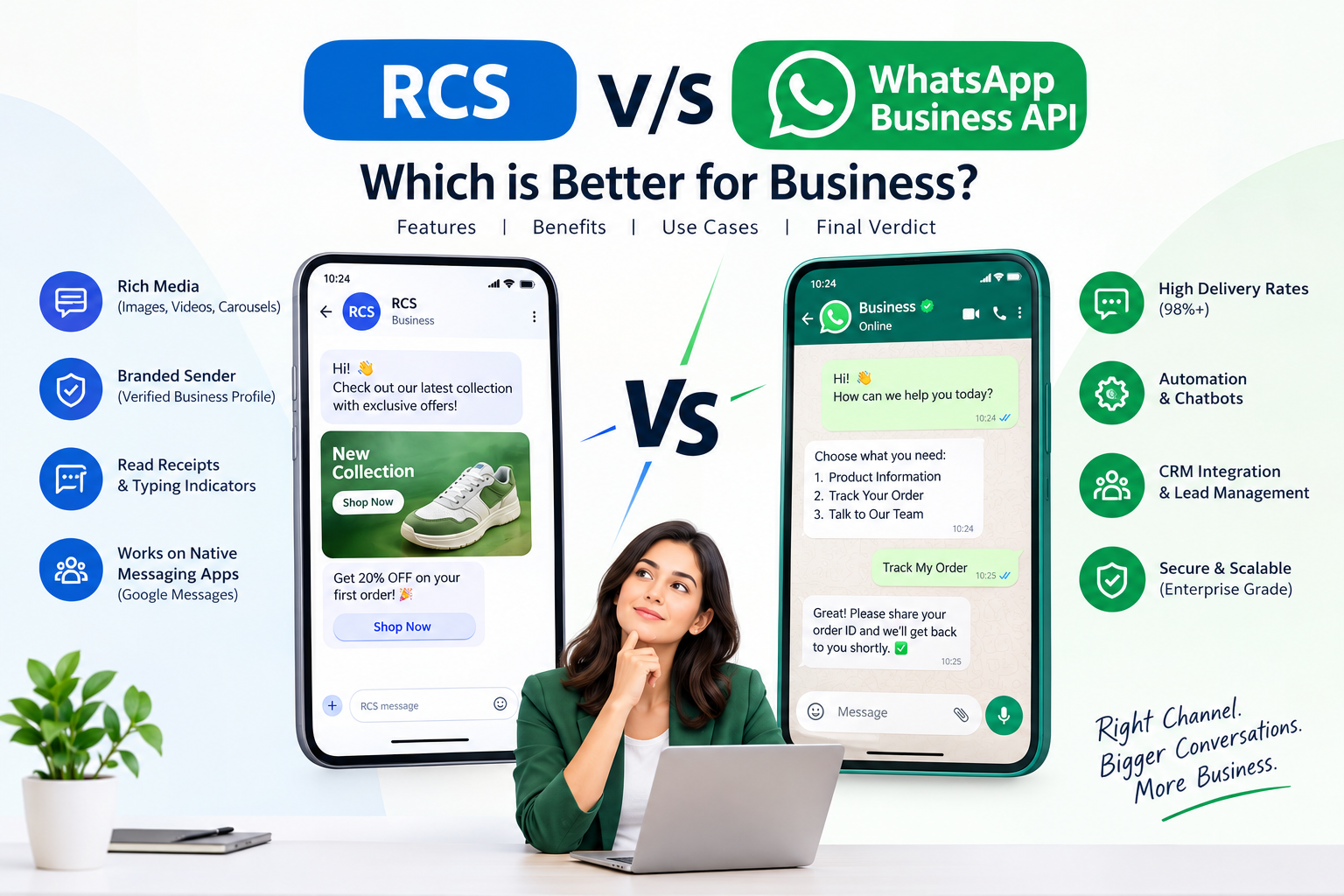
With RCS Business Messaging, companies can send branded messages containing images, videos, product cards, suggested replies, and action buttons. Consequently, customers can interact with a business directly through a supported messaging application.
For instance, an online store can send a product recommendation with an image, price, and button to view the item. Similarly, an airline can share travel updates and provide useful actions within a message.
Unlike traditional SMS, RCS can create a more visual and interactive experience. Moreover, supported business messaging implementations can display a verified business profile with the company name and logo.
According to Google’s RCS for Business documentation, brands can use rich cards, carousels, suggested actions, and analytics to improve messaging experiences.
Key Features of RCS
- Rich media: Send images, videos, GIFs, and supported files.
- Branded messaging: Display business branding and verification where supported.
- Interactive buttons: Let customers take actions without typing every response.
- Product carousels: Present multiple products in a single messaging experience.
- Delivery and engagement insights: Measure supported messaging activity.
- Native messaging experience: Reach customers through compatible messaging apps without requiring a separate messaging app installation.
However, RCS availability depends on device, messaging application, carrier, market, and business messaging support. Therefore, businesses should check audience compatibility before launching a campaign.
What Is WhatsApp Business API?
WhatsApp Business API, commonly referred to as the WhatsApp Business Platform, helps businesses communicate with customers at scale.
Unlike the standard WhatsApp Business app, the platform supports integrations with business systems, automation tools, customer relationship management (CRM) software, and customer support workflows.
As a result, companies can manage customer conversations more efficiently while maintaining a familiar messaging experience.
For example, an ecommerce company can send order updates, answer product questions, automate frequently asked questions, and direct complex enquiries to a human support agent.
Additionally, businesses can use approved message templates for eligible business-initiated conversations and respond to customers according to WhatsApp’s messaging rules.
Key Features of WhatsApp Business API
- Automated conversations: Respond to common questions using chatbot workflows.
- Message templates: Send approved templates for eligible notifications and marketing messages.
- CRM integration: Connect customer conversations with supported sales and support systems.
- Team inboxes: Allow multiple agents to manage customer enquiries through compatible platforms.
- Interactive messaging: Use supported buttons, lists, and product messaging features.
- Lead management: Capture customer information and route enquiries to the right team.
- Customer support: Combine automated responses with human assistance.
- Campaign reporting: Track available delivery, engagement, and conversion metrics.
For businesses that want to combine customer communication with lead generation and sales automation, WhatsApp Business API can be a practical solution.
Campaign Plus provides WhatsApp automation, chatbot, and other business communication solutions designed to support business growth. With the right setup, businesses can develop workflows that connect customer enquiries with their sales and support processes.
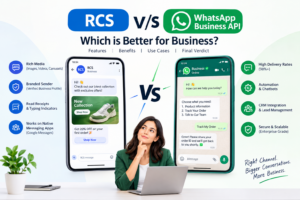
RCS vs WhatsApp Business API: Key Differences
Although both technologies support modern business communication, their strengths differ.
| Feature | RCS Business Messaging | WhatsApp Business API |
|---|---|---|
| Messaging application | Compatible native messaging apps | |
| App installation | No separate app required for supported native messaging | Customers need WhatsApp |
| Rich media | Images, videos, rich cards, and carousels | Images, videos, documents, and supported interactive formats |
| Brand identity | Branded sender profiles and verification where supported | Business profile and applicable account verification features |
| Chatbots | Available through suitable business messaging integrations | Available through API-connected chatbot platforms |
| CRM integration | Possible through compatible integrations | Widely supported through business messaging platforms and integrations |
| Customer conversations | Interactive two-way messaging where supported | Two-way messaging and ongoing customer conversations |
| Audience reach | Depends on device, carrier, and market support | Depends on WhatsApp adoption and customer messaging permissions |
| Fallback options | SMS fallback may be available when configured | No automatic SMS fallback is inherent to WhatsApp itself |
| Best use cases | Rich notifications, branded alerts, and interactive native messaging | Lead generation, customer support, sales, and ongoing conversations |
Therefore, the best platform depends on your audience, campaign objectives, technical requirements, and available budget.
1. Customer Reach: Which Platform Reaches More People?
Audience reach is one of the most important factors when selecting a messaging channel.
WhatsApp has an established presence in India, where consumers frequently use it for personal and business communication. Consequently, businesses can often use WhatsApp to connect with customers through a familiar application.
For example, a local retailer can answer product enquiries, share a catalogue, and follow up with interested customers through WhatsApp.
RCS, meanwhile, provides an opportunity to reach customers through compatible native messaging applications. Customers do not need to install a separate app specifically for RCS.
However, actual reach depends on compatible devices, carrier support, the messaging app, and business messaging availability.
Winner for many Indian businesses: WhatsApp Business API.
WhatsApp is often the more practical starting point for businesses targeting Indian consumers who already use the platform. Nevertheless, RCS can complement WhatsApp when a business wants to reach compatible devices through native messaging.
2. Rich Media and Interactive Experiences
Both platforms support engaging messaging experiences, although their implementation differs.
RCS is designed to make traditional messaging more interactive. Businesses can combine text, images, rich cards, and suggested actions within a supported messaging experience.
For instance, a fashion retailer could display several product cards in a carousel. Customers could then explore products or open a website directly from the message.
WhatsApp also supports rich communication features. Depending on the implementation, businesses can share product images, documents, catalogues, interactive buttons, and structured chatbot responses.
Furthermore, WhatsApp conversations allow customers to ask follow-up questions and receive assistance through the same channel.
Which platform is better?
RCS is attractive for visually rich messages delivered through native messaging apps. In contrast, WhatsApp Business API is particularly useful when businesses want to combine rich content with ongoing customer conversations, automation, and sales support.
3. Automation and Chatbot Capabilities
Automation helps businesses manage enquiries without requiring a team member to answer every question manually.
WhatsApp Business API supports automated workflows through compatible platforms. For example, a business can create a chatbot that answers product questions, shares pricing information, collects lead details, and routes qualified enquiries to a salesperson.
Moreover, businesses can connect these workflows with CRM systems to organise customer information and follow-up activities.
Campaign Plus can support this type of WhatsApp-focused communication strategy through its automation and chatbot solutions.
RCS also supports automated business conversations. However, businesses need a compatible RCS business messaging provider, technical integration, and an appropriate conversation workflow.
Therefore, the better choice depends on the integrations and automation features available through the provider you select.
Winner for many businesses seeking established WhatsApp workflows: WhatsApp Business API.
It is a strong option for businesses that want to manage enquiries, automate repetitive tasks, and connect messaging with sales operations.
4. Lead Generation and Sales Conversions
Generating a lead is only the first step. Businesses must also answer questions, understand customer needs, and encourage potential buyers to take action.
WhatsApp Business API can support this process through interactive conversations.
For example, a real estate company can invite prospects to enquire about a property. A chatbot can then collect their preferred location, budget, and buying timeline before forwarding the enquiry to a sales representative.
Similarly, a marketing agency can use WhatsApp to answer service questions, schedule consultations, and follow up with interested prospects.
RCS can also support lead generation through interactive cards, suggested replies, and action buttons. Customers can explore an offer or visit a landing page without navigating through a long SMS conversation.
However, the final result depends on targeting, message relevance, landing-page quality, follow-up speed, and the sales process.
Winner for conversation-led sales: WhatsApp Business API.
For businesses that rely on enquiries and personalised follow-ups, WhatsApp can provide a convenient environment for guiding customers from initial interest to purchase.
5. Customer Support and Relationship Building
Customer support is not limited to answering questions. It also involves building trust, resolving problems, and maintaining a consistent customer experience.
WhatsApp Business API can help support teams manage incoming questions through shared inboxes, automated responses, and agent handovers available through compatible platforms.
For instance, an ecommerce business can automate order-status enquiries while allowing a human agent to handle returns or complaints.
Similarly, an education company can answer course enquiries, share admission information, and direct students to the relevant team.
RCS can also improve customer support through interactive messages, suggested replies, and useful actions. For example, a delivery notification could provide an order-tracking link or an option to contact support.
However, WhatsApp may be more convenient for ongoing support when customers already use it regularly.
Winner for ongoing customer relationships: WhatsApp Business API.
Its conversational environment makes it a practical choice for businesses that want to combine automation with human support.
6. Security, Privacy, and Customer Trust
Security should be a priority whenever businesses communicate with customers.
WhatsApp provides end-to-end encryption for personal messages between users. However, businesses should understand that communications involving the WhatsApp Business Platform, business providers, integrations, and stored customer data follow their respective technical and privacy arrangements. Businesses must review the applicable policies before selecting a provider.
RCS Business Messaging uses business verification and security measures designed for the messaging ecosystem. However, its security and encryption properties are not identical across every implementation or messaging client.
Consequently, businesses should not assume that RCS and WhatsApp provide identical encryption protections.
Before choosing either platform, check:
- How the provider stores and processes customer data.
- Which systems can access conversations and customer records.
- Whether integrations follow appropriate security practices.
- How consent, opt-outs, and customer preferences are managed.
- Whether the provider supports relevant privacy and compliance requirements.
Additionally, businesses should use approved integrations, restrict unnecessary access, and avoid sharing sensitive customer information through inappropriate workflows.
Verdict: Both platforms can support business communication, but businesses must evaluate the specific provider, integration, and privacy requirements rather than relying on the channel name alone.
7. Pricing and Implementation Costs
Cost is another important consideration when comparing RCS and WhatsApp Business API.
Neither platform has one universal price that applies to every business. Actual expenses depend on message types, volumes, countries, provider charges, integrations, and additional software features.
WhatsApp Business Platform pricing depends on the applicable Meta pricing model, message category, recipient market, and any provider or software charges. Businesses should check the latest official pricing and their provider’s fees before calculating campaign costs.
RCS Business Messaging costs can also vary by provider, carrier, country, and message type. In addition, businesses may need technical support to configure the messaging agent, integrations, and fallback arrangements.
When comparing providers, evaluate the complete cost rather than only the advertised message rate.
Consider the following expenses:
- Message delivery and usage charges.
- Monthly platform or subscription fees.
- Chatbot development and maintenance.
- CRM or ecommerce integration.
- Team inbox and agent access.
- Reporting and analytics tools.
- Onboarding and technical support.
For small businesses, the best option is not necessarily the cheapest platform. Instead, calculate the cost per qualified lead, completed purchase, or successfully resolved customer enquiry.
Step4Growth can help businesses understand digital marketing, customer acquisition, and growth strategies. Combining these insights with an appropriate messaging solution can help organisations evaluate campaign performance more effectively.
8. Which Platform Is Better for Different Industries?
The right messaging platform can vary by industry because customer expectations and communication needs are different.
Ecommerce and Retail
WhatsApp Business API is useful for product enquiries, order updates, customer support, and personalised follow-ups. Meanwhile, RCS can present products through rich cards and interactive promotional messages.
Healthcare and Clinics
Clinics can use WhatsApp for appointment enquiries, reminders, and support workflows, subject to applicable privacy requirements. RCS can complement these efforts with supported appointment notifications and interactive actions.
Education and Training
Educational institutions can use WhatsApp to answer admission questions, share course information, and follow up with prospective students. RCS can support branded announcements and interactive information messages.
Real Estate
WhatsApp is useful for collecting buyer requirements, sharing property details, and arranging site visits. RCS can showcase property images and direct prospects to relevant listings.
Banking and Financial Services
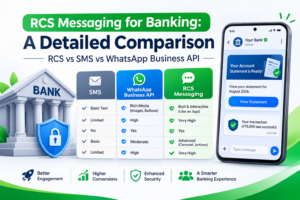
RCS can support branded alerts and interactive service notifications where available. WhatsApp may support customer assistance and eligible notifications through approved implementations. In either case, organisations must follow strict security, authentication, and regulatory requirements.
Digital Marketing Agencies
Agencies can combine messaging with lead generation, CRM workflows, and campaign analytics. For example, Campaign Plus can help businesses implement WhatsApp automation, while Step4Growth and Trending Bulb can provide marketing content and growth-focused insights.
Ultimately, industry requirements, customer preferences, and available integrations should guide the final decision.
9. Can Businesses Use RCS and WhatsApp Together?
Yes. Businesses do not always need to choose only one messaging channel.
A combined strategy can help companies use each platform for its strengths. For example, an organisation could use RCS for compatible native messaging notifications and WhatsApp for customer enquiries that require longer conversations.
Consider a simple customer journey:
- A customer receives a supported RCS message about a new product.
- The customer taps a button to explore the offer.
- The customer chooses to contact the business through WhatsApp.
- A WhatsApp chatbot answers initial questions.
- A sales representative handles complex queries.
- The business measures enquiries, conversions, and campaign costs.
This approach can help businesses create a connected experience across multiple channels.
However, the journey must be configured properly. Businesses need suitable integrations, clear consent practices, reliable tracking, and consistent customer records.
Moreover, the transition between channels should feel natural. Customers should understand why they are being directed to another messaging application.
For a business considering this approach, start with one measurable use case. Test customer response, delivery performance, cost, and conversion quality before expanding the campaign.
10. How to Choose the Right Messaging Platform
Before investing in a messaging solution, define what you want to achieve.
Use the following checklist to guide your decision.
Choose WhatsApp Business API if you want to:
- Generate and qualify leads through conversations.
- Automate frequently asked questions.
- Manage customer enquiries at scale.
- Connect conversations with CRM systems.
- Support customers before and after purchases.
- Build a messaging-led sales process.
Consider RCS Business Messaging if you want to:
- Send branded messages through supported native messaging apps.
- Showcase products using rich cards and carousels.
- Deliver interactive alerts and notifications.
- Offer suggested replies and action buttons.
- Reach compatible devices without requiring a separate messaging app.
Consider using both if you want to:
- Build a multichannel customer communication strategy.
- Match messaging formats to different customer journeys.
- Use RCS for suitable notifications and WhatsApp for deeper conversations.
- Compare channel performance using consistent business metrics.
In addition, ask your provider about onboarding, support, pricing, integrations, reporting, and fallback capabilities.
Start with a small pilot campaign. Then measure delivery, customer responses, qualified leads, conversions, and cost per result. This process will help you identify which channel delivers the strongest business value.
Final Verdict: RCS vs WhatsApp Business API
So, which is better for business: RCS or WhatsApp Business API?
For many businesses in India, WhatsApp Business API is a practical starting point for lead generation, customer engagement, chatbot automation, and conversational sales. Its suitability is especially strong when customers already use WhatsApp and the business needs ongoing two-way communication.
However, RCS Business Messaging is also worth considering. It offers branded, interactive messaging through compatible native messaging apps and can be valuable for notifications, product discovery, and customer actions.
Neither platform is automatically better for every organisation. The final decision depends on audience reach, customer preferences, message purpose, technical requirements, and measurable results.
For businesses that want to improve WhatsApp communication, Campaign Plus offers WhatsApp automation and chatbot solutions. Meanwhile, Step4Growth provides digital growth insights, and Trending Bulb explores practical marketing strategies to help businesses make informed decisions.
The smartest approach is to select the channel that supports your business goals, test it with real customers, and improve your strategy using performance data.
Choose the right channel, create meaningful conversations, and turn customer communication into measurable business growth.
Frequently Asked Questions (FAQs)
1. What is the main difference between RCS and WhatsApp Business API?
RCS delivers rich, interactive messages through compatible native messaging applications. WhatsApp Business API enables businesses to communicate through WhatsApp using automation, integrations, and structured customer support workflows.
2. Is WhatsApp Business API better than RCS in India?
WhatsApp Business API is often a practical choice for Indian businesses because of WhatsApp’s established consumer adoption and its conversational capabilities. However, RCS can be useful when the target audience and messaging infrastructure support it.
3. Does RCS require customers to install a separate app?
No separate app is required specifically for RCS when customers have a compatible native messaging application. However, RCS availability depends on device, carrier, app, and market support.
4. Can businesses use chatbots with RCS?
Yes. Businesses can build automated RCS conversations through compatible business messaging infrastructure and integrations. The available features depend on the provider and implementation.
5. Can WhatsApp Business API integrate with a CRM?
Yes. Businesses can connect the WhatsApp Business Platform with compatible CRM systems and automation tools to organise enquiries, manage customer records, and improve follow-ups.
6. Is RCS cheaper than WhatsApp Business API?
Not always. Pricing depends on message type, volume, location, provider fees, and implementation costs. Businesses should compare total costs and cost per conversion before deciding.
7. Can RCS and WhatsApp be used together?
Yes. Businesses can use RCS for suitable native messaging interactions and WhatsApp for ongoing conversations, provided the necessary integrations and customer permissions are in place.
8. Which platform is best for lead generation?
WhatsApp Business API is a strong option for conversational lead generation, qualification, and follow-up. RCS can also generate leads through interactive messages and action buttons. The best choice depends on the target audience and campaign design.
Grow Your Business with Smarter Messaging
Modern messaging can help businesses improve customer experiences, respond faster, and support sales growth. The key is to select the right technology and build a strategy around customer needs.
Explore Trending Bulb for more digital marketing insights, discover Campaign Plus for WhatsApp automation solutions, and learn from Step4Growth for practical business growth strategies.
Start with the right messaging strategy and build stronger customer relationships.