Introduction
Digital banking has changed how financial institutions communicate with customers. Today, customers expect timely notifications, convenient support, secure communication, and simple ways to access banking services. Therefore, banks must choose messaging channels that meet these expectations while maintaining customer trust.
Traditional SMS has helped banks send transaction alerts, OTPs, payment reminders, and account notifications for years. However, customer communication is becoming more interactive. As a result, banks are exploring modern messaging solutions such as Rich Communication Services (RCS) and WhatsApp Business API.
Each channel offers different features, advantages, and limitations. For example, SMS provides broad reach, WhatsApp Business API supports conversational customer engagement, and RCS messaging enables branded, interactive experiences directly within supported messaging apps.
So, which channel is best for banking?
In this detailed comparison, Trending Bulb explores RCS messaging for banking alongside SMS and WhatsApp Business API. We will also explain their features, security considerations, business applications, and practical differences. Additionally, we will discuss how businesses can approach messaging automation with support from platforms such as Campaign Plus and digital growth expertise from Step4Growth.
What Is RCS Messaging for Banking?
Rich Communication Services, commonly known as RCS, is a modern messaging standard that adds interactive features to traditional mobile messaging.
Unlike conventional SMS, RCS for Business can support branded sender profiles, rich media, interactive buttons, suggested replies, and messaging analytics. Consequently, banks can create more informative customer communication experiences without requiring customers to download a separate application specifically for the conversation.
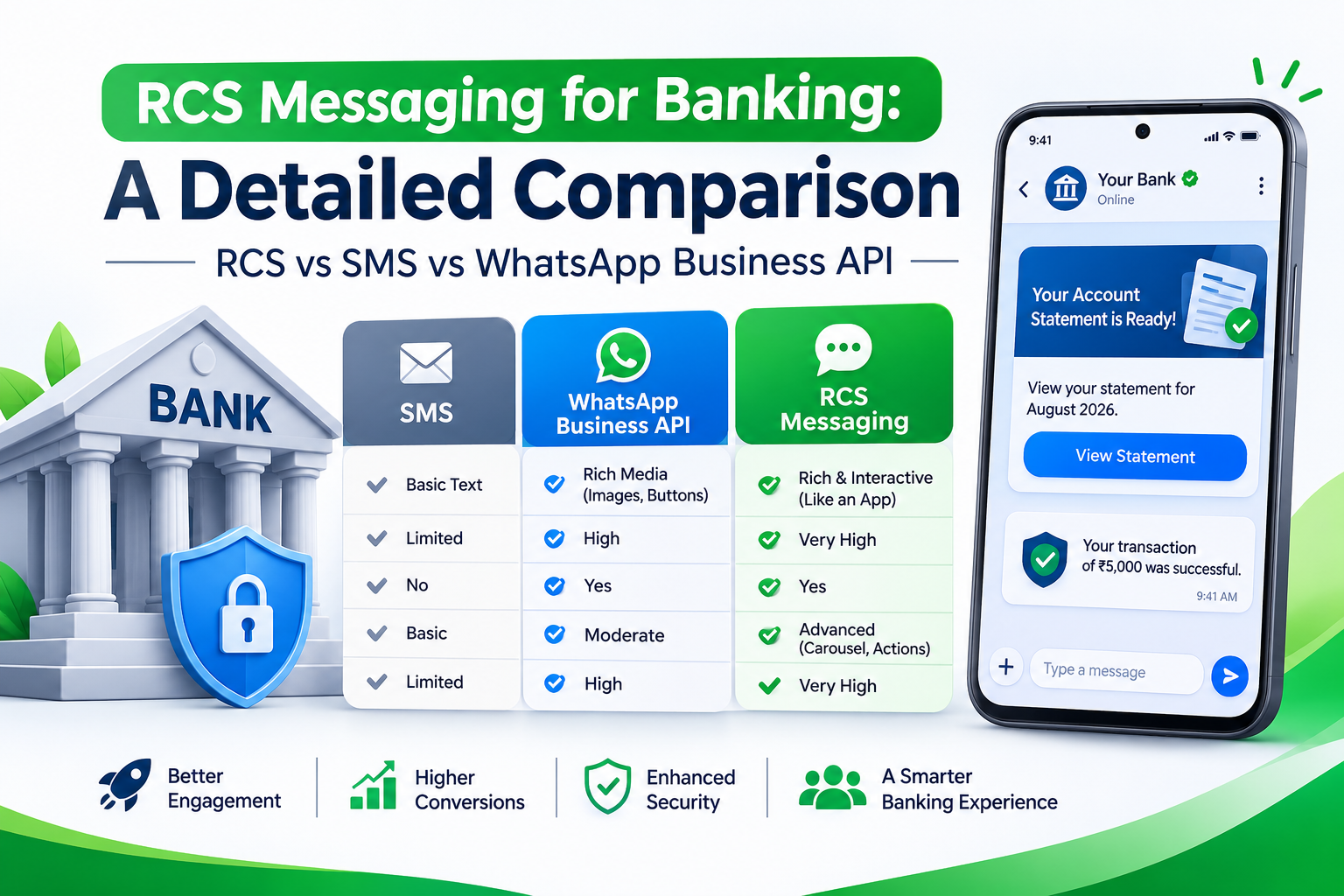
For example, a bank could send an RCS message informing a customer that their monthly account statement is ready. Instead of receiving only a short text and a link, the customer might see a branded message card with a clear “View Statement” button.
Similarly, banks can use interactive messages to explain credit card benefits, share loan information, promote relevant banking services, or direct customers to official support channels.
However, RCS availability depends on supported devices, messaging applications, carriers, and service providers. Therefore, banks should check their target audience’s compatibility before making RCS their primary communication channel.
According to Google’s RCS for Business documentation, businesses can use rich cards, carousels, suggested actions, verified sender profiles, and analytics to improve customer interactions.
Why Is Messaging Important in Banking?
Banking communication must be clear, timely, and trustworthy. Customers regularly need updates about their accounts, transactions, cards, loans, and service requests.
However, poorly designed messages can create confusion or reduce customer confidence. Therefore, banks should choose communication channels that deliver useful information while protecting sensitive customer data.
Here are some important banking applications of business messaging.
1. Transaction Notifications
Banks can notify customers about successful transactions, account activity, and other relevant events. Timely alerts help customers stay informed and identify transactions they do not recognize.
2. Loan and Credit Card Communication
Banks can share information about eligible financial products, application progress, repayment dates, and relevant offers. Additionally, interactive messaging can help customers navigate to official application or service pages.
3. Customer Support
Customers frequently need assistance with card blocking, account queries, payment issues, and service requests. Therefore, messaging channels that support convenient responses can improve the customer experience.
4. Payment Reminders
Banks and financial service providers can send reminders about upcoming payments, loan instalments, and credit card due dates. Clear messaging helps customers understand deadlines and take appropriate action.
5. Customer Education
Financial institutions can share information about digital banking, fraud prevention, account features, and responsible financial practices. Moreover, interactive content can make educational information easier to explore.
The best channel depends on the message’s purpose, urgency, security requirements, customer preferences, and available technology.
Understanding SMS, RCS, and WhatsApp Business API
Before comparing these channels, it is important to understand how each one works.
What Is SMS Banking?
Short Message Service (SMS) allows banks to send text messages to mobile phones through telecommunications networks. It remains useful for basic notifications because it does not require an internet connection on the recipient’s device to receive a standard SMS.
For instance, a bank can send a transaction alert stating that a payment has been processed. Similarly, SMS can support account notifications and certain authentication workflows.
Nevertheless, SMS offers limited formatting and interaction. Messages generally cannot display the rich cards, carousels, and interactive business experiences available through RCS for Business.
What Is RCS Messaging?
RCS enhances mobile messaging with features such as branded business profiles, images, rich cards, suggested replies, and interactive actions.
As a result, banks can present information in a more organized and engaging format. For example, an RCS message could include a loan product overview with a “Learn More” button that directs the customer to the bank’s official website.
However, RCS requires compatible devices, applications, and network support. Banks must also evaluate how messages will be handled when RCS is unavailable.
What Is WhatsApp Business API?
WhatsApp Business API, also known as the WhatsApp Business Platform, enables businesses to communicate with customers through WhatsApp using approved integrations and messaging workflows.
Depending on the implementation, banks and financial service providers can use it for customer support, service updates, notifications, and approved business communication.
Furthermore, integrations can connect messaging with customer relationship management systems, chatbots, agent inboxes, and automation workflows.
Campaign Plus provides WhatsApp automation, chatbot, and related business communication solutions designed to support business growth. For financial institutions, any implementation must be assessed against applicable WhatsApp policies, banking requirements, data protection obligations, and approved use cases.
Unlike RCS, WhatsApp Business API operates within the WhatsApp ecosystem. Therefore, customers need access to WhatsApp to interact through that channel.
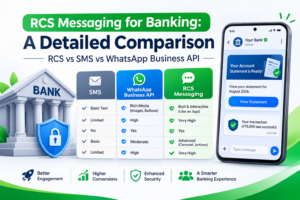
RCS Messaging vs SMS vs WhatsApp Business API: A Detailed Comparison
The following table highlights the main differences between these three messaging channels.
| Feature | SMS | RCS for Business | WhatsApp Business API |
|---|---|---|---|
| Message format | Primarily plain text | Rich text, media, cards, and supported actions | Text, supported media, templates, and interactive formats |
| Branding | Limited | Branded sender profile and verification where supported | Business profile and available verification features |
| Internet requirement | Not required for standard SMS delivery | Generally requires data connectivity | Requires internet connectivity |
| Customer interaction | Limited | Suggested replies and interactive actions | Replies, buttons, lists, and supported interactive workflows |
| Rich media | Very limited in standard SMS | Images, videos, and rich cards, subject to support | Images, videos, documents, and supported media formats |
| Delivery information | Depends on provider and network | Delivery and read-related analytics where supported | Delivery, read, and other metrics where available |
| Automation | Supported through gateways and integrations | Supported through business messaging integrations | Supported through API integrations and automation platforms |
| Audience reach | Broad mobile reach | Depends on compatible devices, carriers, and availability | Depends on WhatsApp adoption and customer access |
| Fallback options | Already a basic messaging channel | SMS fallback may be available through the provider | Other channels can be used in a multichannel strategy |
| Best suited for | Basic alerts and broad reach | Interactive, branded messaging | Conversational support and WhatsApp-based engagement |
Important: Features, delivery reports, pricing, and availability vary by provider, region, device, and implementation. Banks should confirm these details before selecting a channel.
1. Customer Experience
SMS delivers information quickly and simply. However, customers may need to open a separate website or application to complete the next step.
RCS can make the experience more interactive by presenting relevant information and actions within the messaging conversation. Consequently, customers may find it easier to navigate service information.
WhatsApp Business API, meanwhile, can support ongoing conversations between customers and businesses. For example, a customer may ask a question, receive an automated response, and request assistance from a support agent.
Therefore, the best option depends on whether the bank needs a simple notification, an interactive message, or an ongoing conversation.
2. Branding and Customer Trust
Brand identity matters greatly in banking because customers must distinguish genuine communication from fraudulent messages.
Standard SMS provides limited branding space. In contrast, RCS for Business can support a branded and verified sender profile, subject to the relevant verification process and platform availability.
WhatsApp business profiles also provide customers with business identity information and available verification indicators.
Nevertheless, branding alone does not guarantee that every message or link is safe. Banks should use approved sender identities, official domains, secure authentication, and clear fraud-prevention instructions across all channels.
3. Interactive Communication
Traditional SMS generally relies on short text and links. Although links can direct customers to online services, the messaging format itself offers limited interaction.
RCS adds features such as rich cards, carousels, and suggested actions. For example, a customer could explore available banking services using clearly labelled buttons.
WhatsApp Business API can support interactive customer journeys through supported buttons, lists, templates, and chatbot integrations.
Consequently, RCS and WhatsApp Business API can both provide richer experiences than standard SMS, although their capabilities and implementation requirements differ.
4. Reach and Accessibility
SMS remains valuable because it can reach mobile users without requiring mobile data for standard message delivery. This makes it useful for broad communication.
RCS offers a richer experience when the recipient’s device, application, carrier, and region support the required features. Therefore, banks should not assume that every customer can receive every RCS feature.
WhatsApp Business API is useful for customers who actively use WhatsApp and can access the service. However, it cannot independently reach customers who do not use the platform.
For this reason, banks should assess their customer base before prioritizing any single channel.
5. Automation and Integration
Automation helps banks manage repetitive communication and improve response times. However, automated workflows must follow banking policies and security requirements.
SMS gateways can integrate with banking systems to deliver transaction alerts, reminders, and other notifications.
RCS integrations can support richer message delivery, suggested actions, and available engagement analytics. Moreover, banks can design journeys that direct customers to official digital banking services.
WhatsApp Business API can support automated conversations, customer support routing, and CRM-connected workflows where permitted.
Campaign Plus offers WhatsApp automation and chatbot capabilities that businesses can evaluate for suitable customer communication needs. In a banking context, teams should verify technical integrations, access controls, data handling, and regulatory suitability before deployment.
Step4Growth can also help businesses develop digital marketing and customer engagement strategies. However, banks should keep promotional activity separate from sensitive account servicing and subject all communications to the institution’s internal approval process.
How Banks Can Use RCS Messaging Effectively
RCS messaging can support several banking use cases when the implementation aligns with customer needs and applicable security requirements.
1. Credit Card and Loan Promotions
Banks can use rich cards to present approved financial product information in a structured format.
For example, a message could introduce a credit card’s key features and provide a “View Details” action. Customers can then review the official terms and conditions on the bank’s website.
However, banks should clearly disclose eligibility criteria, fees, applicable conditions, and relevant risks. Promotional messages must also follow consent and communication requirements.
2. Account Statement Notifications
An RCS message can notify customers when a statement becomes available.
Instead of including sensitive account information directly in the message, the bank can provide a button that directs the customer to its official website or secure mobile banking application.
This approach helps customers access the required information through an authenticated environment.
3. Fraud Awareness Campaigns
Banks can use branded messaging to explain common scams, suspicious links, and safe digital banking practices.
For example, a bank could send an educational message explaining why customers should never share their PIN, password, or OTP.
Additionally, an interactive card could direct customers to official fraud-prevention guidance. The bank should avoid creating messages that resemble phishing attempts or request sensitive credentials.
4. Customer Service Navigation
RCS actions can help customers reach official support pages or contact channels.
For instance, a message about a blocked card could include a link to the bank’s verified support page. Nevertheless, identity verification and account-specific actions should take place through the bank’s approved secure systems.
5. Digital Banking Education
Banks can use rich media to explain mobile banking features, online payment safety, and available digital services.
Moreover, concise educational messages can help customers discover services they may not know how to use. Banks should keep the content relevant and avoid sending excessive promotional messages.
Security Considerations for RCS Messaging in Banking
Security is one of the most important factors when selecting a banking communication channel.
RCS can provide stronger sender identification and additional protections compared with conventional SMS in supported implementations. However, it should not automatically be considered secure enough for every banking activity.
Banks must evaluate the entire communication workflow, including message delivery, customer authentication, data storage, third-party integrations, and the destination of any links.
Important Security Practices
Use verified business identities. Banks should complete the applicable registration and verification processes for their messaging channels.
Avoid exposing sensitive information. Messages should not unnecessarily reveal account numbers, personal information, credentials, or confidential transaction details.
Use secure authentication. Sensitive account actions should require the bank’s approved authentication process rather than relying only on a messaging conversation.
Protect customer data. Banks should assess provider access, data retention, encryption, audit logs, and incident response procedures.
Use official links. Customer-facing messages should direct users to recognized bank domains and approved applications.
Obtain required consent. Banks should follow applicable consent, opt-out, privacy, and messaging rules.
Maintain fallback procedures. If a customer cannot receive RCS, the bank should use an approved alternative where appropriate.
The Reserve Bank of India’s digital banking safety guidance warns customers against sharing PINs, passwords, OTPs, and other sensitive credentials. It also advises customers to avoid suspicious links received through messages and other communication channels.
Therefore, RCS should complement a bank’s broader security framework rather than replace it.
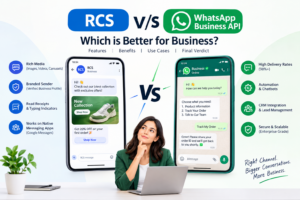
RCS Messaging vs WhatsApp Business API: Which Is Better for Banking?
Although both channels support richer communication than standard SMS, they serve somewhat different customer engagement needs.
RCS is particularly useful when a bank wants to deliver branded, interactive messages through supported native messaging experiences. For example, it can present service information, promotional cards, and clear actions within the messaging interface.
WhatsApp Business API is often attractive when the bank needs a conversational channel for customer enquiries, automated responses, and support workflows. Its suitability depends on WhatsApp’s policies, the provider’s capabilities, and the bank’s compliance requirements.
Consider the following examples:
- Choose RCS for consideration when: the bank wants branded messaging, interactive service cards, and supported actions in the native messaging experience.
- Choose WhatsApp Business API for consideration when: the bank needs a WhatsApp-based support journey, chatbot interactions, or agent-assisted conversations.
- Choose SMS for consideration when: the bank needs basic text notifications and broad mobile reach.
These options are not mutually exclusive. In fact, a carefully designed multichannel strategy may deliver better coverage than relying on one messaging platform.
For example, a bank could use SMS for a basic notification, RCS for an interactive service message where supported, and WhatsApp for approved conversational support. The final design should reflect customer preferences, consent, security requirements, and the bank’s technology architecture.
How to Choose the Right Messaging Solution for Your Bank
Banks should evaluate messaging solutions against clear operational and customer experience requirements.
Step 1: Define the Communication Objective
First, identify whether the bank needs transaction notifications, customer support, fraud awareness, service updates, or promotional messaging.
Different use cases require different levels of interactivity, authentication, and data protection.
Step 2: Understand Your Customers
Next, assess device compatibility, messaging preferences, language requirements, and access to internet services.
This information helps the bank determine whether SMS, RCS, WhatsApp, or a combination of channels is appropriate.
Step 3: Evaluate Integration Requirements
The chosen solution should work with the bank’s approved systems and operational processes.
For example, review API availability, CRM integration, workflow automation, reporting, access controls, and the ability to manage customer requests securely.
Step 4: Review Security and Compliance
Before implementation, assess vendor security, data handling, privacy controls, consent management, message approval procedures, and applicable regulatory obligations.
Banks should involve their security, legal, compliance, and technology teams before launching customer-facing workflows.
Step 5: Compare Total Costs
Pricing can depend on message volume, message type, provider fees, integrations, and regional availability.
Therefore, compare the total cost of ownership rather than looking only at the price of an individual message.
Step 6: Run a Pilot Campaign
Finally, test the selected channel with a limited and appropriate audience.
Measure delivery rates, engagement, successful service completion, customer complaints, and operational performance. Use the findings to improve the implementation before expanding it.
Measuring the Success of RCS Messaging in Banking
Banks should evaluate messaging based on meaningful business and customer outcomes, not simply the number of messages sent.
The following metrics can help:
Delivery rate: Measures the proportion of messages reported as delivered.
Read rate: Shows how many messages were reported as read, where the channel supports this metric.
Click-through rate: Measures the proportion of delivered messages that generate clicks on tracked links or actions, according to the reporting method used.
Conversion rate: Tracks the proportion of eligible customers who complete a defined action after receiving a message.
Customer support resolution time: Measures how quickly customer enquiries are resolved through the selected workflow.
Cost per successful outcome: Evaluates the cost associated with a completed action, such as a service request or an approved application.
Opt-out and complaint rates: Help banks identify unwanted messaging, unclear content, or potential customer trust issues.
Furthermore, banks should compare these results with a relevant baseline or controlled pilot. RCS does not guarantee higher engagement or conversions; performance depends on the audience, message quality, timing, relevance, and implementation.
The Role of Campaign Plus and Step4Growth in Modern Messaging Strategies
A successful messaging strategy requires more than choosing a communication channel. It also involves relevant content, automation, audience planning, integration, and continuous improvement.
Campaign Plus provides WhatsApp automation, chatbot, and related communication solutions that businesses can explore for suitable customer engagement workflows. These capabilities may be relevant when a business needs structured responses, customer enquiry management, and automated messaging.
However, banks should confirm that any proposed solution supports their specific banking use case and meets all applicable security, data protection, and platform requirements. A WhatsApp automation solution should not be assumed to provide RCS messaging or banking-grade compliance without explicit confirmation.
Step4Growth focuses on digital growth and marketing strategy. Its expertise can support planning around customer communication, content, digital engagement, and campaign measurement, where these services fit the bank’s requirements.
Meanwhile, Trending Bulb shares insights into emerging digital communication technologies and business messaging trends. Understanding these developments helps businesses make informed decisions as customer expectations continue to evolve.
Together, technology evaluation and strategic planning can help financial institutions build more useful, measurable, and customer-focused communication experiences.
Common Mistakes Banks Should Avoid
Even an advanced messaging channel can fail when the strategy is poorly designed.
1. Treating RCS as a Complete Replacement for SMS
RCS availability is not universal across every device, network, and region. Therefore, banks should evaluate fallback options and maintain suitable alternatives.
2. Assuming Verified Branding Guarantees Security
Verification helps customers identify a legitimate sender, but it does not replace secure authentication, safe link handling, or internal security controls.
3. Sending Too Many Promotional Messages
Frequent, irrelevant messages can frustrate customers. Instead, banks should prioritize relevance, appropriate consent, clear preferences, and useful information.
4. Sharing Sensitive Data in Messages
Banks should avoid exposing confidential account information or requesting credentials through messaging conversations. Sensitive activities should use approved secure banking environments.
5. Ignoring Performance Measurement
Sending messages without measuring customer outcomes makes it difficult to understand their value. Consequently, banks should define success metrics before launching a campaign.
6. Selecting a Provider Without Proper Evaluation
A messaging provider should be assessed for reliability, integration capability, data protection, support, scalability, and transparent pricing. Additionally, banks must verify the provider’s suitability for their intended use case.
Frequently Asked Questions (FAQs)
1. What is RCS messaging in banking?
RCS messaging in banking uses Rich Communication Services to deliver branded, interactive messages to customers on supported devices and messaging applications. Banks can use it for service notifications, educational content, and other approved communications.
2. How is RCS different from SMS?
SMS primarily delivers plain text, whereas RCS for Business can support rich media, branded sender profiles, interactive actions, and additional engagement analytics. However, RCS depends on compatible devices, applications, carriers, and regional availability.
3. Is RCS messaging secure for banks?
RCS can offer verified sender identities and additional communication protections in supported implementations. Nevertheless, banks must evaluate authentication, encryption, data handling, access controls, and regulatory requirements before using it for sensitive workflows.
4. Is RCS better than WhatsApp Business API for banking?
Neither channel is universally better. RCS may suit branded, interactive messages in supported native messaging environments, while WhatsApp Business API may suit approved conversational support and automation. Banks should choose according to their customers, objectives, policies, and security requirements.
5. Can banks use RCS for transaction alerts?
Banks can evaluate RCS for suitable transaction-related notifications where the provider, platform, and banking requirements permit it. However, messages should minimize sensitive information and direct customers to secure banking systems when authentication is required.
6. Does RCS require an internet connection?
RCS generally requires mobile data or Wi-Fi connectivity. Standard SMS, by contrast, does not require mobile internet for message delivery.
7. Can RCS replace SMS completely?
Not in every situation. Device and network compatibility can limit RCS delivery, so banks should evaluate SMS or other approved fallback channels for customers who cannot receive RCS messages.
8. How can banks measure RCS campaign performance?
Banks can track delivery and read metrics where available, click-through rates, completed actions, customer support outcomes, cost per successful outcome, and complaint rates. Results should be compared against relevant baselines to assess effectiveness.
9. Can WhatsApp automation support banking communication?
WhatsApp automation may support suitable customer enquiries, service workflows, and approved notifications. However, banks must assess the provider, platform policies, security controls, and regulatory requirements before implementation.
10. How should a bank start using RCS messaging?
A bank should begin by defining its use case, reviewing customer compatibility, evaluating providers, completing security and compliance checks, and running a controlled pilot. Afterward, the bank can assess the results and expand the solution where appropriate.
Conclusion: Is RCS Messaging the Future of Banking Communication?
RCS messaging offers banks an opportunity to make customer communication more interactive, visually informative, and recognizable. Through rich cards, suggested actions, and verified sender profiles, it can improve how customers access relevant information and navigate digital services.
However, SMS remains valuable for basic notifications and broad reach. Similarly, WhatsApp Business API can support conversational engagement and automated customer support where permitted.
Therefore, banks should not select a messaging channel based on features alone. They should consider customer accessibility, security, compliance, integration, cost, and measurable outcomes.
For financial institutions, the most practical strategy may be a well-planned combination of channels, with each one serving a clearly defined purpose.
At Trending Bulb, we believe that understanding emerging communication technologies is an important step towards smarter digital engagement. Businesses can also explore Campaign Plus for suitable WhatsApp automation capabilities and Step4Growth for digital growth and engagement strategy.
Ready to build a smarter customer communication strategy? Evaluate your use cases, identify the right messaging channels, and prioritize secure, useful, customer-focused experiences.