Introduction
Customer expectations are changing fast.
People want quick answers. They also expect personalized communication, instant support, and simple buying experiences.
As a result, businesses need more than traditional marketing channels.
They need a direct way to connect with customers after generating interest.
That is where the WhatsApp API in 2026 becomes increasingly important.
Businesses can use WhatsApp to connect marketing, sales, customer support, automation, and CRM systems. Instead of treating WhatsApp as another messaging channel, companies can make it part of the complete customer journey.
For example, a customer may discover a brand through Google Search. Next, they may see a Meta Ad. After that, they can click a WhatsApp button and start a conversation.
From there, automation can answer questions, collect requirements, qualify the lead, and involve a sales representative.
Therefore, WhatsApp can help businesses move customers from click to conversation and conversation to conversion.
The technology is also becoming more advanced. AI, conversational commerce, calling, centralized campaign management, and business automation are changing how companies use WhatsApp.
For digital marketing agencies such as Trending Bulb and Step4Growth, these developments create new opportunities for businesses that want better lead generation and stronger conversions.
At the same time, platforms such as Campaign Plus can help businesses build WhatsApp-based automation and communication workflows.
So, what should businesses know about the WhatsApp API in 2026?
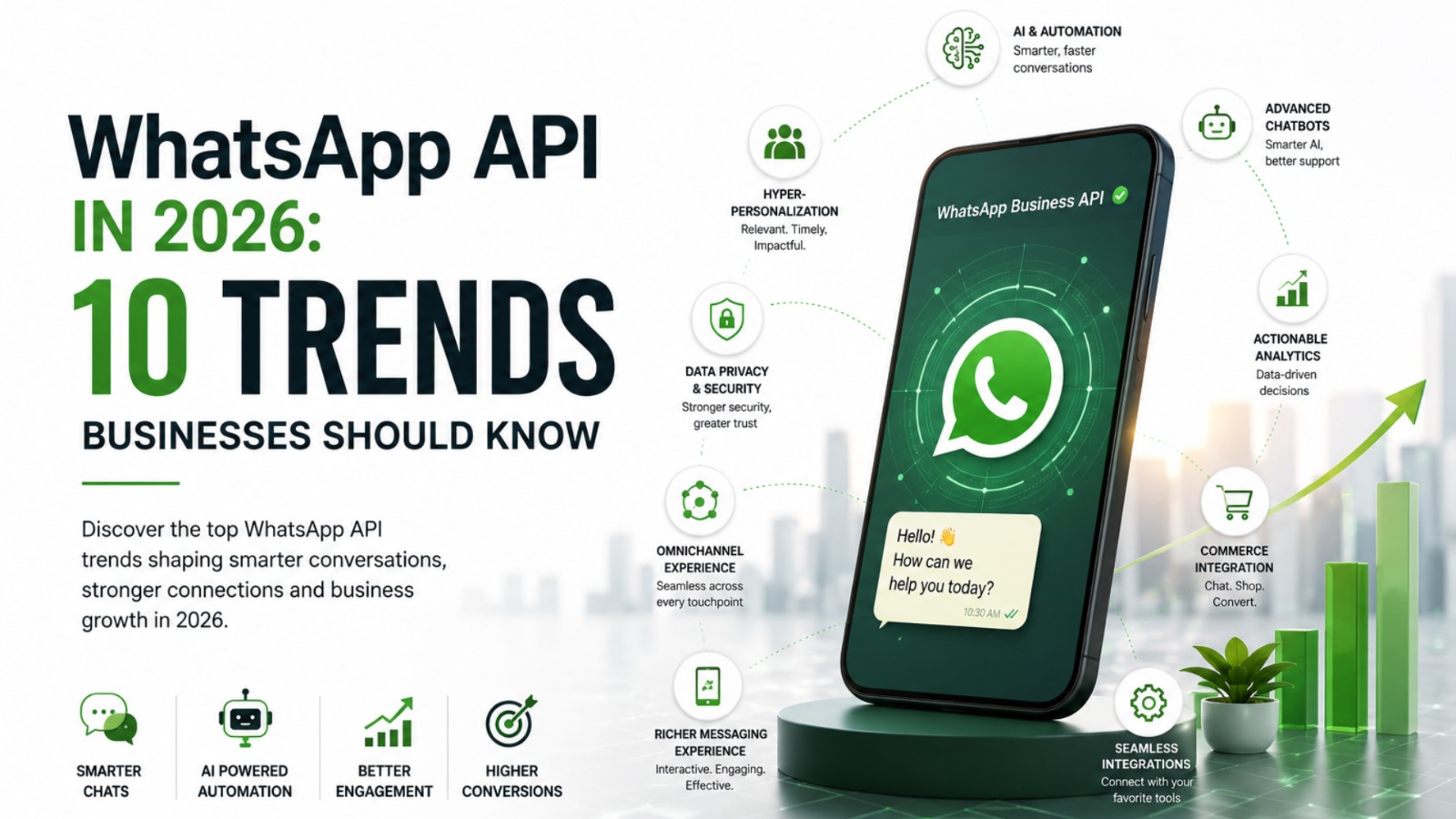
Here are the 10 trends that matter most.
1. AI-Powered WhatsApp Automation Will Become More Important
Artificial intelligence is one of the biggest trends in business messaging.
Earlier, companies mainly used WhatsApp automation for simple tasks.
These included welcome messages, FAQs, order updates, and basic lead collection.
Now, AI can support much more advanced conversations.
Businesses can use AI-powered systems to understand customer questions, provide relevant information, recommend products, and guide conversations.
For example, imagine a customer messaging a jewellery brand:
Customer:
“I need a Diwali gift under ₹5,000.”
A basic chatbot may show a generic catalogue.
An AI-powered system can take a different approach.
It can understand the budget. Then, it can ask about the recipient, preferred style, and product type.
After that, it can recommend suitable products.
The conversation can continue until the customer is ready to speak with a sales representative.
Therefore, AI can help businesses deliver faster support without requiring a human agent for every question.
Businesses can use AI automation for:
- Lead qualification
- Product recommendations
- Customer support
- FAQs
- Appointment booking
- Order assistance
- Follow-ups
- Customer engagement
- Sales conversations
Meta has also been developing AI capabilities for businesses on WhatsApp, making AI-powered customer conversations an important part of the platform’s direction.
As a result, businesses should start viewing WhatsApp as an AI-powered customer experience channel rather than only a messaging tool.
2. Conversational Commerce Will Change Online Shopping
Online shopping usually follows a familiar journey.
A customer sees an advertisement.
Then, they visit a website.
Next, they search for a product.
After that, they compare options.
Finally, they decide whether to purchase.
Unfortunately, customers can leave at almost any stage.
Conversational commerce can shorten this journey.
With WhatsApp, customers can ask questions before buying.
They can also request recommendations, compare products, check availability, and continue the conversation with a business.
For example, a fashion brand can run a festive campaign.
A customer clicks the advertisement and opens WhatsApp.
The automated conversation can ask:
“What are you shopping for?”
The customer can select:
- Festive wear
- Gifts
- Accessories
- Jewellery
- Footwear
The system can then guide the customer toward relevant products.
Consequently, WhatsApp can become more than a support channel.
It can become a digital sales assistant.
This trend is especially useful for e-commerce, jewellery, fashion, beauty, travel, real estate, and other businesses where customers need information before making a purchase.
3. Click-to-WhatsApp Ads Will Become a Stronger Lead Generation Strategy
Getting a click is not the same as getting a conversation.
A website visitor may browse a page and leave.
However, a WhatsApp conversation gives the business an opportunity to engage directly.
That is why Click-to-WhatsApp Ads are becoming an important part of the digital marketing funnel.
The journey can look like this:
Meta Ad → WhatsApp → Automated Welcome Message → Lead Qualification → Sales Team → Conversion
Consider a real estate business.
The advertisement can promote a new residential project.
Instead of sending every user to a long enquiry form, the business can invite interested people to WhatsApp.
The automation can ask:
“Which property are you looking for?”
The customer can choose:
- 1 BHK
- 2 BHK
- 3 BHK
- Commercial
- Investment
The system can then ask about budget and location.
Finally, the qualified lead can reach the sales team.
This approach can reduce friction.
More importantly, it creates a direct path between advertising and sales.
For Trending Bulb and Step4Growth, this strategy can help businesses connect Meta advertising with WhatsApp automation instead of managing the two activities separately.
4. WhatsApp API and CRM Integration Will Become Essential
Customer data often sits across different systems.
Marketing information may exist in an advertising platform.
Sales information may sit inside a CRM.
Customer conversations may remain inside WhatsApp.
This separation can create problems.
Salespeople may not know where a lead came from.
They may also miss previous conversations.
CRM integration can solve this problem.
A connected WhatsApp system can help businesses bring customer conversations into wider sales and marketing workflows.
For example:
Lead Generated → CRM Record Created → WhatsApp Message Sent → Customer Responds → Lead Qualified → Salesperson Assigned
The CRM can also store important information such as:
- Customer name
- Lead source
- Product interest
- Budget
- Previous interactions
- Sales stage
- Follow-up date
- Purchase history
Therefore, the sales team gets better context.
Customers also avoid repeating the same information.
This creates a smoother experience.
For growing businesses, WhatsApp API and CRM integration can become an important part of the sales infrastructure.
5. Personalized WhatsApp Marketing Will Replace Generic Messaging
Customers see a large number of promotional messages every day.
Because of that, generic messages can easily get ignored.
Consider this example.
Generic message:
“Get amazing offers on our latest collection.”
Now compare it with:
Personalized message:
“Hi Priya, you recently checked our gold earrings. Our festive collection is now available. Would you like to see similar designs?”
The second message feels more relevant.
However, personalization should always provide value.
Businesses should not simply add a customer’s name to every message.
Instead, they should use relevant information such as:
- Previous product interest
- Purchase history
- Location
- Customer segment
- Browsing behaviour
- Service requirements
- Sales stage
For example, a real estate company can communicate differently with a first-time enquiry and an existing customer.
Similarly, an e-commerce company can recommend products based on previous purchases.
As a result, WhatsApp marketing can become more relevant and less repetitive.
6. WhatsApp Calling and Voice Communication Will Expand
Text messages work well for many situations.
However, some conversations need a voice interaction.
Customers may want to discuss:
- Property investments
- Insurance
- Travel plans
- Healthcare services
- Technical problems
- High-value purchases
- Complex service requirements
WhatsApp has been expanding business calling capabilities, creating more options for customer communication.
Therefore, businesses should prepare for a broader communication model.
The future customer journey may include:
Text → Image → Document → Voice → Call → Human Support
This flexibility can improve customer experience.
For instance, an AI assistant can handle the initial enquiry.
If the customer needs more help, the system can move the conversation toward a human agent or supported calling experience.
Consequently, businesses can combine automation with human assistance.
That balance can be particularly valuable for high-intent leads.
7. WhatsApp Will Become Part of Omnichannel Marketing
Customers do not follow one fixed path.
A person may discover a business through Google.
Later, they may see the same brand on Instagram.
Then, they might encounter a Facebook Ad.
Finally, they may contact the company through WhatsApp.
Therefore, businesses need to connect these channels.
A strong omnichannel journey could look like:
Google Search → Website → WhatsApp
Another journey could be:
Instagram → Meta Ad → WhatsApp
A third journey could be:
Facebook → Advertisement → WhatsApp Automation → CRM → Sales
This approach creates continuity.
The customer does not feel like they are starting from zero every time they interact with the brand.
Meta has also been working toward more centralized business campaign and messaging experiences across its platforms.
For this reason, WhatsApp should become part of the broader digital marketing strategy.
8. Automated Lead Qualification Will Improve Sales Efficiency
Not every lead has the same value.
Some customers are ready to purchase.
Others are comparing options.
A few may simply be researching.
Sales teams cannot spend equal time on every enquiry.
WhatsApp automation can help identify high-intent leads.
A chatbot can ask simple questions such as:
“Which product are you interested in?”
“What is your budget?”
“When do you plan to purchase?”
“Which location do you prefer?”
Based on the answers, the system can categorize the lead.
Hot Lead
The customer is ready to buy.
Warm Lead
The customer needs more information.
Cold Lead
The customer is still researching.
The sales team can then focus on high-priority enquiries.
Meanwhile, automation can continue nurturing other prospects.
This process can save time.
More importantly, it can help sales teams respond to high-intent leads faster.
That matters because a delayed response can turn a potential customer into a lost opportunity.
9. WhatsApp Automation Will Support Complete Customer Journeys
Businesses should not think about automation as one isolated message.
Instead, they should build complete customer journeys.
Here is an example.
Step 1: Customer Sees an Ad
A potential customer sees a Meta Ad.
Step 2: Customer Clicks WhatsApp
The CTA opens a WhatsApp conversation.
Step 3: Automation Responds
The customer receives an instant welcome message.
Step 4: System Collects Requirements
The chatbot asks relevant questions.
Step 5: Lead Gets Qualified
The system identifies the customer’s intent.
Step 6: CRM Gets Updated
Customer information enters the sales workflow.
Step 7: Salesperson Takes Over
A human agent handles the important conversation.
Step 8: Follow-Up Happens Automatically
The system reminds the customer when appropriate.
Step 9: Customer Converts
The customer purchases a product or books a service.
Step 10: Business Continues Engagement
The company can provide support, updates, and relevant future offers.
This is the real power of WhatsApp automation.
It does not simply send messages.
It can connect marketing, sales, support, and retention.
For businesses using Campaign Plus, such workflows can become part of a structured WhatsApp automation strategy.
10. WhatsApp Will Become a Core Sales and Customer Support Channel
The biggest trend is the changing role of WhatsApp itself.
Businesses are moving away from viewing WhatsApp as only a communication app.
Instead, they are using it across multiple business functions.
Marketing
Generate conversations from campaigns.
Sales
Qualify leads and answer product questions.
Customer Support
Handle common customer requests.
Retention
Stay connected with existing customers.
Re-Engagement
Reconnect with people who showed interest but did not purchase.
Commerce
Guide customers toward products and purchases.
Notifications
Share relevant updates and reminders.
Therefore, WhatsApp can support the entire customer lifecycle.
That makes the platform increasingly important for businesses that want direct, measurable customer communication.
WhatsApp API + Digital Marketing: The Winning Combination
The real opportunity does not come from WhatsApp API alone.
It comes from combining WhatsApp with digital marketing.
Think about the complete funnel.
SEO attracts people searching for solutions.
Google Ads capture high-intent searches.
Meta Ads create demand and generate conversations.
Social media marketing builds awareness.
Content marketing builds trust.
WhatsApp API starts direct conversations.
Automation qualifies leads.
CRM manages customer information.
Sales teams close opportunities.
This creates a connected customer journey.
Instead of asking:
“How many leads did our ads generate?”
Businesses can ask:
“How many conversations became qualified leads?”
Then:
“How many qualified leads became customers?”
That is a much stronger way to measure marketing performance.
How Trending Bulb, Step4Growth and Campaign Plus Fit Into This Strategy
Modern businesses need more than individual marketing activities.
They need an integrated growth strategy.
Trending Bulb can focus on digital visibility, content, SEO, social media, and performance marketing.
Step4Growth can help businesses focus on growth-oriented digital strategies and conversion journeys.
Meanwhile, Campaign Plus can support the WhatsApp API and automation layer that connects customer conversations with business workflows.
Together, these areas can create a powerful model:
Attract → Engage → Qualify → Nurture → Convert → Retain
The goal is not simply to generate more traffic.
The goal is to turn attention into conversations and conversations into business.
How Businesses Can Prepare for WhatsApp API in 2026
Understanding the trends is only the first step.
Businesses also need to prepare their systems.
1. Map Your Customer Journey
Start with the customer.
Ask:
- Where do customers discover your business?
- Which channel generates the most enquiries?
- How quickly does your team respond?
- Where do leads drop off?
- Which questions do customers ask repeatedly?
- Which follow-ups does your team miss?
These answers will reveal where automation can help.
2. Connect Your Ads With WhatsApp
Do not treat advertising and WhatsApp as separate activities.
Instead, create a connected funnel.
Ad → WhatsApp → Automation → CRM → Sales
This approach can reduce friction between marketing and sales.
3. Automate Repetitive Tasks
Start with simple processes.
Automate:
- Welcome messages
- FAQs
- Lead collection
- Appointment requests
- Product enquiries
- Order updates
- Payment reminders
- Follow-ups
- Customer feedback
Then, add AI where it creates real value.
4. Keep Humans in the Loop
Automation should not remove the human element.
Instead, use AI for repetitive interactions.
Let human agents handle:
- Complex questions
- Negotiations
- Complaints
- High-value leads
- Sensitive situations
- Final sales conversations
This creates a human + AI customer experience.
5. Track Revenue, Not Just Messages
Message volume is not the final goal.
Businesses should track meaningful metrics.
Important KPIs include:
- Leads generated
- Conversations started
- Response rate
- Qualified leads
- Cost per lead
- Cost per conversation
- Follow-up rate
- Conversion rate
- Sales revenue
- Customer retention
Ultimately, the best WhatsApp strategy is the one that improves business results.
WhatsApp API Trends for Different Industries
The opportunity looks different across industries.
E-commerce
Businesses can use WhatsApp for product recommendations, order updates, abandoned-cart follow-ups, and customer support.
Jewellery
Brands can promote festive collections, gifting offers, personalized recommendations, and high-value product enquiries.
Real Estate
Companies can qualify buyers by budget, property type, location, and purchase timeline.
Education
Institutes can automate course enquiries, counselling requests, application reminders, and follow-ups.
Healthcare
Businesses can support appointment requests, reminders, FAQs, and customer communication within applicable policies and regulations.
Travel
Travel companies can handle destination questions, itinerary discussions, booking assistance, and follow-ups.
Local Businesses
Restaurants, salons, clinics, stores, and service providers can use WhatsApp to handle enquiries and bookings.
Therefore, the same technology can support very different customer journeys.
Why Businesses Should Not Wait
The biggest change in 2026 is not simply the availability of WhatsApp automation.
It is the growing expectation for instant and personalized communication.
Customers do not want to wait for every answer.
They also do not want to complete a complicated journey before speaking with a business.
Instead, they want convenience.
That is why WhatsApp is becoming increasingly valuable.
Businesses that build strong WhatsApp workflows now can create an advantage in:
- Response speed
- Lead qualification
- Customer experience
- Sales follow-up
- Personalization
- Marketing efficiency
However, automation should never mean sending random promotional messages.
The strategy should focus on relevance.
Send the right message.
Reach the right customer.
Use the right timing.
Provide the right next step.
That is how WhatsApp automation becomes useful.
Final Thoughts
The WhatsApp API in 2026 is evolving into much more than a business messaging solution.
AI-powered automation is making conversations smarter.
Conversational commerce is making buying journeys easier.
Click-to-WhatsApp Ads are connecting advertising with direct conversations.
CRM integration is connecting customer communication with sales data.
Personalization is making messages more relevant.
Calling and voice features are expanding communication options.
Omnichannel marketing is connecting WhatsApp with other digital channels.
Automated lead qualification is helping sales teams prioritize opportunities.
Complete customer journeys are connecting marketing, sales, and support.
Finally, WhatsApp is becoming a stronger business infrastructure for customer engagement and conversion.
For businesses, the opportunity is clear.
Do not use WhatsApp only to reply to customers.
Use it to attract, engage, qualify, nurture, convert, and retain customers.
That is the real value of the WhatsApp API in 2026.
With the right digital marketing strategy from Trending Bulb, growth-focused planning from Step4Growth, and WhatsApp automation through Campaign Plus, businesses can build a more connected customer journey.
The future belongs to businesses that respond faster, understand customers better, and remove friction from the buying process.
In 2026, the winning strategy is simple: