Introduction: A New Era of Student Engagement Through RCS Marketing
The education industry is experiencing a significant digital transformation. Today, students expect educational institutions to provide quick responses, personalized information, and convenient communication. As a result, traditional promotional methods alone may no longer deliver the interactive experiences that modern students expect.
However, many colleges, universities, coaching institutes, and EdTech companies still depend heavily on conventional SMS campaigns and email communication. Consequently, important admission announcements, course promotions, and educational updates can struggle to capture students’ attention.
This is where RCS (Rich Communication Services) education marketing creates new opportunities.
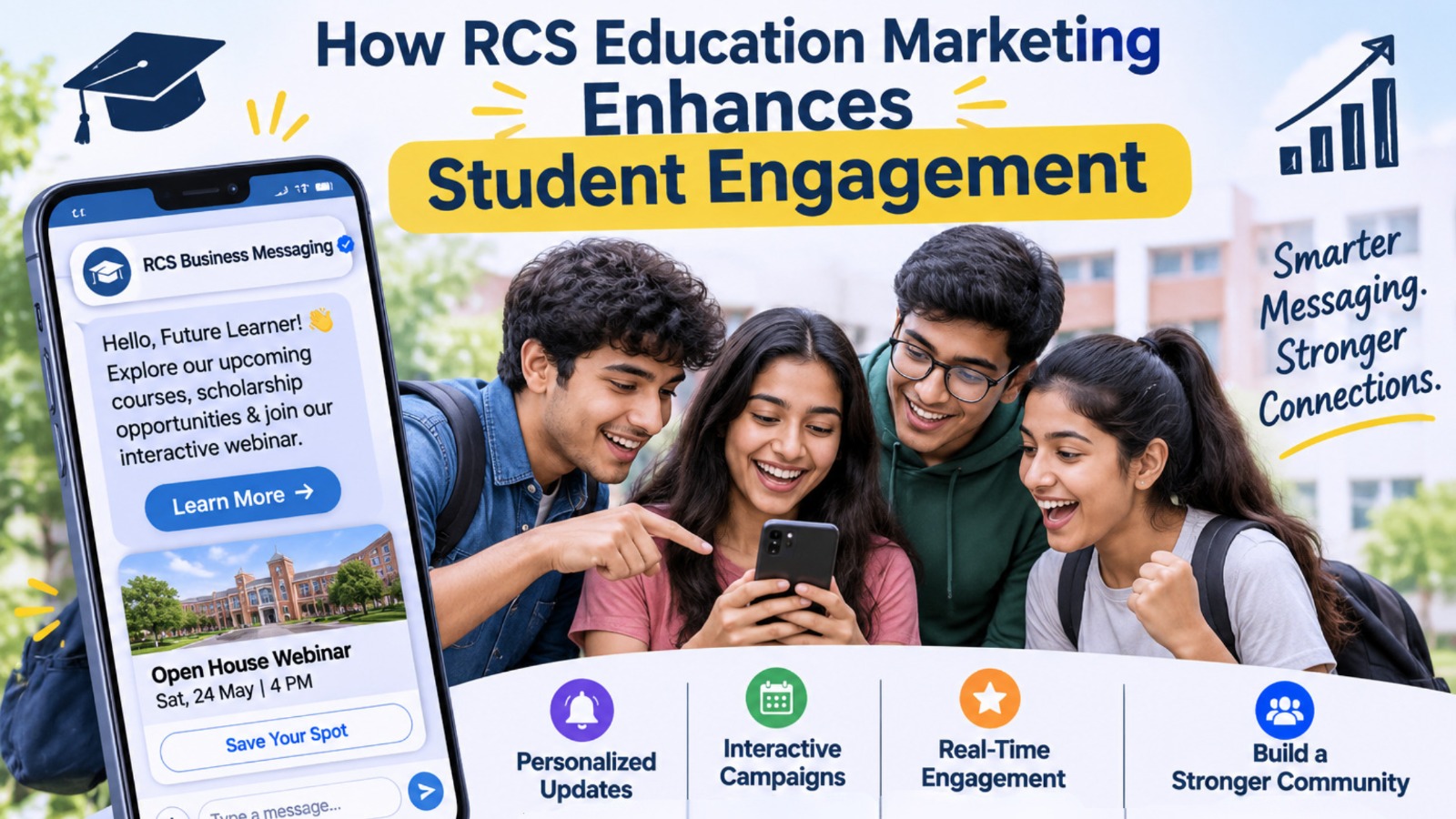
Unlike traditional text messaging, RCS transforms ordinary messages into richer communication experiences. For example, educational institutions can share images, videos, interactive buttons, branded messages, and personalized information through compatible messaging applications.
Moreover, students can explore courses, register for webinars, receive admission updates, and interact with educational brands through familiar messaging interfaces. Therefore, institutions have another way to make communication more convenient and engaging.
At Trending Bulb, we believe that the future of digital marketing depends on meaningful communication, relevant content, and smarter technology. As businesses increasingly explore advanced messaging solutions, RCS presents an opportunity for educational institutions to rethink how they attract, engage, and communicate with students.
Furthermore, our focus on digital marketing trends and emerging communication technologies highlights how businesses can combine innovative messaging approaches with effective marketing strategies. Platforms such as Campaign Plus and the digital communication solutions offered by Step4Growth also demonstrate how messaging can complement a broader digital engagement strategy.
Let’s explore how RCS education marketing can transform student engagement and help educational institutions build stronger digital relationships.
1. What Is RCS Education Marketing?
RCS stands for Rich Communication Services. Essentially, it is an advanced messaging standard designed to enhance traditional SMS communication.
Unlike conventional SMS, which primarily supports plain text and basic links, RCS offers a richer messaging experience through multimedia content and interactive features.
For instance, educational institutions can use RCS to share:
- Course descriptions and promotional images.
- Campus photographs and virtual tour previews.
- Faculty introductions and educational videos.
- Scholarship announcements.
- Admission notifications and reminders.
- Webinar invitations and registration buttons.
- Interactive course information cards.
Consider a university promoting its postgraduate management program. Instead of sending a basic text message, the university can share an attractive course card containing a program image, course highlights, eligibility information, and an admission inquiry button.
As a result, students can explore the opportunity and take the next step directly from the message. This makes the communication experience more informative and convenient.
Therefore, RCS education marketing helps institutions move beyond one-way promotional communication and create more interactive student experiences.
2. Why Student Engagement Matters in Education Marketing
Attracting prospective students is important. Nevertheless, keeping them interested throughout the admission journey is equally essential.
Students usually explore multiple institutions before making an educational decision. During this process, they compare courses, fees, faculty, infrastructure, placements, and learning opportunities.
Consequently, educational institutions need consistent communication that provides relevant information at the right time.
Effective student engagement contributes to this process in several ways:
Builds trust: Regular and useful communication helps educational institutions establish credibility with prospective students. Moreover, consistent updates make it easier for students to understand available opportunities.
Improves admission inquiries: Relevant course information and clear calls to action encourage students to request additional details. As a result, institutions can create more opportunities for meaningful conversations.
Increases event participation: Interactive invitations and reminders can support webinar registrations, campus visits, and counselling sessions. Furthermore, timely reminders help students stay informed about upcoming activities.
Strengthens student relationships: Personalized communication helps institutions remain connected with students throughout their academic journey. Therefore, engagement does not need to end after admission.
Creates better experiences: Convenient messaging makes it easier for students to access important educational information. In addition, interactive communication can reduce the effort required to find relevant details.
Mobile-first communication has also become an important consideration for education marketers. For this reason, RCS provides another opportunity to reach students through a familiar digital environment.
3. How RCS Messaging Makes Education Marketing More Interactive
One of the biggest advantages of RCS is its ability to transform ordinary messages into engaging communication experiences. Instead of relying only on text, institutions can combine information, visuals, and interactive actions.
Let’s examine some of its major features.
A. Rich Media Creates More Attractive Messages
Visual communication can make educational promotions more informative and engaging. Through RCS, institutions can showcase campus photographs, laboratory facilities, classroom videos, faculty introductions, and course demonstrations.
For instance, a college promoting its engineering program can share images of laboratories, practical learning environments, and campus facilities. Consequently, prospective students gain a better understanding of the institution before arranging a campus visit.
Moreover, visual content can help institutions present complex information in a more accessible format.
B. Interactive Buttons Encourage Student Action
RCS supports suggested actions that help students navigate relevant information. Instead of asking students to search through several website pages, institutions can provide convenient options within compatible messaging experiences.
For example, educational institutions can include buttons such as:
- Explore Courses
- Apply Now
- Book Counselling
- Download Brochure
- Register for Webinar
- Contact Admission Team
As a result, students can access relevant destinations more directly. Furthermore, institutions can create a smoother journey from initial interest to admission inquiry.
C. Two-Way Messaging Encourages Conversations
Students often have questions about eligibility, scholarships, fees, and admission procedures. However, traditional promotional messages generally provide limited opportunities for interaction.
RCS supports richer conversational experiences through suggested replies and actions. For example, a prospective student can select an option asking about postgraduate courses. The institution can then guide the student towards relevant program information or a counselling representative.
Therefore, communication becomes more interactive and student-focused. Most importantly, students have a clearer path to the information they need.
4. Seven Ways RCS Education Marketing Enhances Student Engagement
RCS can support different stages of the student journey. From the first course inquiry to ongoing academic communication, institutions can use its capabilities in several practical ways.
1. Personalized Course Recommendations
Every student has different interests, academic backgrounds, and career aspirations. Therefore, sending identical promotional messages to every prospective student may not produce meaningful engagement.
Instead, educational institutions can use available student preferences and communication data to develop more relevant messaging campaigns.
For example:
- Engineering students can receive information about technical programs.
- Management aspirants can explore MBA opportunities.
- Students interested in online learning can receive relevant course updates.
- Postgraduate applicants can receive scholarship announcements.
Moreover, personalized communication helps students discover opportunities that match their interests. As a result, institutions can make their promotional messages more relevant.
2. Faster Admission Notifications
Admission processes involve multiple stages, including application submissions, document verification, entrance examinations, and counselling appointments.
RCS can help institutions communicate these updates through clear and engaging messages. For instance, a college can share an application status notification containing submission instructions, important dates, and a link to the admission portal.
Consequently, students can access essential information without repeatedly checking institutional websites. Additionally, timely notifications can help reduce confusion during important admission stages.
3. Interactive Webinar Registrations
Webinars, workshops, career guidance sessions, and virtual events play an important role in education marketing. However, attracting registrations and maintaining attendance can be challenging.
RCS enables institutions to create visually appealing event invitations containing speaker information, event banners, dates, and registration buttons.
Furthermore, institutions can send appropriate reminders before an event. As a result, students can discover and register for educational events more conveniently.
4. Scholarship and Financial Aid Communication
Scholarships can influence students’ decisions when selecting an educational institution. Nevertheless, many prospective students may not discover suitable financial assistance opportunities.
RCS allows institutions to communicate scholarship announcements, eligibility information, deadlines, and application links. Moreover, interactive actions can help interested students request additional information.
Therefore, scholarship communication becomes easier to access and understand. At the same time, institutions can help students discover opportunities that may support their educational goals.
5. Examination and Academic Reminders
Student engagement continues after admission. In fact, existing students also require timely information about examinations, assignments, timetable changes, and academic activities.
RCS can support communication through reminders and notifications. For example, institutions can send examination dates, reporting times, subject details, and links to relevant instructions.
Similarly, they can communicate workshop announcements, assignment deadlines, and campus updates. Consequently, students remain informed throughout their academic journey.
6. Virtual Campus Tours and Course Demonstrations
Selecting an educational institution is an important decision. Before applying, students often want to explore campus facilities, teaching environments, laboratories, and faculty experience.
RCS makes it possible to introduce these experiences through rich media. For example, universities can share short campus introduction videos, laboratory photographs, and course demonstration content.
Additionally, students can select an option to request a campus visit. This approach makes early-stage communication more informative and helps prospective students explore an institution more conveniently.
7. Better Student Support Through Conversational Messaging
Students frequently require assistance with admission eligibility, course fees, payment procedures, and document verification. Therefore, accessible communication is essential throughout the student journey.
RCS can support conversational communication through suggested replies, automated responses, and integrations with customer support systems.
For example, a student can select an admission-related option and receive relevant information. If the question requires personal assistance, the conversation can be directed to a counsellor.
Thus, institutions can combine automation with human support. Ultimately, this helps create a more convenient student communication experience.
5. RCS vs Traditional SMS: Understanding the Difference
Traditional SMS remains useful for short notifications. However, RCS provides additional capabilities that can improve the overall messaging experience.
| Feature | Traditional SMS | RCS |
|---|---|---|
| Text messaging | Yes | Yes |
| Rich images | Limited | Supported |
| Video content | No native rich-media experience | Supported |
| Interactive buttons | Basic links | Suggested actions |
| Rich cards | No | Yes |
| Carousels | No | Yes |
| Branded messaging | Limited | Supported where available |
| Read receipts | Generally unavailable | Supported where available |
| Engagement analytics | Basic | Additional capabilities |
For education marketers, the major advantage is the ability to combine information and interaction within a single messaging experience.
Nevertheless, RCS availability depends on compatible devices, operating systems, carriers, and regional support. Therefore, institutions should maintain appropriate fallback communication methods, including SMS where suitable.
6. How Trending Bulb Is Shaping the Digital Marketing Conversation
Digital marketing is constantly evolving. New technologies, changing consumer expectations, and mobile-first communication are influencing how businesses connect with their audiences.
At Trending Bulb, we focus on understanding these developments and exploring how businesses can use modern digital marketing approaches to improve communication and audience engagement.
For the education sector, this means looking beyond conventional promotional campaigns. Instead, institutions need strategies that combine content marketing, search engine visibility, social media, messaging technology, and personalized communication.
Trending Bulb emphasizes several important areas within this evolving ecosystem.
Digital Marketing That Connects With the Right Audience
Successful education marketing starts with understanding the target audience. Search engine optimization, informative blogs, social media campaigns, and digital advertising can help institutions reach prospective students who are actively exploring educational opportunities.
However, attracting website visitors is only the beginning. Institutions also need effective communication strategies to convert initial interest into meaningful inquiries.
Therefore, education marketers should connect audience acquisition with relevant follow-up communication.
Smarter Messaging and Communication
RCS and WhatsApp offer additional opportunities for businesses to communicate through mobile messaging. For educational institutions, these channels can support course promotions, admission updates, event invitations, and student assistance.
Furthermore, integrating messaging with CRM and automation workflows can help institutions organize student inquiries more effectively.
Technology-Driven Marketing Strategies
At Trending Bulb, we recognize that modern marketing requires more than visibility. Businesses must also focus on user experience, relevant communication, and measurable engagement.
For this reason, emerging messaging technologies such as RCS deserve attention from educational marketers planning their future digital strategies.
Our goal is to highlight practical digital marketing developments that help businesses understand new opportunities and make informed technology decisions.
7. How Campaign Plus Supports Modern Education Messaging
An effective RCS strategy requires suitable communication technology and well-planned campaign execution. This is where Campaign Plus becomes relevant to the education marketing ecosystem.
Campaign Plus provides messaging solutions across WhatsApp, RCS, and SMS, helping businesses explore different communication channels.
Educational institutions can consider these capabilities for several activities.
Omnichannel Student Communication
Different students may prefer different communication channels. Therefore, institutions can develop communication strategies that combine suitable messaging platforms.
For example:
- RCS can showcase courses through rich media and interactive cards.
- WhatsApp can support conversational inquiries.
- SMS can deliver short and important notifications.
Consequently, institutions can create a more connected communication experience. Moreover, they can select channels according to the purpose of each message and the availability of the technology.
Automated Student Inquiry Management
Admission teams often receive repetitive questions about fees, eligibility, scholarships, and course duration. However, answering every inquiry manually can consume considerable time.
Messaging automation can help institutions structure responses to frequently asked questions. For example, a student interested in an MBA program can receive relevant course information through an automated conversation.
Additionally, complex questions can be directed to an appropriate counsellor. As a result, institutions can combine faster initial responses with personal assistance when required.
Organized Follow-Up Campaigns
Generating student inquiries is important. Nevertheless, consistent follow-ups are equally essential.
Campaign Plus can support messaging campaigns that help institutions communicate with prospective students throughout the admission journey.
A typical communication sequence may include:
- Initial course introduction.
- Digital brochure sharing.
- Scholarship information.
- Counselling invitation.
- Admission deadline reminder.
As a result, institutions can maintain more consistent communication. Furthermore, a planned sequence can help admission teams organize their follow-up activities.
Campaign Management and Performance Monitoring
Marketing teams need to understand how their campaigns perform. Messaging platforms with reporting capabilities can help organizations monitor campaign activity and available engagement indicators.
Therefore, institutions can review campaign performance and improve future communication strategies.
Explore Campaign Plus: https://campaignplus.in/
8. How Step4Growth Complements Education Marketing
Education marketing requires more than attractive messages. Institutions must attract the right audience, generate inquiries, and maintain communication throughout the student journey.
This is where Step4Growth complements the broader digital communication ecosystem.
Step4Growth offers WhatsApp marketing and related communication solutions, including WhatsApp Business API, chatbot automation, and CRM-related services.
These capabilities can support educational institutions in several ways.
WhatsApp Marketing for Student Communication
WhatsApp is an important communication channel for many Indian students. Therefore, educational institutions can explore suitable WhatsApp Business solutions to share course information, answer inquiries, communicate admission updates, and support prospective students.
Furthermore, structured messaging can help admission teams manage conversations more efficiently.
Chatbot Automation for Faster Responses
Students frequently ask similar questions about courses, eligibility, fees, and admission procedures. However, responding to every common inquiry manually can slow down communication.
Chatbot automation can provide structured responses to frequently asked questions. Consequently, students can access basic information without waiting for every response from an admission representative.
When necessary, institutions can also provide a route to human assistance. This way, automation supports rather than replaces personal guidance.
Connecting Marketing With Lead Generation
A strong education marketing strategy connects different digital activities. For example:
- SEO attracts students searching for courses.
- Social media builds awareness.
- Paid campaigns generate inquiries.
- RCS showcases programs through rich messaging.
- WhatsApp supports conversations.
- CRM helps organize prospective student information.
Therefore, Step4Growth’s WhatsApp marketing and automation capabilities can complement an institution’s broader student engagement strategy.
Explore Step4Growth: https://step4growth.com/
9. Best Practices for Successful RCS Education Marketing Campaigns
RCS provides advanced messaging features. However, institutions must use them strategically to deliver meaningful experiences.
Here are seven important practices to consider.
Understand Your Target Audience
First, identify student interests, academic backgrounds, and preferred programs before creating campaigns. Then, develop messages that address their specific requirements.
As a result, communication can become more relevant to different student groups.
Create Attractive and Concise Content
Students receive numerous notifications every day. Therefore, use clear headlines, relevant images, short descriptions, and one prominent call to action.
Additionally, make sure that the message communicates its main purpose quickly.
Use Relevant Calls to Action
Guide students towards a useful next step. For example, suitable actions may include Explore Courses, Apply Now, Book Counselling, and Register for Webinar.
Most importantly, make each action clear and relevant to the message.
Segment Your Student Database
Avoid sending identical promotional messages to every contact. Instead, organize audiences based on course interests, admission stages, and communication preferences.
Consequently, institutions can create more targeted campaigns.
Follow Messaging and Privacy Guidelines
Educational institutions must obtain appropriate consent and follow applicable privacy, messaging, and platform policies.
Furthermore, they should respect opt-out requests and avoid unnecessary promotional communication. Responsible messaging helps maintain trust.
Measure Meaningful Engagement
Monitor relevant indicators such as message delivery, available read indicators, button clicks, inquiries, registrations, and completed applications.
However, remember that message delivery does not automatically translate into student engagement or admissions. Therefore, evaluate meaningful actions alongside basic delivery statistics.
Maintain Human Support
Automation improves convenience. Nevertheless, students sometimes require personal guidance.
For this reason, provide a clear way to connect with an admission representative. Ultimately, a combination of automation and human support can create a more helpful experience.
10. Common RCS Education Marketing Mistakes to Avoid
Even advanced messaging technology can create a poor experience when campaigns lack proper planning. Therefore, educational institutions should avoid the following mistakes.
Sending excessive promotions: Too many messages can irritate students. Instead, establish an appropriate communication frequency and prioritize useful updates.
Using generic content: Identical messages may not address different student interests. Consequently, personalize communication where appropriate.
Ignoring mobile experience: Make sure rich media and destination pages work smoothly on compatible devices. Otherwise, students may struggle to access the information.
Adding too many buttons: Multiple actions can create confusion. Therefore, highlight the most important next step.
Ignoring student responses: Make sure someone can handle incoming inquiries and requests for assistance. After all, interactive communication should include appropriate responses.
Failing to measure performance: Review available analytics to identify successful campaigns and areas for improvement. Furthermore, use those findings to refine future messages.
Ultimately, the best campaigns focus on relevance, timing, transparency, and convenience.
11. The Future of RCS Education Marketing in India
India’s education industry is becoming increasingly digital. Today, students discover institutions through search engines, social media, online advertisements, and educational platforms.
Consequently, institutions need communication strategies that connect these digital touchpoints. RCS can contribute to this transformation through richer and more interactive messaging.
AI-Powered Student Communication
Artificial intelligence can help educational institutions respond to common inquiries, recommend relevant information, and organize student support.
Furthermore, when combined with messaging automation, AI can make communication more efficient. However, institutions should ensure that automated responses remain accurate and provide access to human support when necessary.
Personalized Student Experiences
Institutions can use appropriate student preferences and interaction data to provide more relevant information.
As a result, prospective students can discover courses and opportunities aligned with their interests. Moreover, relevant communication can make the decision-making process easier.
Integrated Messaging Ecosystems
Educational marketers can combine RCS, WhatsApp, SMS, CRM, and digital marketing tools.
Instead of managing every channel separately, institutions can plan connected communication workflows. Consequently, they may be able to manage different stages of the student journey more effectively.
Data-Driven Marketing Decisions
Marketing analytics will continue to influence campaign planning. By evaluating student interactions and campaign outcomes, institutions can refine their communication strategies.
At Trending Bulb, we believe that understanding emerging technologies is essential for businesses preparing for the next stage of digital marketing. Therefore, we encourage education marketers to explore new communication opportunities while keeping student needs at the centre of their strategies.
12. How Educational Institutions Can Get Started With RCS
Institutions can begin with a structured implementation strategy. Rather than launching multiple campaigns immediately, it is better to start with a specific communication objective.
| Step | Recommended action |
|---|---|
| 1 | Define student engagement objectives. |
| 2 | Identify the target student audience. |
| 3 | Select a suitable RCS messaging provider. |
| 4 | Prepare branded images and message templates. |
| 5 | Develop interactive course and admission campaigns. |
| 6 | Integrate messaging with relevant CRM workflows. |
| 7 | Test device compatibility and fallback options. |
| 8 | Monitor campaign performance and improve results. |
Additionally, institutions should verify RCS availability across their target audience and follow applicable platform and regional requirements.
For the best results, start with a specific communication objective, test the campaign, evaluate the results, and expand gradually. This approach makes it easier to identify what works before increasing campaign activity.
Conclusion: Build Stronger Student Connections With RCS Education Marketing
The education industry is moving towards more connected, personalized, and interactive communication. Traditional SMS and email continue to play important roles. However, RCS introduces additional opportunities through rich media, interactive buttons, branded messaging, and conversational experiences.
From course promotions and admission notifications to scholarship announcements and webinar registrations, RCS can support multiple stages of the student journey.
Furthermore, combining RCS with WhatsApp marketing, chatbot automation, and digital marketing can help educational institutions create more organized communication strategies.
At Trending Bulb, we believe that the future of digital marketing belongs to businesses that combine innovative technology with meaningful audience relationships. Through our focus on digital marketing developments and emerging communication opportunities, we aim to help businesses understand how smarter messaging can improve customer experiences.
Meanwhile, Campaign Plus offers messaging and automation capabilities that support omnichannel communication. Similarly, Step4Growth complements the ecosystem through WhatsApp marketing and related digital communication solutions.
Ultimately, the objective is not simply to send more messages. Instead, it is to deliver relevant information, encourage meaningful conversations, and make every student interaction valuable.
Ready to explore smarter digital communication? Discover the possibilities with Trending Bulb, explore messaging solutions through Campaign Plus, and learn more about WhatsApp marketing with Step4Growth.
Frequently Asked Questions (FAQs)
1. What is RCS education marketing?
RCS education marketing uses Rich Communication Services to help educational institutions communicate with students through interactive messages, rich media, images, videos, and suggested actions. As a result, institutions can create richer messaging experiences than basic text communication.
2. How does RCS improve student engagement?
RCS makes communication more interactive and visually engaging. For example, students can explore courses, view campus information, register for webinars, and access admission details through compatible messaging applications.
3. What are the benefits of RCS messaging for colleges?
RCS supports interactive course promotions, admission notifications, scholarship updates, webinar registrations, campus tour promotions, and academic reminders. Furthermore, it can help institutions present information through a more engaging messaging format.
4. Is RCS better than traditional SMS?
RCS provides additional capabilities such as rich media, interactive buttons, and branded messaging. However, traditional SMS remains useful for basic notifications and reaching devices that do not support RCS. Therefore, institutions should consider their audience and communication requirements before choosing a channel.
5. Can RCS increase admission inquiries?
RCS can make it easier for interested students to access course information, brochures, and counselling options. Nevertheless, actual inquiry and admission results depend on audience targeting, campaign quality, and follow-up processes.
6. How does Campaign Plus help educational institutions?
Campaign Plus provides messaging capabilities across WhatsApp, RCS, and SMS. Its communication and automation solutions can support student inquiries, promotional campaigns, and follow-up workflows. Consequently, institutions can explore different channels within their communication strategy.
7. What does Step4Growth offer?
Step4Growth offers WhatsApp marketing and related digital communication services, including WhatsApp Business API, chatbot automation, and CRM-related solutions. These capabilities can complement student communication and inquiry management.
8. Is RCS suitable for Indian educational institutions?
Yes. Educational institutions in India can explore RCS for student communication, subject to device and carrier availability, platform policies, and applicable regulations. Therefore, institutions should check compatibility with their intended audience.
9. Can RCS support existing students?
Yes. Institutions can use RCS for examination reminders, timetable updates, academic announcements, event invitations, and other relevant notifications. In addition, these messages can help students access important information conveniently.
10. Why should educational institutions adopt modern messaging strategies?
Modern messaging strategies help institutions deliver relevant information, improve communication convenience, support student inquiries, and create more connected digital experiences. Ultimately, the goal is to make communication more useful for students.