Introduction
A customer sends a WhatsApp message because they need an answer.
Perhaps they want to know the price of a product. Maybe they need delivery information or want to book an appointment. In another situation, they may simply need help with an existing order.
Now imagine that the business does not respond.
Minutes turn into hours. Eventually, the customer may lose interest and contact another business.
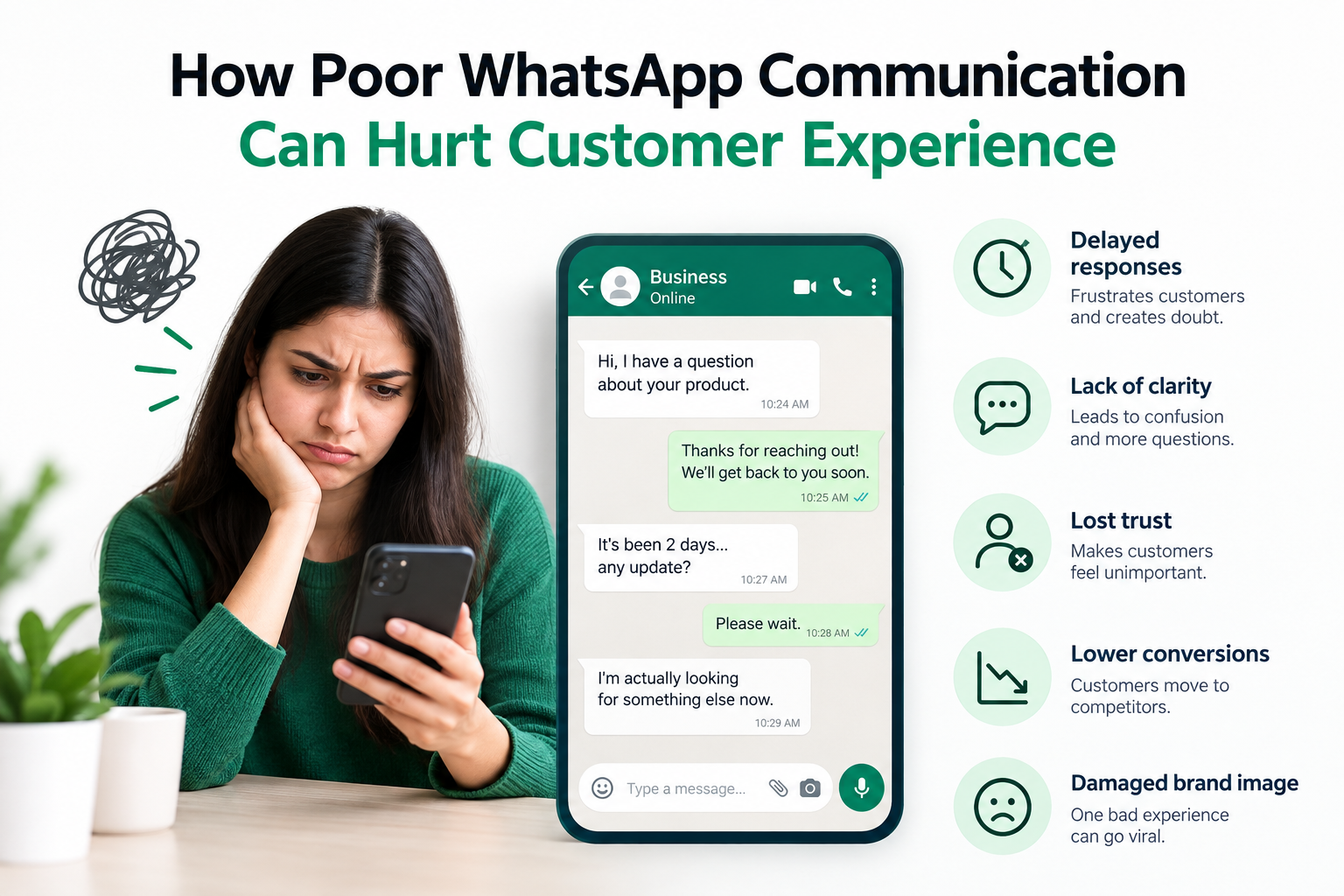
This is one of the most common problems caused by poor WhatsApp communication.
WhatsApp has become an important channel for sales, customer support, lead generation, order updates, appointments, and follow-ups. However, simply having a WhatsApp number does not guarantee a positive customer experience.
Customers expect businesses to communicate quickly, clearly, and consistently. Therefore, a delayed, incomplete, or irrelevant response can create friction at an important stage of the customer journey.
In addition, poor WhatsApp communication can affect more than customer satisfaction. It can also contribute to missed leads, lower engagement, weaker trust, and lost sales.
On the other hand, businesses can use WhatsApp Business API, automation, chatbots, CRM integration, and structured follow-ups to create a more organized communication process.
For Trending Bulb, this topic connects directly with the changing role of digital customer experience. Similarly, Step4Growth can connect customer acquisition with broader digital growth strategies. Meanwhile, Campaign Plus provides WhatsApp automation, chatbot and more to make business growth.
So, how can poor WhatsApp communication affect your business?
Let’s explore the major problems and practical ways to improve them.
What Is Poor WhatsApp Communication?
Poor WhatsApp communication happens when a business fails to provide customers with timely, clear, relevant, and useful information.
The problem does not always involve ignoring a message.
Sometimes, a business responds quickly but still creates a poor experience.
For example, a customer may ask:
“What is the price of this product?”
The business replies:
“Yes, available.”
Although the response is quick, it does not answer the customer’s question.
As a result, the customer has to send another message.
A better response would provide the price and, if relevant, information about availability, delivery, payment, or the next step.
Common examples of poor WhatsApp communication include:
- Delayed replies
- Incomplete answers
- Generic messages
- Excessive promotional messages
- Missed follow-ups
- Poor complaint handling
- Missing order updates
- Repeated questions
- Confusing instructions
- Lack of personalization
- No clear next step
- Unorganized lead management
Individually, these issues may appear small. However, together they can create significant friction throughout the customer journey.
Consequently, a customer who started with strong purchase intent may stop responding before reaching the sales stage.
Why WhatsApp Customer Experience Matters
Customer experience develops through every interaction with a business.
That includes advertisements, websites, social media, emails, phone calls, and WhatsApp conversations.
However, WhatsApp can be especially important because it creates a direct communication channel between a customer and a business.
Consider a simple example.
A customer discovers a product through Instagram. After viewing the product, they click the WhatsApp button and ask about price and availability.
If the business responds quickly with useful information, the conversation can continue.
However, if the reply arrives much later, the customer’s interest may have already declined.
Meanwhile, a competitor may have answered the same question within minutes.
Therefore, WhatsApp communication can influence what happens after a customer shows interest.
The advertisement may generate the inquiry. The WhatsApp experience can then influence the next step.
For this reason, businesses should treat WhatsApp as an important part of the complete customer journey rather than simply another messaging platform.
1. Delayed WhatsApp Replies Can Frustrate Customers
One of the biggest communication problems is a slow response.
Customers often contact businesses because they need information at a particular moment.
For instance, someone may want to:
- Check product availability
- Confirm a price
- Book an appointment
- Ask about delivery
- Resolve a problem
- Request a quotation
- Compare product options
When a response takes too long, that moment of interest can disappear.
Imagine a customer sees a product advertisement at 10 AM. They immediately send a WhatsApp message.
However, the business responds at 6 PM.
During those eight hours, the customer may have contacted other businesses.
Therefore, the company could lose an opportunity even though its advertising successfully generated the inquiry.
A better approach is to use instant acknowledgements.
With WhatsApp automation, businesses can send an immediate response while the relevant sales or support team prepares a detailed reply.
As a result, the customer knows that the message has been received.
2. Unclear Messages Create Customer Confusion
Customers should not have to ask the same question several times.
Unfortunately, unclear WhatsApp communication often creates unnecessary back-and-forth conversations.
Suppose a customer asks:
“How long will delivery take?”
The business responds:
“It depends.”
Naturally, the customer still needs more information.
Instead, the business could explain the expected delivery period and mention any conditions that could affect it.
In this way, one useful message can replace several unnecessary exchanges.
Clear WhatsApp communication should answer the customer’s actual question.
Depending on the business, useful information can include:
- Product name
- Price
- Availability
- Key features
- Delivery time
- Payment options
- Return policy
- Booking process
- Contact details
- Purchase link
Furthermore, structured messages make it easier for customers to understand what they should do next.
3. Generic WhatsApp Messages Can Reduce Engagement
Personalized communication can make customers feel understood.
However, many businesses still send the same response to every person.
For example:
“Hello! Welcome to our business. How can we help you?”
As an initial greeting, this message is perfectly reasonable.
The problem begins when the customer has already explained their requirement and receives the same generic response again.
At that point, the customer may feel that nobody is actually paying attention to the conversation.
Instead, businesses can use customer context.
Suppose someone asks about a particular product. The response can acknowledge that product and provide relevant information.
Similarly, different communication flows can be created for:
- New leads
- Existing customers
- Repeat buyers
- Product inquiries
- Support requests
- Appointment bookings
- Quote requests
- Abandoned conversations
This approach makes communication more relevant.
As a result, customers can move through the conversation with less effort.
4. Missed Follow-Ups Can Result in Lost Leads
Not every customer makes a purchase during the first conversation.
Some people need additional information. Others want to compare products or discuss the purchase with someone else.
Therefore, follow-up plays an important role in lead nurturing.
However, effective follow-up should provide value.
Sending:
“Are you interested?”
again and again may eventually frustrate the customer.
Instead, businesses can create a structured follow-up journey.
First Follow-Up
First, share the information the customer requested.
Second Follow-Up
Next, answer common questions or address possible concerns.
Third Follow-Up
Finally, provide a relevant reminder or clear next step.
This approach keeps the conversation useful rather than repetitive.
For businesses generating leads through Meta Ads, Google Ads, SEO, or social media, this process becomes especially important.
After all, a lead is not the final result.
The business still needs to communicate effectively, qualify the inquiry, nurture the prospect, and guide them toward an appropriate action.
5. Poor WhatsApp Customer Service Can Damage Trust
Customers often remember how a business handles problems.
Imagine someone receives a damaged product and contacts the company through WhatsApp.
Unfortunately, the customer receives delayed replies and unclear instructions.
As a result, frustration increases.
More importantly, that experience may affect the customer’s perception of the brand.
A professional support conversation should clearly explain:
- What information the customer needs to provide.
- What action the business will take.
- What happens next.
- When the customer can expect an update.
Even when a problem cannot be solved immediately, clear communication can reduce uncertainty.
Therefore, businesses should create dedicated WhatsApp workflows for common customer support situations.
At the same time, customers should have a clear path to human assistance when automation cannot solve their problem.
6. Too Many WhatsApp Messages Can Hurt Customer Experience
Fast communication is valuable.
However, sending more messages does not automatically create better customer service.
Some businesses send promotional messages too frequently.
For example, a customer might receive:
- A product promotion
- A discount message
- A reminder
- Another offer
- A product recommendation
- A sales follow-up
Eventually, the customer may mute or ignore the conversation.
Therefore, businesses should focus on relevant communication instead of message volume.
Every message should have a clear purpose.
Before sending a message, businesses should ask:
“Does this message provide value to the customer?”
If the answer is yes, the communication may be useful.
Otherwise, the business should reconsider the message frequency or purpose.
7. Lack of Order Updates Creates Unnecessary Questions
After making a purchase, customers want visibility.
They may wonder:
Has my order been confirmed?
Has it been shipped?
Where is my order?
When will it arrive?
Without timely updates, customers may contact support repeatedly.
Consequently, customer service teams have to spend additional time answering questions that could have been handled automatically.
WhatsApp automation can help businesses send useful notifications throughout the order journey.
For example:
Order Confirmed → Processing → Shipped → Out for Delivery → Delivered
This simple flow provides visibility at important stages.
Furthermore, customers do not need to contact the business for information that can be delivered automatically.
As a result, both the customer and the support team can benefit.
8. Poor WhatsApp Communication Can Reduce Sales
Customer experience and sales are closely connected.
A customer may click an advertisement because they are interested in a product.
However, that interest can disappear when the next step becomes difficult.
Consider this journey:
Meta Ad → WhatsApp Inquiry → Delayed Reply → Customer Loses Interest → Lost Opportunity
Now consider a more organized journey:
Meta Ad → WhatsApp Inquiry → Instant Response → Product Information → Follow-Up → Purchase
The difference is what happens after the initial inquiry.
Therefore, businesses should not measure only clicks, impressions, or lead volume.
They should also examine what happens after a customer starts a WhatsApp conversation.
For example, if an advertising campaign generates many inquiries but very few conversions, businesses should review the complete journey.
That review may include communication quality, lead qualification, follow-up, pricing, offer, audience, and sales processes.
9. Poor WhatsApp Communication Can Affect Brand Perception
A business can invest heavily in building a professional online presence.
It may have:
- A modern website
- Professional social media profiles
- High-quality advertisements
- Attractive creatives
- Helpful content
- Strong branding
However, the customer experience can still feel inconsistent when WhatsApp communication is poorly managed.
For example, a premium brand may look highly professional on Instagram but respond to customers with unclear or careless messages.
That disconnect can weaken the overall experience.
Therefore, businesses should maintain a consistent communication style across:
- Website
- Sales
- Customer support
When communication feels consistent, customers can experience a smoother journey across different channels.
10. Missed WhatsApp Leads Can Increase Marketing Waste
Generating leads requires time and investment.
Businesses may spend money on:
- Meta Ads
- Google Ads
- SEO
- Social media marketing
- Influencer campaigns
- Content marketing
- Email marketing
However, generating a lead is only one part of the process.
If the business receives an inquiry but fails to respond effectively, the marketing investment may not produce the expected result.
For example:
₹5,000 advertising spend → 100 inquiries → poor follow-up → limited conversions
The advertising campaign may not be the only factor affecting performance.
Instead, the post-lead experience should also be reviewed.
Therefore, businesses should examine the entire funnel:
Reach → Engagement → Lead → WhatsApp Conversation → Qualification → Follow-Up → Conversion
This broader view can help identify where potential customers are dropping off.
How WhatsApp Automation Can Improve Customer Experience
WhatsApp automation can help businesses manage repetitive communication more efficiently.
Instead of manually answering every common question, businesses can automate specific parts of the customer journey.
For example, automation can support:
Instant Responses
Customers can receive an immediate acknowledgement after starting a conversation.
Frequently Asked Questions
A chatbot can answer common questions about products, services, pricing, or processes.
Lead Qualification
Businesses can ask basic questions to understand a customer’s requirement.
Product Discovery
Customers can select categories and receive relevant product information.
Appointment Booking
Automated flows can guide customers through the initial booking process.
Order Notifications
Businesses can provide timely order updates.
Follow-Ups
Relevant leads can enter structured follow-up journeys.
Human Handover
Complex questions can be transferred to a human team member.
Campaign Plus can support businesses with WhatsApp automation, chatbot workflows, and business communication solutions.
However, automation should not replace every human interaction.
Instead, businesses should automate repetitive tasks while keeping human support available for situations that require judgment, empathy, or detailed assistance.
WhatsApp Business API and Customer Communication
As a business grows, manually managing WhatsApp conversations can become difficult.
Message volume may increase.
At the same time, multiple employees may need access to customer conversations.
The WhatsApp Business API can help businesses connect WhatsApp with business systems, automation platforms, CRMs, and customer support workflows.
For example, a business can connect WhatsApp communication with its CRM.
When a new lead enters the system, an appropriate communication workflow can begin.
Similarly, customer information can help organize follow-ups and support conversations.
Businesses can connect WhatsApp with systems such as:
- CRM platforms
- Chatbots
- Lead management systems
- E-commerce platforms
- Customer support tools
- Marketing automation systems
Consequently, communication can become more organized as message volume grows.
7 Practical Ways to Improve WhatsApp Customer Experience
Improving WhatsApp communication does not mean sending more messages.
Instead, businesses should make every interaction more useful.
1. Respond Quickly
Use automated acknowledgements for incoming inquiries.
Afterward, make sure the appropriate team member handles conversations that require human support.
2. Give Complete Answers
Answer the customer’s actual question.
Otherwise, customers may have to send multiple messages just to obtain basic information.
3. Personalize Conversations
Use relevant customer context whenever appropriate.
For example, mention the product or service the customer has already asked about.
4. Build Follow-Up Workflows
Create structured follow-up sequences instead of relying entirely on manual reminders.
As a result, fewer leads may be forgotten.
5. Provide Clear Next Steps
Tell customers exactly what they can do next.
For example:
Buy Now
Book an Appointment
Request a Quote
Talk to an Expert
Track My Order
Clear options reduce friction.
6. Use Chatbots for Repetitive Questions
Automate FAQs and simple requests.
Then, route complex issues to human agents.
7. Monitor Performance
Track response times, conversation rates, qualified leads, follow-up responses, conversions, and customer feedback.
Over time, these metrics can reveal communication gaps.
WhatsApp Communication Mistakes Businesses Should Avoid
Several mistakes can make WhatsApp customer experience worse.
Sending the Same Message to Everyone
Different customers have different needs.
Therefore, communication should reflect the customer’s situation.
Ignoring Old Leads
A lead that did not purchase today may still have future potential.
For this reason, structured nurturing can help businesses reconnect appropriately.
Sending Only Promotional Messages
Customers also need support, information, updates, and useful content.
Providing Incomplete Answers
A short response is not necessarily an effective response.
Instead, businesses should provide enough information to help the customer take the next step.
Asking Customers to Repeat Information
When conversation history is available, teams should use it.
This saves time and creates a smoother customer experience.
Not Providing Human Handover
Automation is useful, but some situations require human assistance.
Therefore, customers should have a clear path to a support representative.
Forgetting the Post-Purchase Experience
Communication should not stop after payment.
Order updates, support, feedback requests, and useful information can continue the relationship.
A Simple WhatsApp Customer Journey Example
Consider an online fashion business running a Meta Ads campaign.
First, a potential customer sees an advertisement for a new collection.
Next, they click the WhatsApp button.
Step 1: Instant Greeting
The customer receives an automated welcome message.
Step 2: Product Selection
The customer chooses the product category they are interested in.
Step 3: Product Information
The system provides relevant product details.
Step 4: Customer Questions
The customer asks about size and delivery.
Step 5: Automated Assistance
The chatbot provides basic information.
Step 6: Human Support
If necessary, the conversation moves to a sales representative.
Step 7: Follow-Up
If the customer does not purchase immediately, an appropriate follow-up can be scheduled.
Step 8: Post-Purchase Communication
After the purchase, the customer receives order confirmation and delivery updates.
This journey creates several opportunities to reduce friction.
More importantly, the customer receives relevant information at different stages.
How TrendingBulb Can Use WhatsApp Customer Experience Insights
For Trending Bulb, WhatsApp communication is more than a technology topic.
It is part of a larger digital customer experience discussion.
Businesses often focus heavily on getting attention.
They create advertisements, publish social media posts, optimize websites, and generate leads.
However, the customer journey continues after that first interaction.
For example, a customer who clicks an advertisement may move to WhatsApp.
Similarly, a website visitor may request a quotation.
A social media follower may ask a product question.
Therefore, businesses should also consider what happens after each interaction.
This creates a simple digital marketing principle:
Attract attention → Start conversations → Provide value → Build trust → Make the next step easy.
As a result, customer experience becomes an important part of digital growth.
How Step4Growth Connects Marketing With Customer Communication
Digital marketing works best when its different stages connect with one another.
Advertising can generate awareness.
Content can create interest.
SEO can help customers discover a business.
Social media can build engagement.
WhatsApp can continue the conversation.
CRM systems can organize customer information.
Follow-ups can nurture potential customers.
Sales teams can complete the conversion.
Together, these stages can create a connected funnel:
Awareness → Engagement → Lead → WhatsApp → Nurturing → Conversion → Retention
For businesses working with Step4Growth, this broader approach can connect customer acquisition activities with communication and growth objectives.
Furthermore, businesses can identify where customers experience friction.
If people are not clicking, review the marketing message.
If people click but do not inquire, review the offer and landing experience.
If people inquire but do not convert, review communication, qualification, follow-up, pricing, and the overall sales process.
Therefore, looking at the complete funnel can provide more useful insights than focusing on a single metric.
How Campaign Plus Can Support WhatsApp Automation
As WhatsApp inquiries increase, manual communication can become difficult to manage.
Campaign Plus focuses on WhatsApp automation, chatbots, and business communication workflows.
For example, a business can create a journey such as:
Customer Message → Automated Greeting → Requirement Selection → Information → Lead Capture → Sales Follow-Up
Such workflows can reduce repetitive manual work.
In addition, they can help teams organize customer conversations more effectively.
However, automation should always be designed around customer needs.
A good workflow should make the customer journey easier.
It should not force customers through unnecessary menus or repeated questions.
Therefore, businesses should keep automated flows simple, provide useful options, and offer human assistance when required.
How to Measure WhatsApp Customer Experience
Businesses need measurable indicators to understand whether their WhatsApp communication is working.
Some useful metrics include:
Response Time
How quickly does the business respond to incoming messages?
Conversation Rate
How many customers continue the conversation after the first interaction?
Lead Qualification Rate
How many inquiries become qualified leads?
Follow-Up Response Rate
How many customers respond to follow-up communication?
Conversion Rate
How many qualified conversations lead to the desired business action?
Customer Support Resolution
How efficiently are customer issues resolved?
Customer Feedback
What do customers say about their WhatsApp experience?
By tracking these metrics, businesses can identify communication gaps.
Moreover, they can compare performance across different campaigns, products, audiences, and customer journeys.
The Future of WhatsApp Customer Experience
Business communication is becoming increasingly automated.
AI, chatbots, CRM systems, analytics, and WhatsApp automation are changing how businesses communicate with customers.
Nevertheless, technology alone does not create a great customer experience.
The strategy behind the technology matters just as much.
Businesses still need to understand:
- Who is the customer?
- What does the customer need?
- What information should be provided?
- When should the business respond?
- When should the business follow up?
- When should automation stop?
- When should a human take over?
By answering these questions, businesses can create communication journeys that are both efficient and customer-focused.
The future is not simply about sending automated messages.
Instead, it is about delivering the right information at the right stage of the customer journey.
Conclusion
Poor WhatsApp communication can affect far more than a single conversation.
A delayed response can reduce interest.
An unclear answer can create confusion.
A generic message can reduce engagement.
A missed follow-up can affect a potential sale.
Likewise, poor support can influence how customers perceive a brand.
Therefore, businesses should treat WhatsApp as an important part of the customer experience.
The solution is not to send more messages.
Instead, businesses should focus on speed, clarity, relevance, personalization, useful follow-ups, automation, and human support.
WhatsApp Business API, chatbots, CRM integration, and automation can help businesses organize communication as they grow.
At the same time, a strong digital marketing strategy can connect advertising, content, SEO, social media, WhatsApp, sales, and retention into one customer journey.
For Trending Bulb, this creates an important digital marketing insight: attracting a customer is only the beginning.
For Step4Growth, connecting acquisition with customer communication can help businesses build a more complete digital growth journey.
For Campaign Plus, WhatsApp automation and chatbot workflows can help businesses manage repetitive communication and create more organized customer interactions.
Ultimately, effective WhatsApp communication comes down to one simple principle:
Make it easy for customers to get the information, support, and next step they need.
When businesses communicate clearly and consistently, they can create a smoother customer journey and build stronger relationships over time.