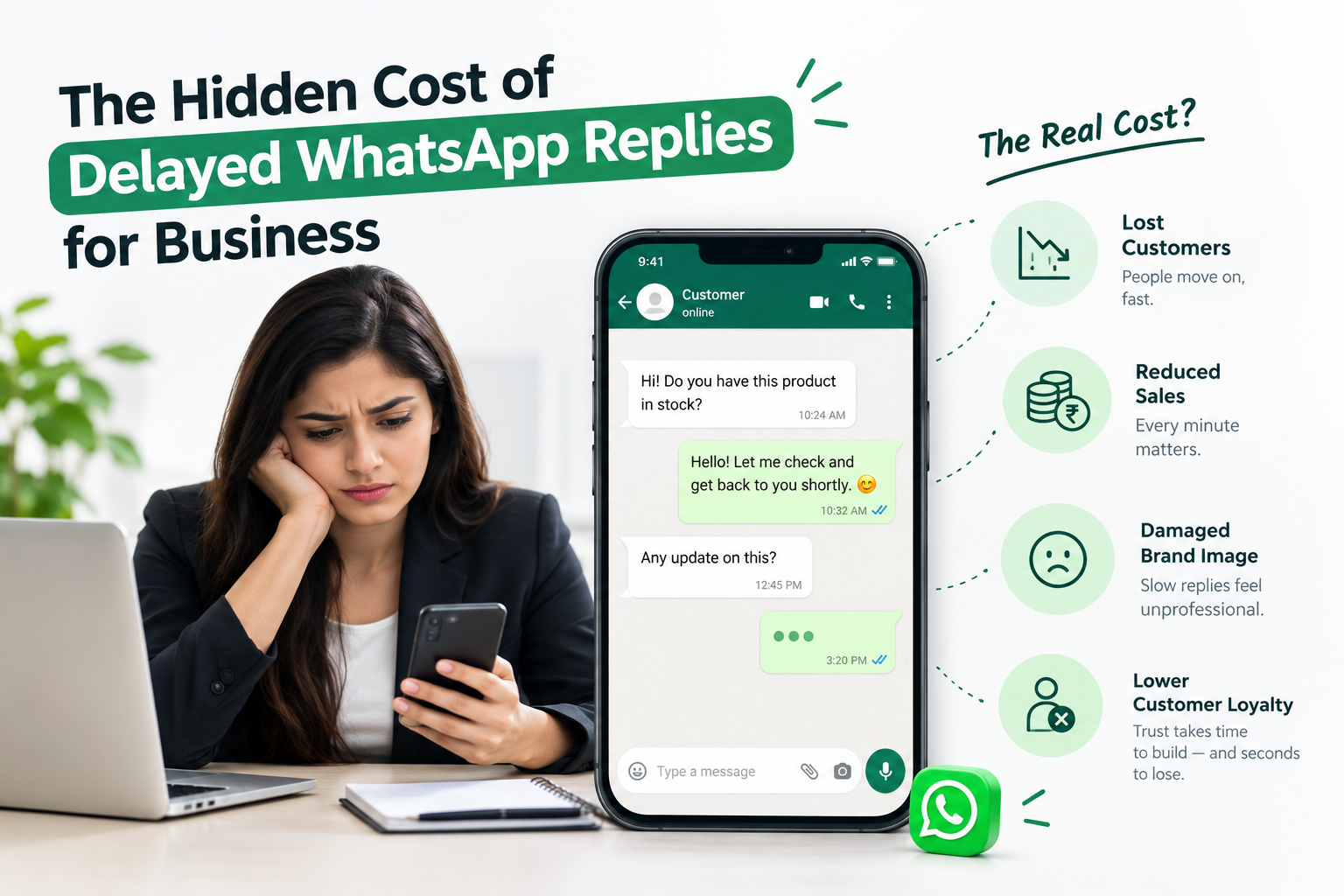
In today’s digital-first market, customers expect businesses to respond quickly. In fact, when someone sends a WhatsApp message, they often expect an answer while they are still interested, ready to buy, or looking for information.
However, many businesses still treat WhatsApp replies as a task that can wait.
A customer sends a product enquiry in the morning. The business responds several hours later. By then, the customer may have already contacted another company, compared different products, or simply lost interest.
That delay may look harmless. However, it can quietly affect sales, customer experience, lead conversion, and brand reputation.
This is the hidden cost of delayed WhatsApp replies for business.
For businesses using WhatsApp as a communication and sales channel, speed is no longer just a customer-service advantage. Instead, it can become an important part of the overall customer journey.
With tools such as WhatsApp Business API, chatbots, automated replies, and smart follow-ups, businesses can respond faster while still keeping conversations useful and relevant.
At Trending Bulb, we focus on digital trends and communication strategies that help brands stay connected with modern customers. Similarly, Step4Growth helps businesses understand how digital marketing and automation can support growth. Meanwhile, Campaign Plus provides WhatsApp automation, chatbot and more to make business growth easier.
Let’s explore why delayed WhatsApp replies can cost businesses more than they realize and how automation can help solve the problem.
Why WhatsApp Response Time Matters for Business
WhatsApp has become an important communication channel for many businesses.
Customers use it to ask about prices, products, availability, appointments, services, delivery updates, offers, and more.
Unlike a traditional email enquiry, a WhatsApp conversation often feels immediate.
Therefore, customers naturally expect businesses to respond within a reasonable time.
Imagine a customer searching for a new product.
They find your Instagram page and click the WhatsApp button. Next, they send a simple message asking about the price.
If your business replies quickly, the conversation can continue naturally.
The customer may ask another question. Your sales team can provide product information. Then, the conversation can move toward a purchase.
However, if the reply arrives hours later, the situation can change completely.
The customer may have already purchased from another business.
As a result, one delayed response can become a lost sales opportunity.
The Hidden Cost Is Bigger Than a Missed Message
Delayed replies do not simply create unanswered chats.
Instead, they can create a chain reaction.
A slow response can affect:
- Lead conversion
- Customer satisfaction
- Sales opportunities
- Repeat purchases
- Brand perception
- Sales-team productivity
- Follow-up efficiency
- Customer trust
Moreover, these losses may not appear clearly in a monthly report.
For example, a business might see 500 WhatsApp enquiries in a month. However, if many customers receive responses several hours later, the business may never know how many potential buyers moved to competitors.
That is why delayed responses can become a hidden business cost.
1. Delayed Replies Can Lead to Lost Customers
Customers have more choices than ever.
Consequently, they do not always wait for one company to respond.
Suppose someone wants to purchase a service and contacts three businesses on WhatsApp.
Business A responds within minutes.
Business B responds after two hours.
Business C responds the next day.
Even if Business C offers a competitive price, the customer may already have made a decision.
Therefore, response time can influence whether a conversation gets a second message or ends after the first one.
For businesses, this means every unanswered or delayed enquiry deserves attention.
2. Slow Responses Can Reduce Lead Conversion
Generating leads is only the first step.
The real challenge is converting those leads into customers.
Businesses often spend money on Meta Ads, Google Ads, Instagram promotions, influencer campaigns, and other marketing activities to generate enquiries.
However, the marketing investment can lose value if leads do not receive timely responses.
For example, imagine a jewellery brand running a festival campaign.
A potential customer clicks the advertisement and starts a WhatsApp conversation.
They ask:
“Is this pendant available?”
If the business responds quickly, the customer can immediately continue the conversation.
However, if the response comes much later, the buying intent may have disappeared.
Therefore, marketing and communication should work together.
At Step4Growth, digital growth should not stop at lead generation. Businesses also need a process for handling those leads effectively.
That is where WhatsApp automation can support the customer journey.
3. Customers May See Slow Replies as Poor Service
Customers do not always understand what happens behind the scenes.
They may not know that your sales executive is handling 50 conversations.
They may not know that your team is busy with meetings.
They may not know that someone forgot to check the WhatsApp inbox.
From the customer’s perspective, there is only one thing they see:
No response.
As a result, customers may feel ignored.
Furthermore, if they receive fast responses from competitors, your business can appear less responsive by comparison.
This does not necessarily mean that your product or service is poor.
Nevertheless, the communication experience can influence how customers perceive the business.
4. Delayed Replies Can Damage Customer Trust
Trust develops through repeated positive interactions.
Therefore, every customer conversation contributes to the overall relationship.
A business that responds quickly can show that customer enquiries matter.
On the other hand, repeated delays can create frustration.
For instance, a customer may ask for a quotation.
After waiting several hours, they may send another message.
If there is still no response, they may stop following up.
Eventually, the customer could move to another provider.
The lost opportunity may never be recorded as a lost sale because the customer simply disappears.
That makes delayed replies particularly difficult to measure.
5. Your Sales Team Can Lose Valuable Time
Manual WhatsApp management can become difficult as message volume increases.
Sales teams may have to answer the same basic questions repeatedly.
For example:
- What is the price?
- Is the product available?
- What are the business hours?
- Where are you located?
- How can I place an order?
- Do you provide home delivery?
- Can I book an appointment?
- When will someone call me?
These questions may seem simple.
However, answering them manually throughout the day consumes valuable employee time.
Moreover, repetitive conversations can make it harder for sales teams to focus on high-value leads.
Automation can help handle routine questions while allowing human employees to focus on conversations that require personal attention.
6. Missed Follow-Ups Can Cost Even More
Not every customer purchases immediately.
Some people need more information.
Others need time to compare products.
Similarly, B2B customers may need internal approval before making a purchase.
Therefore, follow-up plays an important role.
Imagine a customer asks for a quotation.
Your team sends the quotation.
Then, nothing happens.
Without a proper follow-up process, the lead may remain inactive.
A smart WhatsApp automation system can help businesses send timely follow-up messages based on the customer journey.
For example:
Day 1: Thank the customer for the enquiry.
Day 2: Ask whether they need additional information.
Day 4: Share a relevant product benefit.
Day 7: Ask whether they would like assistance completing the purchase.
This approach keeps the conversation active without requiring employees to remember every follow-up manually.
7. Delayed Responses Can Increase Customer Drop-Off
Customers often contact businesses at different times.
Some enquiries arrive during working hours.
Others come during evenings, weekends, holidays, or after advertisements run.
However, a business may not have employees available at every moment.
That creates a communication gap.
For example, an advertisement may generate several enquiries at 10 PM.
If the sales team starts work at 10 AM the next morning, those leads have already been waiting for hours.
Therefore, businesses need a way to acknowledge enquiries even when employees are unavailable.
A chatbot or automated WhatsApp response can provide an immediate first interaction.
It can collect basic information, answer frequently asked questions, share relevant details, or inform the customer that a team member will respond soon.
As a result, the customer does not feel completely ignored.
8. WhatsApp Automation Can Reduce Response Delays
WhatsApp automation can help businesses create faster and more organized communication.
With the right setup, businesses can automate several parts of the customer journey.
For example, automation can support:
- Instant enquiry acknowledgements
- Frequently asked questions
- Lead qualification
- Product information
- Appointment booking
- Order updates
- Payment reminders
- Follow-ups
- Customer feedback
- Support requests
However, automation should not mean sending random messages.
Instead, businesses should build meaningful workflows around customer intent.
For example, someone asking about a product should receive product-related information.
Similarly, someone asking for an appointment should be guided toward appointment booking.
This makes automation more useful and customer-friendly.
WhatsApp Business API: Moving Beyond Basic Messaging
For growing businesses, WhatsApp Business API can provide more advanced communication possibilities.
It can connect WhatsApp communication with business processes, CRM systems, chatbots, automation workflows, and other tools.
As a result, businesses can create more structured customer journeys.
For example, a customer may come from a Meta advertisement.
They click the WhatsApp button.
Next, an automated message welcomes them.
The system can then ask what they are interested in.
Based on the response, the customer can be directed to the relevant product, service, sales representative, or information.
This reduces unnecessary manual work.
Moreover, it helps businesses respond consistently.
Campaign Plus focuses on WhatsApp automation, chatbot solutions, and business communication workflows that can help brands manage conversations more efficiently.
From Instant Replies to Smart Conversations
Fast replies are important.
However, speed alone is not enough.
A business can respond within seconds and still provide a poor customer experience if the message is irrelevant.
Therefore, businesses should focus on smart responses, not just quick responses.
For example, instead of sending:
“Thanks for contacting us. Someone will contact you.”
A more useful automated conversation could ask:
“Hi! What are you looking for today?”
The customer can then select:
1. Product Information
2. Pricing
3. Order Status
4. Talk to Sales
This simple structure can make the conversation more useful.
Additionally, it can help businesses understand customer intent before a sales representative joins the conversation.
How Different Businesses Can Use WhatsApp Automation
WhatsApp automation is not limited to one industry.
Different businesses can use it according to their customer journey.
E-commerce Businesses
Online stores can use WhatsApp for order confirmations, product enquiries, abandoned-cart follow-ups, shipping updates, and customer support.
Consequently, customers receive important information without waiting for manual responses.
Jewellery Businesses
Jewellery brands can use WhatsApp to answer product enquiries, share catalogues, provide pricing information, and follow up with customers interested in specific products.
During festivals and gifting seasons, quick responses can become particularly useful because customers often compare multiple options.
Healthcare Businesses
Clinics can use WhatsApp automation for appointment requests, reminders, basic information, and follow-ups.
However, sensitive or clinical decisions should still be handled through appropriate professional channels.
Education and Coaching
Coaching institutes can automate course enquiries, admission information, counselling requests, fee-related information, and follow-ups.
Therefore, prospects can receive information even outside normal office hours.
Real Estate
Real estate businesses receive many enquiries that require follow-up.
WhatsApp automation can help collect requirements such as location, budget, property type, and preferred timeline.
Then, sales teams can prioritize conversations based on the information provided.
B2B Businesses
B2B sales cycles can take longer.
Therefore, follow-ups become particularly important.
Businesses can use WhatsApp to share quotations, product information, meeting reminders, updates, and follow-up messages.
This can help sales teams maintain communication throughout longer buying journeys.
The Role of Chatbots in Reducing Response Time
A chatbot can act as the first point of contact.
Instead of making every customer wait for a human representative, the chatbot can handle common requests.
For example:
Customer: “I want to know the price.”
Chatbot: “Sure. Which product are you interested in?”
The customer selects a product.
The chatbot can then provide relevant information or connect the customer with a sales representative.
Therefore, employees can spend less time answering repetitive questions.
At the same time, customers can move through the first stage of the conversation without unnecessary waiting.
Automation Does Not Replace Human Conversations
One common concern is that automation can make communication feel robotic.
That can happen when businesses create poor workflows.
However, automation and human communication do not have to compete.
Instead, they can work together.
Automation can handle repetitive tasks.
Human employees can handle complex questions, negotiations, complaints, personalized recommendations, and important sales conversations.
This creates a hybrid communication model.
The customer gets speed when they need it and human assistance when it matters.
How to Build a Faster WhatsApp Customer Journey
Businesses can start by mapping the customer journey.
First, identify where customers usually contact you.
Then, identify the questions they ask most frequently.
Next, divide conversations into different categories.
For example:
New Lead → Qualification → Product Information → Sales Conversation → Follow-Up → Conversion
After that, identify which steps can be automated.
For instance, the initial greeting and lead qualification may be automated.
However, the final negotiation could be handled by a sales representative.
This approach keeps automation practical.
Measure Response Time, Not Just Lead Volume
Many businesses measure how many leads they generate.
However, lead volume alone does not tell the complete story.
Businesses should also monitor communication metrics such as:
- First response time
- Number of unanswered enquiries
- Follow-up completion rate
- Qualified leads
- Conversion rate
- Customer response rate
- Sales generated from WhatsApp
- Frequently asked questions
- Drop-off points
These metrics can help identify where potential customers are leaving the journey.
For example, if a business receives many enquiries but very few qualified conversations, the problem may not be advertising alone.
Instead, the business may need to improve its response and follow-up process.
Turning WhatsApp Into a Business Growth Channel
WhatsApp should not be viewed only as a customer-support application.
With the right strategy, it can become part of the complete customer journey.
A potential customer can discover your business through an advertisement.
Then, they can start a WhatsApp conversation.
Next, automation can qualify the enquiry.
After that, a sales representative can continue the conversation.
Finally, the business can use WhatsApp for follow-ups, updates, support, and retention.
This creates a connected communication system.
At Trending Bulb, the focus is on understanding emerging digital trends and turning them into practical content and marketing ideas.
Similarly, Step4Growth focuses on digital growth strategies that connect marketing activity with business objectives.
Meanwhile, Campaign Plus brings WhatsApp automation, chatbots, and business communication workflows into this customer journey.
Together, these approaches highlight an important point:
Generating a lead is not enough. Businesses also need to respond, engage, nurture, and follow up.
5 Practical Ways to Reduce WhatsApp Response Delays
Businesses can begin improving their response process with a few simple steps.
1. Create Instant Welcome Messages
Start every new conversation with a clear acknowledgement.
This immediately tells the customer that their message has been received.
2. Build FAQ Automation
Identify the questions customers ask repeatedly.
Then, create automated responses for those questions.
3. Use Lead Qualification
Ask simple questions to understand customer requirements.
This helps sales teams prioritize relevant leads.
4. Create Follow-Up Workflows
Do not depend entirely on employees remembering every follow-up.
Instead, create automated reminders and customer journeys.
5. Connect WhatsApp With Your Sales Process
Where appropriate, connect WhatsApp conversations with CRM and sales workflows.
As a result, your team can maintain better visibility over leads and conversations.
The Real Cost of Waiting
Delayed WhatsApp replies may not appear as a direct expense on your balance sheet.
However, the cost can show up in other ways.
A potential customer may never respond again.
A sales opportunity may disappear.
A marketing lead may become wasted ad spend.
A customer may choose another business.
A sales employee may spend hours answering repetitive questions.
Over time, these small inefficiencies can become significant.
That is why businesses should look beyond the number of WhatsApp messages they receive.
The more important question is:
How quickly and effectively are those conversations being handled?
Final Thoughts
Customers live in a fast-moving digital environment.
Therefore, businesses must adapt to faster communication expectations.
A delayed WhatsApp reply may seem like a small operational issue. However, repeated delays can affect lead conversion, customer experience, sales opportunities, and long-term relationships.
The solution is not simply to tell employees to reply faster.
Instead, businesses can create a structured communication system using WhatsApp Business API, chatbots, automation, lead qualification, and smart follow-ups.
When automation handles repetitive tasks, teams can focus on conversations that require human attention.
As a result, businesses can create a faster and more organized customer journey.
For brands exploring WhatsApp automation, Campaign Plus can help businesses build communication workflows around WhatsApp API, chatbots, and automation.
Likewise, Step4Growth can help connect digital marketing efforts with broader growth strategies, while Trending Bulb continues to explore digital trends and practical business communication ideas.
Ultimately, the hidden cost of delayed WhatsApp replies is not just the time customers spend waiting.
It is the business opportunity that may disappear while they wait.
Conclusion
WhatsApp has moved beyond being a simple messaging platform.
For modern businesses, it can become an important channel for lead generation, customer support, sales, follow-ups, and retention.
However, the value of WhatsApp depends heavily on how businesses manage conversations.
A customer who receives a useful response at the right time can continue the buying journey.
On the other hand, a customer who waits too long may simply move on.
That is the hidden cost of delayed WhatsApp replies.
Respond faster. Automate smarter. Follow up consistently. Turn conversations into opportunities.