Introduction
Running a small business is not just about selling products or providing services. It is also about building customer relationships, responding to enquiries, and delivering a smooth communication experience.
However, managing customer conversations manually can become difficult as a business grows. Customers expect quick replies, personalised assistance, and regular updates. Therefore, businesses need smarter ways to manage everyday communication.
Today, WhatsApp has become an important communication channel for businesses. Since customers already use it regularly, companies can use this familiar platform to connect with their audiences more conveniently.
This is where the WhatsApp API for Small Business makes a difference.
The WhatsApp Business Platform, commonly known as WhatsApp API, allows businesses to automate conversations, connect CRM systems, manage multiple agents, and create structured messaging workflows.
Moreover, small businesses can reduce repetitive communication tasks while improving customer engagement. As a result, employees can spend more time on important business activities instead of answering the same questions repeatedly.
Whether you own a retail store, real estate agency, educational institute, restaurant, or online business, WhatsApp API can help simplify customer interactions.
In this comprehensive guide, Trending Bulb explains how WhatsApp API improves small business communication, its important features, practical benefits, and how Campaign Plus and Step4Growth can contribute to a connected digital growth strategy.
What Is WhatsApp API for Small Business?
WhatsApp API is a business communication solution that allows companies to connect WhatsApp with compatible software, chatbots, CRM systems, and automation platforms.
Unlike the regular WhatsApp Business App, the WhatsApp Business Platform supports more advanced communication and integration capabilities.
For example, businesses can manage conversations through a shared dashboard, automate frequently asked questions, send approved notification templates, and connect customer information with other business tools.
Additionally, multiple team members can manage customer conversations through compatible platforms. Consequently, businesses can coordinate their communication activities more effectively.
Here are some important WhatsApp API capabilities:
- Automated Replies: Respond to common customer enquiries automatically.
- Chatbot Integration: Guide customers through predefined conversation flows.
- Multi-Agent Support: Allow multiple employees to manage conversations.
- CRM Integration: Connect customer information with business systems.
- Message Templates: Send approved business-initiated messages.
- Customer Notifications: Share order updates, appointment reminders, and important information.
- Performance Insights: Review available messaging and engagement metrics.
Furthermore, these features help businesses create an organised communication system without depending entirely on manual messaging.
10 Ways WhatsApp API for Small Business Boosts Communication
1. Provides Faster Customer Responses
Customers value businesses that respond quickly. However, small business owners often handle multiple responsibilities, including sales, marketing, customer support, and daily operations.
Consequently, responding to every enquiry immediately becomes challenging.
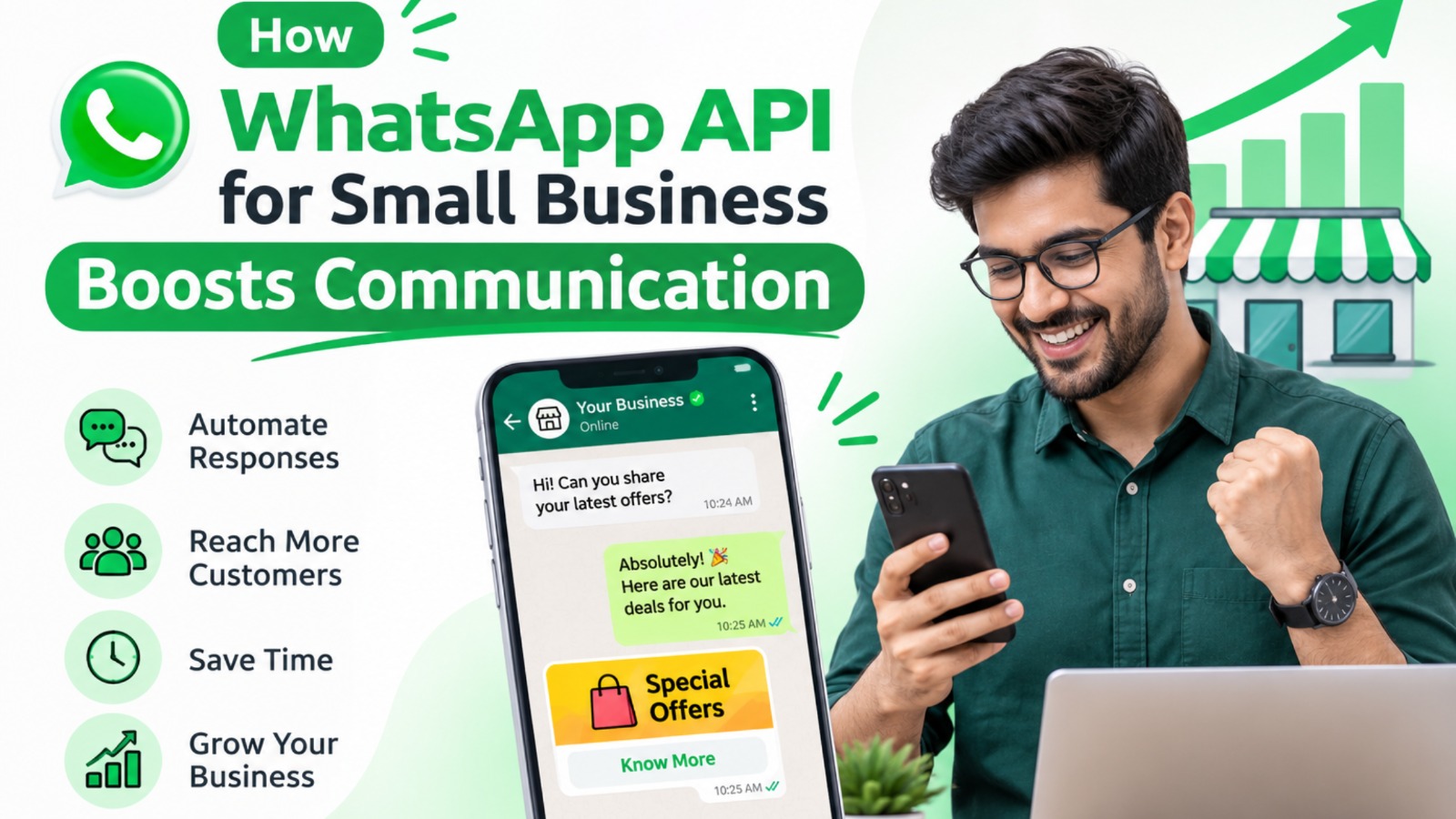
WhatsApp API helps businesses improve response times through automated welcome messages and chatbot workflows.
For example, when a customer sends an enquiry, an automated message can acknowledge the conversation:
“Hello! Welcome to our business. Thank you for contacting us. How can we help you today?”
Additionally, businesses can configure automated responses for frequently asked questions about pricing, products, services, and availability.
Therefore, customers receive an initial response even when the support team is busy. Meanwhile, employees can focus on more complicated enquiries that require personal attention.
Key benefit: Faster communication, improved customer experience, and fewer unanswered enquiries.
2. Automates Repetitive Customer Communication
Small businesses frequently receive similar questions from different customers. For instance, customers may ask about product prices, business locations, working hours, delivery options, or payment methods.
Answering these questions individually takes valuable time. However, WhatsApp automation allows businesses to create predefined responses and chatbot workflows.
For example, a clothing store can create an automated menu with options such as:
- Explore New Arrivals
- Check Product Prices
- View Available Offers
- Contact the Sales Team
Furthermore, customers can select the information they need without waiting for an employee.
As a result, businesses can reduce repetitive work and focus more on important customer interactions. In addition, automated responses help maintain consistent communication across different customer conversations.
Key benefit: Less manual work, faster assistance, and improved operational efficiency.
3. Manages Multiple Customer Conversations
As a business grows, customer enquiries increase as well. Unfortunately, managing all these conversations through one mobile phone can quickly become confusing.
Messages may get missed. Similarly, employees may respond to the same customer twice. In addition, important enquiries may remain unanswered.
Fortunately, WhatsApp API platforms can provide shared inbox and multi-agent management features.
With a suitable communication dashboard, businesses can assign conversations to different employees according to their responsibilities.
For example:
- Sales representatives manage product enquiries.
- Support agents handle customer complaints.
- Marketing teams manage campaign-related conversations.
- Managers monitor important customer interactions.
Moreover, conversation assignment improves coordination between departments. Consequently, employees can understand their responsibilities and manage customer requests more efficiently.
Key benefit: Better teamwork, organised conversations, and improved customer support.
4. Improves Lead Generation and Follow-Ups
Generating leads is important. However, converting potential customers into paying customers requires consistent communication.
Imagine someone visiting your website and enquiring about your services. If your business does not respond promptly, that person may contact another company instead.
WhatsApp API can help businesses create structured lead management workflows.
First, an automated message acknowledges the enquiry. Next, a chatbot can collect basic customer requirements. Afterward, the system can route the conversation to the appropriate sales representative.
Additionally, businesses can organise follow-ups for interested prospects who have not completed a purchase.
For example, a real estate company can collect information about a customer’s preferred location, property type, and budget before assigning the enquiry to an agent.
As a result, sales representatives can understand customer requirements before starting a detailed conversation.
However, businesses should always respect customer consent and applicable WhatsApp messaging policies.
Key benefit: Better lead management, organised follow-ups, and improved sales opportunities.
5. Sends Important Business Updates
Customers want to stay informed after purchasing a product or requesting a service.
For example, an online store may need to share order confirmations, shipping updates, and delivery notifications. Similarly, a service provider may need to send appointment confirmations and reminders.
WhatsApp API allows businesses to communicate these updates through suitable approved messaging workflows.
Furthermore, customers can receive important information directly through a communication channel they already use regularly.
As a result, businesses can reduce repetitive manual calls and provide a more convenient customer experience. Meanwhile, customers can stay informed without repeatedly contacting the business for updates.
Key benefit: Timely notifications, better transparency, and stronger customer trust.
6. Creates Personalised Customer Experiences
Every customer has different requirements. Therefore, sending identical messages to everyone may not deliver the best experience.
WhatsApp API can support personalised communication when connected with customer information and compatible automation systems.
For example, an educational institute can share course information according to a student’s interests. Similarly, a retail business can provide product recommendations based on a customer’s previous enquiries.
Moreover, businesses can organise customers into relevant categories to make conversations more useful.
This approach allows companies to understand their audiences better. Consequently, customers receive information that matches their requirements instead of irrelevant promotional messages.
Key benefit: More relevant interactions, improved engagement, and stronger customer relationships.
7. Connects WhatsApp with CRM and Business Tools
Managing customer information across multiple applications can create unnecessary work.
For instance, an employee may need to switch between WhatsApp, spreadsheets, emails, and CRM software to understand a customer’s previous interactions.
However, WhatsApp API supports integration with compatible CRM systems and business applications.
Depending on the selected platform, businesses can:
- Store customer enquiry details.
- Track lead status.
- Assign enquiries to sales representatives.
- Maintain customer interaction records.
- Organise customer information.
- Improve follow-up processes.
Additionally, CRM integration helps managers understand how enquiries move through the sales pipeline.
As a result, businesses can avoid scattered information and create a more connected communication system. Furthermore, employees can access relevant customer details more efficiently.
Key benefit: Improved customer data management and better team coordination.
8. Makes Promotional Communication More Effective
Customers often want to explore products, services, and special offers before making a purchase.
WhatsApp Business Platform supports rich messaging experiences, including images, documents, interactive messages, and product-related communication.
For example, a jewellery store can share collection images, while a restaurant can provide menu information. Similarly, an online business can communicate relevant offers through approved marketing templates to customers who have opted in.
However, promotional communication should always provide value. Sending excessive or irrelevant messages can negatively affect customer relationships and message quality.
Therefore, businesses should focus on relevant campaigns instead of unnecessary promotions.
In addition, analysing campaign performance can help companies understand which messages generate meaningful customer engagement.
Key benefit: Better product discovery, convenient communication, and meaningful customer engagement.
9. Supports Communication Outside Business Hours
Customer enquiries do not always arrive during working hours.
For example, someone may visit your website at night, discover your Instagram page during the weekend, or enquire about a service when your team is unavailable.
Without automation, these enquiries may remain unanswered until the next working day.
Fortunately, WhatsApp API helps businesses configure automated workflows that acknowledge enquiries outside business hours.
For example:
“Thank you for contacting us! Our team is currently unavailable. Please share your requirements, and we will get back to you during business hours.”
Additionally, chatbots can collect basic enquiry information and guide customers through predefined options.
Although automation cannot replace every human interaction, it helps businesses maintain communication continuity. As a result, customers can receive an acknowledgement even when representatives are unavailable.
Key benefit: Better enquiry handling and fewer missed opportunities.
10. Helps Track Communication Performance
Successful communication requires continuous improvement. Therefore, businesses need to understand whether their messages reach customers, which campaigns generate responses, and where potential customers lose interest.
WhatsApp Business Platform provides messaging insights. Moreover, compatible third-party platforms can offer additional analytics and reporting features.
Businesses can evaluate:
- Message delivery performance.
- Available read and engagement metrics.
- Customer response patterns.
- Lead management performance.
- Campaign effectiveness.
- Follow-up efficiency.
For example, if a campaign generates enquiries but very few customers proceed towards a purchase, the business can review its message quality, targeting, and sales follow-up process.
Furthermore, regular performance reviews help companies identify communication gaps.
Key benefit: Better insights, improved strategies, and more organised customer engagement.
Which Small Businesses Should Use WhatsApp API?
WhatsApp API can support communication across several industries. Since customers already use WhatsApp regularly, businesses can use it to simplify their customer journeys.
Here are some practical examples.
Retail and E-Commerce
Retail businesses can answer product enquiries, share product information, send order updates, and communicate relevant offers.
Additionally, automated responses help customers find information more conveniently. As a result, employees can spend more time handling complex customer requests.
Real Estate Companies
Real estate agencies receive enquiries from different marketing channels.
With WhatsApp API, they can acknowledge property enquiries, collect budget requirements, share property information, and assign leads to sales representatives.
Consequently, agents can spend more time engaging with relevant prospects. Moreover, automated workflows can help organise property enquiries according to customer preferences.
Educational Institutes
Schools, colleges, and coaching centres can share admission details, course information, class schedules, and important announcements.
Furthermore, automated workflows can answer frequently asked student questions. Therefore, administrative teams can reduce repetitive communication tasks.
Healthcare and Clinics
Clinics can use WhatsApp communication for appointment enquiries, booking confirmations, reminders, and administrative updates.
However, healthcare businesses must protect patient information and follow applicable privacy requirements.
Restaurants and Food Businesses
Restaurants can share menus, answer customer questions, provide booking information, and send order-related updates.
As a result, customers can communicate with the business more easily. Additionally, automated responses can provide basic information about opening hours and available services.
Travel and Hospitality
Travel agencies and hotels can share travel packages, booking information, itinerary updates, and customer assistance.
Moreover, automated conversations can collect travel preferences before a representative takes over.
WhatsApp Business App vs WhatsApp API: Which Is Better?
Many business owners wonder whether they should continue using the WhatsApp Business App or move to WhatsApp API.
Both solutions serve different business requirements.
| Feature | WhatsApp Business App | WhatsApp API |
|---|---|---|
| Basic business messaging | Yes | Yes, through a platform |
| Automated communication | Basic tools | Advanced automation |
| Chatbot integration | Limited | Supported through integrations |
| Multi-agent management | Limited | Supported through platforms |
| CRM integration | Limited | Supported |
| Advanced workflows | Limited | Supported |
| Business scalability | Suitable for simpler operations | Suitable for growing communication needs |
The WhatsApp Business App works well for businesses with straightforward communication requirements.
On the other hand, WhatsApp API is more suitable when a company needs advanced automation, CRM integrations, shared inboxes, and structured team communication.
Therefore, businesses should select a solution according to their requirements, budget, and expected communication volume.
How to Get Started with WhatsApp API for Small Business
Getting started becomes easier when businesses follow a structured process.
Step 1: Identify Your Communication Requirements
First, understand how your business communicates with customers.
Identify common enquiries, customer support requirements, lead generation activities, and follow-up processes.
Consequently, you can select the features that actually benefit your operations.
Step 2: Choose the Right WhatsApp API Solution
Next, select a suitable WhatsApp Business Platform integration or service provider.
Compare available features, pricing, support, automation capabilities, and integration options.
For example, Campaign Plus offers WhatsApp communication and automation solutions that can help businesses manage customer conversations.
Additionally, review whether the platform supports your expected team size and communication requirements.
Step 3: Complete Business Account Setup
After selecting a solution, complete the required Meta business setup and WhatsApp Business Platform onboarding.
Configure your business phone number, display name, and other required account information.
Furthermore, ensure that your business follows Meta’s messaging and commerce policies.
Step 4: Create Automated Message Templates
Prepare messages for common customer interactions.
These may include:
- Welcome messages.
- Enquiry acknowledgements.
- Appointment confirmations.
- Order notifications.
- Customer support responses.
- Approved promotional messages.
Remember that business-initiated messages outside the customer service window must follow applicable template requirements.
Step 5: Configure Chatbots and Team Workflows
Next, create automated conversation flows according to your business requirements.
For example, a chatbot can ask customers whether they need product information, pricing details, or customer support.
Afterward, route conversations to the appropriate employee whenever human assistance is required.
As a result, customers can receive more organised assistance.
Step 6: Monitor and Improve Communication
Finally, review your communication performance regularly.
Check whether customers receive timely responses, whether leads reach the right department, and whether automated workflows solve customer problems.
Moreover, update your message templates and chatbot flows whenever your business requirements change.
This continuous improvement process helps businesses build a more efficient communication system.
Why Should Businesses Combine WhatsApp API with Digital Marketing?
WhatsApp automation works even better when businesses connect it with their wider digital marketing strategy.
Generating website traffic is only one part of business growth. Companies must also engage visitors, capture enquiries, follow up with potential customers, and build long-term relationships.
For example, a business may invest in Google Ads, social media marketing, and SEO to attract potential customers.
However, what happens after someone clicks an advertisement?
If the business cannot manage enquiries effectively, valuable opportunities may be lost.
This is why digital marketing and WhatsApp automation should work together.
Consider this customer journey:
Digital Marketing → Lead Generation → WhatsApp Communication → Lead Qualification → Follow-Up → Conversion → Customer Retention
Each stage plays an important role.
First, digital marketing attracts the right audience. Next, WhatsApp makes communication easier. Additionally, automation helps manage repetitive interactions.
Finally, the sales team can focus on converting relevant opportunities.
Therefore, businesses should build a connected digital growth strategy instead of depending on individual marketing channels.
How Trending Bulb, Campaign Plus, and Step4Growth Support Business Growth
Modern businesses need more than a messaging application to improve customer communication.
They need digital visibility, effective marketing strategies, customer engagement, and intelligent automation.
This is where Trending Bulb, Campaign Plus, and Step4Growth fit into a connected digital growth ecosystem.
1. Trending Bulb: Discover Digital Marketing Insights
Trending Bulb focuses on digital marketing insights, SEO, content marketing, social media, and emerging digital trends.
For small businesses, online visibility plays an important role in attracting potential customers.
Through informative content and digital marketing knowledge, Trending Bulb helps readers understand digital opportunities, communication solutions, and modern business strategies.
Furthermore, educational resources can help businesses make better decisions about their online presence.
Whether you want to understand SEO, explore WhatsApp automation, or discover digital marketing strategies, Trending Bulb provides informative content to support your learning.
2. Campaign Plus: Simplify WhatsApp Communication and Automation
Once a business attracts potential customers, it needs an effective way to communicate with them.
Campaign Plus offers WhatsApp API and communication automation solutions that can help businesses manage customer interactions more efficiently.
Depending on the selected features, businesses can use capabilities such as:
- WhatsApp Business API integration.
- Automated customer responses.
- AI-powered chatbot experiences.
- Multi-agent communication.
- Lead management workflows.
- CRM integration.
- Bulk messaging to opted-in audiences.
- Customer engagement automation.
Moreover, businesses can organise conversations and reduce repetitive manual tasks through suitable automation workflows.
Consequently, Campaign Plus can help businesses create a more organised customer communication experience.
3. Step4Growth: Build a Strong Digital Presence
Digital marketing should deliver more than website visits and social media engagement.
Businesses also need strategies that attract relevant audiences and create opportunities for conversion.
Step4Growth focuses on growth-oriented digital services, including SEO, Google Ads, Meta Ads, website development, content marketing, and lead generation.
These activities can help businesses improve their online visibility and attract potential customers.
Furthermore, combining marketing campaigns with WhatsApp communication can create a more connected customer journey.
For example, businesses can attract leads through digital advertising, engage prospects through WhatsApp, and use structured follow-ups to move interested customers towards a purchase.
How All Three Work Together
Each brand can contribute to a different stage of the customer journey.
| Brand | Primary Role | Business Objective |
|---|---|---|
| Trending Bulb | Digital insights and educational content | Build awareness and educate audiences |
| Step4Growth | Digital marketing and lead generation | Attract relevant customers |
| Campaign Plus | WhatsApp API and automation | Manage conversations and customer engagement |
Together, they support a connected approach:
Trending Bulb → Step4Growth → Campaign Plus → Customer Engagement → Business Growth
In simple terms, the objective is to attract the right audience, start meaningful conversations, manage enquiries efficiently, and build stronger customer relationships.
Best Practices for Using WhatsApp API Effectively
Although WhatsApp automation offers several advantages, businesses should use it responsibly.
Here are six important practices.
1. Always Obtain Customer Consent
First, obtain the required opt-in before sending business-initiated messages. Additionally, respect customer preferences and provide suitable ways to stop receiving messages.
2. Avoid Unnecessary Promotional Messages
Instead of sending repeated advertisements, focus on relevant information that provides genuine value to customers.
3. Keep Messages Short and Clear
Customers prefer simple communication. Therefore, use straightforward language and clear calls to action.
4. Provide Human Support When Needed
Automation should improve customer service, not create unnecessary barriers. Consequently, allow customers to reach a human representative whenever their questions require personal assistance.
5. Review Your Automation Regularly
Update chatbot responses, message templates, and workflows whenever your products, services, or business processes change.
6. Follow WhatsApp Business Policies
Finally, use approved templates where required, follow messaging guidelines, and maintain good message quality.
By following these practices, businesses can create reliable and customer-friendly communication experiences.
Frequently Asked Questions About WhatsApp API for Small Business
1. What is WhatsApp API for small business?
WhatsApp API for small business refers to using the WhatsApp Business Platform to manage customer communication through automation, integrations, chatbots, and shared business workflows.
In addition, it helps businesses organise conversations and manage growing customer enquiries.
2. Is WhatsApp API useful for small businesses?
Yes. It can help small businesses automate repetitive responses, manage multiple agents, send important updates, integrate CRM systems, and improve customer engagement.
However, the right solution depends on business requirements and budget.
3. What is the difference between WhatsApp Business and WhatsApp API?
WhatsApp Business is an application designed for simpler business communication. In comparison, WhatsApp API provides programmatic messaging capabilities and supports advanced integrations, automation, and multi-agent workflows through compatible platforms.
4. Can WhatsApp API send automated replies?
Yes. Businesses can configure automated responses and chatbot workflows to answer common questions, acknowledge enquiries, and guide customers through predefined options.
As a result, customers can receive basic information without waiting for a representative.
5. Can multiple employees use WhatsApp API?
Yes. Businesses can use compatible platforms that provide shared inboxes and multi-agent access.
Consequently, different employees can manage customer conversations through a centralised communication system.
6. Can WhatsApp API help generate more leads?
WhatsApp API can support lead management by acknowledging enquiries, collecting customer requirements, qualifying prospects, and organising follow-ups.
Nevertheless, actual lead generation also depends on marketing strategy, audience targeting, and campaign performance.
7. Is WhatsApp API suitable for e-commerce businesses?
Absolutely. E-commerce businesses can use it to answer product questions, share order updates, provide customer support, and communicate relevant offers to opted-in customers.
Furthermore, automated workflows can help manage common customer requests.
8. How does Campaign Plus help businesses?
Campaign Plus offers WhatsApp API and automation solutions that can help businesses manage customer communication, chatbot workflows, lead engagement, and team conversations.
9. Why should businesses combine WhatsApp API with digital marketing?
Digital marketing attracts potential customers, while WhatsApp helps businesses communicate with them directly.
Therefore, combining both can create a connected customer journey from awareness and lead generation to engagement, follow-ups, and conversions.
10. How can Trending Bulb and Step4Growth support digital growth?
Trending Bulb provides digital marketing insights and educational content, while Step4Growth focuses on digital marketing, online visibility, and lead generation.
Meanwhile, Campaign Plus helps businesses manage customer communication through WhatsApp automation.
Together, these solutions can support a more connected digital growth strategy.
Conclusion: Make Business Communication Smarter with WhatsApp API
Effective communication is essential for every growing business.
However, managing increasing customer enquiries manually can consume valuable time and create unnecessary operational challenges.
The WhatsApp API for Small Business provides an opportunity to improve communication through automated responses, chatbot workflows, multiple agents, CRM integrations, and structured customer engagement.
Furthermore, businesses can use these capabilities to organise enquiries, provide timely updates, and build stronger customer relationships.
Nevertheless, technology alone does not guarantee business growth. Companies also need the right marketing strategy, relevant content, and consistent customer engagement.
That is why combining Trending Bulb, Step4Growth, and Campaign Plus
can create a connected digital growth approach.
Trending Bulb helps businesses understand digital marketing opportunities. Meanwhile, Step4Growth supports online visibility and lead generation. Finally, Campaign Plus helps businesses manage customer conversations through WhatsApp automation.
Ultimately, successful business communication is not just about sending messages. It is about delivering the right information, at the right time, through the right channel.
Ready to improve your business communication? Explore WhatsApp API solutions from Campaign Plus and discover how smarter automation can help your business manage customer conversations more efficiently.
Start communicating smarter. Automate repetitive work. Build stronger customer relationships. Grow your business with WhatsApp API.