In B2B marketing, generating leads is only the first step. The real challenge begins after a prospect shows interest. Businesses must respond quickly, provide useful information, build trust, answer questions, follow up consistently, and finally move prospects toward a purchase decision.
However, traditional B2B lead nurturing can take time. Sales teams often manage hundreds of leads across emails, phone calls, spreadsheets, websites, and CRM systems. As a result, some prospects receive delayed responses or no follow-up at all.
This is where the WhatsApp Business API can make a major difference.
WhatsApp has become an important business communication channel because customers already use it for everyday conversations. Therefore, B2B companies can use WhatsApp API to create faster, more personalized, and more organized conversations with potential customers.
With automation, chatbots, CRM integrations, notifications, and personalized messaging, businesses can stay connected throughout the buyer journey.
For companies looking to improve their digital marketing and customer communication, Trending Bulb focuses on practical digital strategies that help businesses reach the right audience. Similarly, Step4Growth helps businesses explore growth-focused digital solutions, while Campaign Plus provides WhatsApp automation, chatbot and more to make business growth.
So, how can B2B companies use WhatsApp API to nurture leads and close more deals?
Let’s explore.
What Is WhatsApp Business API?
The WhatsApp Business API is a business communication solution that allows companies to connect WhatsApp with their business systems, automation tools, chatbots, CRM platforms, and customer workflows.
Unlike a basic WhatsApp Business account, the API is designed for businesses that need to manage conversations at scale.
For example, a B2B company can use WhatsApp API to:
- Capture leads from marketing campaigns
- Send automated welcome messages
- Qualify prospects
- Share product information
- Send brochures and catalogs
- Follow up with prospects
- Schedule meetings and demos
- Send quotation updates
- Provide order notifications
- Re-engage inactive leads
- Connect conversations with CRM systems
As a result, WhatsApp can become more than a messaging channel. It can become an important part of the complete B2B sales process.
Why B2B Companies Need Better Lead Nurturing
B2B buyers usually do not make purchasing decisions immediately.
Instead, they may compare multiple vendors, research solutions, request pricing, speak with different team members, and evaluate the return on investment.
Therefore, one sales conversation may not be enough to close a deal.
A prospect might download a brochure today but request a product demonstration two weeks later. Another lead might ask for a quotation but need several follow-ups before making a decision.
Without a proper nurturing strategy, these leads can become inactive.
Moreover, sales representatives may forget to follow up with every prospect at the right time.
WhatsApp API helps businesses create a structured communication process.
Instead of relying entirely on manual follow-ups, companies can combine automation with human sales conversations.
This approach helps sales teams save time while keeping prospects engaged.
1. Capture B2B Leads Directly on WhatsApp
The first step is lead capture.
B2B companies can connect their marketing campaigns, websites, landing pages, social media channels, and other lead sources with WhatsApp.
For example, a software company running a lead-generation campaign can encourage prospects to start a WhatsApp conversation.
A potential customer may click the advertisement and send a message such as:
“I want to know more about your software.”
The business can then trigger an automated response.
Instead of making the prospect wait for a salesperson, the company can immediately acknowledge the inquiry.
This creates a faster first interaction.
Furthermore, businesses can ask basic qualifying questions such as:
- What type of business do you operate?
- Which solution are you looking for?
- How many users do you have?
- What is your expected requirement?
- When are you planning to purchase?
Therefore, WhatsApp can help companies capture and qualify leads at the beginning of the sales journey.
2. Send Instant Welcome Messages
Speed matters in lead generation.
When someone submits an inquiry, a delayed response can reduce the chances of continued engagement. Therefore, an automated WhatsApp welcome message can help businesses respond immediately.
For example:
“Thanks for contacting us. We’ve received your inquiry. Would you like to explore our solutions, pricing, or schedule a demo?”
The message can then provide simple options.
For instance:
1. Product Information
2. Pricing
3. Book a Demo
4. Talk to Sales
As a result, prospects can quickly choose the information they need.
At the same time, the sales team can receive useful information about the prospect’s interest.
3. Qualify Leads Using WhatsApp Chatbots
Not every lead has the same level of buying intent.
Some prospects are researching. Others are actively comparing solutions. Meanwhile, some leads may already be ready to speak with sales.
A WhatsApp chatbot can help identify these differences.
For example, a chatbot can ask:
“What are you interested in?”
The prospect can select:
- Product Demo
- Pricing
- Features
- Enterprise Solution
- Support
Based on the response, the system can guide the lead toward the next step.
Moreover, chatbot automation can reduce repetitive questions for sales teams.
Instead of manually answering basic questions, sales representatives can focus on qualified prospects.
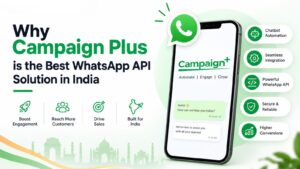
Campaign Plus can be positioned within this workflow as a WhatsApp automation and chatbot solution that helps businesses manage customer conversations more efficiently.
4. Personalize Lead Nurturing
Automation does not mean every customer should receive the same message.
In fact, personalization is especially important in B2B sales.
A company selling CRM software, for example, may have different prospects from healthcare, education, real estate, retail, and manufacturing.
Therefore, each segment can receive more relevant communication.
For example:
Healthcare Lead:
“Here’s how our CRM can help healthcare businesses organize customer communication.”
Real Estate Lead:
“Would you like to see how our platform can help your sales team manage property inquiries?”
Education Lead:
“Explore how our solution can help your admissions team manage student inquiries.”
This type of personalized messaging can make communication more relevant.
Additionally, businesses can use information collected during the initial conversation to create better follow-ups.
5. Share Product Information at the Right Time
B2B prospects often need additional information before they make a decision.
They may request:
- Product brochures
- Pricing information
- Case studies
- Product videos
- Feature lists
- Testimonials
- Company presentations
- Comparison documents
WhatsApp makes it easier to deliver this information within the conversation.
For example, after a prospect asks about a software solution, the company can automatically send a product overview.
Then, after a few days, the business can send a relevant case study.
Later, the company can invite the prospect to schedule a demonstration.
Consequently, the business can guide the prospect through the buying journey instead of sending random promotional messages.
6. Automate Follow-Ups Without Losing Personalization
Follow-up is one of the most important parts of B2B sales.
However, sales teams often struggle to follow up consistently.
A prospect may receive a quotation today but not respond. Another prospect may attend a product demo but require more information.
Instead of forgetting these leads, businesses can create automated follow-up workflows.
For example:
Day 1
Send the quotation.
Day 3
Ask whether the prospect has reviewed the quotation.
Day 7
Share a relevant case study.
Day 10
Offer assistance or answer questions.
Day 14
Invite the prospect for another discussion.
This process keeps the conversation active.
At the same time, businesses should avoid excessive messaging. Every follow-up should provide value and follow applicable WhatsApp messaging and consent requirements.
7. Re-Engage Inactive B2B Leads
Not every lead converts immediately.
Some prospects may become inactive because of timing, budget limitations, internal approvals, or changing business priorities.
However, an inactive lead does not always mean a lost lead.
Businesses can create appropriate re-engagement campaigns for contacts who have opted in to receive messages.
For example:
“Hi [Name], you previously explored our business automation solution. We wanted to check whether your requirements have changed. Would you like an updated product overview?”
This approach can bring old leads back into the sales conversation.
Furthermore, businesses can segment inactive leads based on their previous interests.
That makes re-engagement more relevant.
8. Connect WhatsApp API With CRM Systems
A major advantage of WhatsApp API is integration.
B2B companies can connect WhatsApp conversations with their CRM and other business systems, depending on their technology stack.
This can help sales teams organize customer information more effectively.
For example, a CRM record could contain:
- Lead name
- Company name
- Contact details
- Lead source
- Product interest
- Conversation history
- Sales stage
- Follow-up date
- Assigned salesperson
As a result, sales representatives can understand the context before continuing a conversation.
Instead of asking the prospect the same questions again, the salesperson can continue from the previous interaction.
This creates a smoother customer experience.
9. Use WhatsApp to Schedule Demos and Meetings
Moving a lead from conversation to meeting is an important step in B2B sales.
WhatsApp can simplify this process.
After a prospect shows interest, an automated message can provide meeting options.
For example:
“Would you like to schedule a product demo? Choose a convenient time.”
The business can then connect the process with its scheduling system.
Therefore, prospects do not have to exchange multiple emails just to find a suitable meeting time.
Once the meeting is scheduled, WhatsApp can also support reminder workflows.
For example:
“Your product demo is scheduled for tomorrow at 11:00 AM.”
This can help reduce missed meetings and keep the sales process organized.
10. Use WhatsApp for Quotation Follow-Ups
Quotations are an important part of many B2B sales cycles.
However, sending a quotation does not guarantee a sale.
The sales team may need to answer questions about pricing, features, delivery timelines, implementation, or service terms.
WhatsApp can keep the conversation moving after the quotation is shared.
For example:
“We wanted to check whether you had a chance to review the quotation. If you have any questions about pricing or implementation, our team can assist you.”
This simple follow-up can create an opportunity for the salesperson to understand the prospect’s concerns.
Additionally, businesses can use WhatsApp to notify prospects about quotation updates when appropriate.
11. Move Hot Leads to the Sales Team
Automation should support sales teams rather than replace every human interaction.
When a lead demonstrates strong buying intent, the system can route the conversation to a salesperson.
For example, a prospect may:
- Request pricing
- Ask for a demo
- Request a proposal
- Ask about implementation
- Discuss purchase timelines
These actions can indicate stronger buying intent.
Therefore, the business can prioritize such leads.
A salesperson can then enter the conversation and provide personalized assistance.
This combination of automation and human interaction creates a more efficient sales workflow.
12. Build a Complete B2B Customer Journey
The biggest advantage of WhatsApp API is that businesses can connect multiple stages of the customer journey.
A typical workflow could look like this:
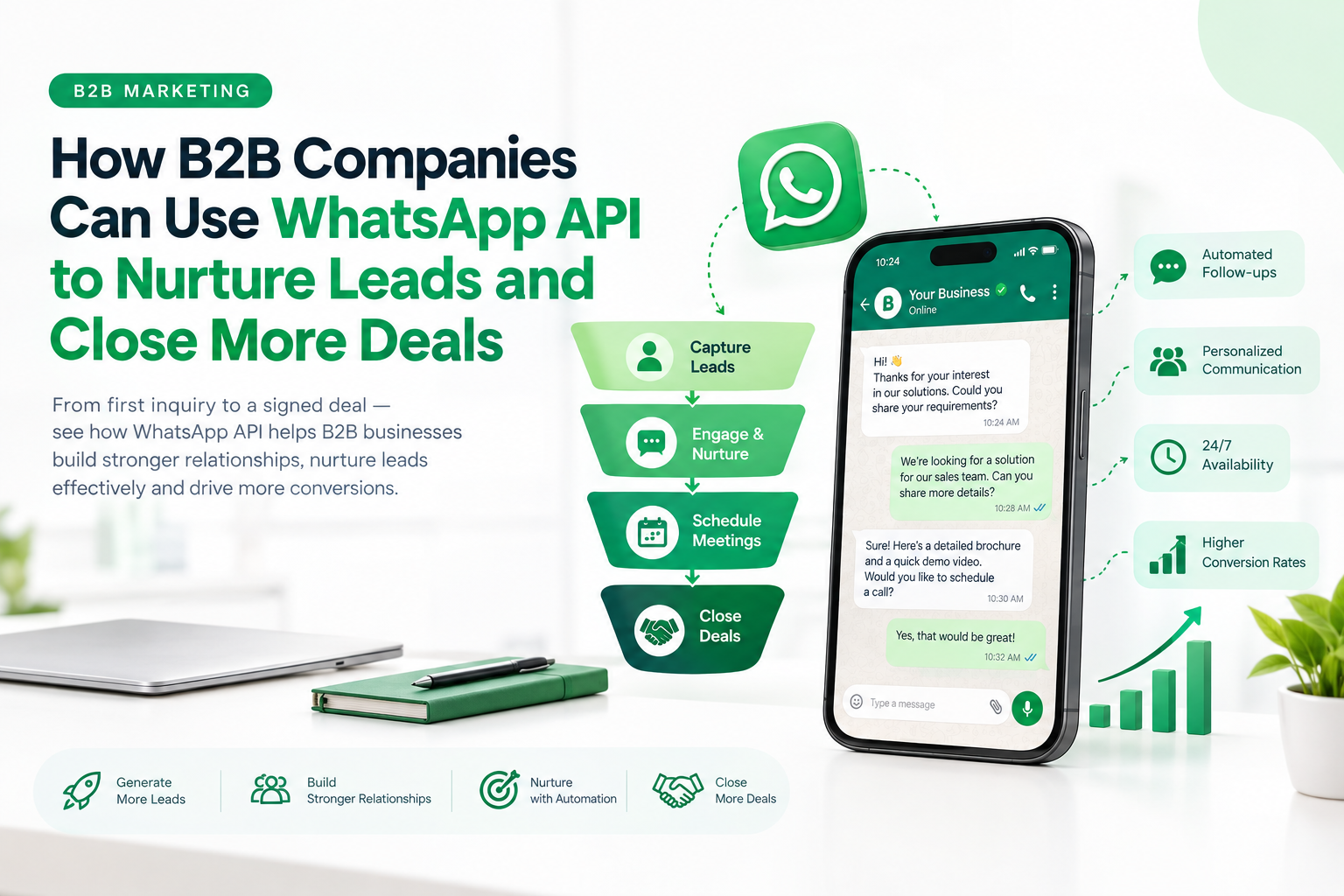
Lead Generation → WhatsApp Inquiry → Lead Qualification → Product Information → Nurturing → Demo → Quotation → Follow-Up → Negotiation → Deal Closure
Each stage can have its own communication strategy.
For example, the initial stage can focus on qualification.
Next, the nurturing stage can focus on education.
Afterward, the sales stage can focus on objections, pricing, and decision-making.
Finally, the closing stage can focus on completing the purchase process.
This creates a more structured B2B sales funnel.
13. Measure WhatsApp Lead Performance
A strong WhatsApp strategy should also be measurable.
Businesses should track relevant metrics to understand which campaigns and conversations generate results.
Important metrics can include:
- Number of leads generated
- Response rate
- Qualified leads
- Demo bookings
- Follow-up responses
- Conversion rate
- Sales opportunities
- Deals closed
- Lead source performance
- Cost per qualified lead
For example, if a company receives 500 leads but only 50 become qualified opportunities, the business can examine the qualification process.
Similarly, if many prospects request demos but few attend them, the company can improve reminder and follow-up workflows.
Therefore, data can help businesses continuously improve their WhatsApp lead nurturing strategy.
14. Combine WhatsApp API With Digital Marketing
WhatsApp works best when it is part of a broader marketing strategy.
B2B companies can combine WhatsApp with:
- Meta Ads
- Google Ads
- LinkedIn marketing
- SEO
- Content marketing
- Email marketing
- Landing pages
- CRM campaigns
- Retargeting
For example, a company can publish an educational blog through Trending Bulb, promote it through social media, capture interested prospects, and then guide qualified prospects toward WhatsApp conversations.
Similarly, Step4Growth can support a broader digital growth approach that connects marketing activities with business objectives.
Then, Campaign Plus can support WhatsApp-based communication and automation within the customer journey.
This integrated approach can help businesses create a connected marketing and sales funnel.
WhatsApp API vs Traditional B2B Follow-Up
Traditional B2B communication often depends heavily on emails and phone calls.
These channels still have value. However, WhatsApp can add another convenient communication layer.
| Traditional Approach | WhatsApp API Approach |
|---|---|
| Manual follow-ups | Automated workflows |
| Multiple communication channels | Centralized WhatsApp conversations |
| Slower responses | Instant automated responses |
| Repetitive questions | Chatbot-based qualification |
| Manual reminders | Automated reminders |
| Difficult lead prioritization | Structured lead workflows |
| Separate customer information | CRM integration possibilities |
Therefore, WhatsApp API does not necessarily replace existing sales channels.
Instead, it can complement them.
Best Practices for Using WhatsApp API for B2B Lead Nurturing
Businesses should follow a few important practices when building WhatsApp campaigns.
1. Get Proper Customer Consent
Only message customers according to applicable WhatsApp policies and consent requirements. Avoid sending unwanted promotional messages.
2. Keep Messages Relevant
Every message should have a clear purpose. Avoid unnecessary communication.
3. Personalize Conversations
Use customer information to make messages more relevant.
4. Provide Human Support
Give prospects a way to connect with a real sales representative when necessary.
5. Segment Your Leads
Different prospects have different needs. Segment them based on industry, interest, stage, and buying intent.
6. Automate Repetitive Tasks
Use automation for welcome messages, qualification, reminders, FAQs, and routine follow-ups.
7. Track Results
Measure lead quality, engagement, meetings, opportunities, and conversions.
8. Focus on Value
Instead of continuously promoting your product, educate prospects and help them make informed decisions.
How Campaign Plus Can Support B2B WhatsApp Automation
For B2B companies, managing a large number of WhatsApp conversations manually can become difficult.
That is where automation can help.
Campaign Plus provides WhatsApp automation, chatbot and more to make business growth.
Businesses can use WhatsApp automation to create structured communication workflows for lead capture, qualification, follow-ups, customer communication, and engagement.
For example, a B2B company can create a workflow where a new lead receives an instant response, answers qualification questions, receives relevant information, and then gets connected with a sales representative.
This can reduce repetitive work while helping businesses maintain consistent communication.
How TrendingBulb and Step4Growth Fit Into a B2B Growth Strategy
A successful B2B strategy requires more than one communication channel.
Trending Bulb can be used as a platform for creating and distributing valuable digital marketing content that attracts and educates potential customers.
Meanwhile, Step4Growth can support a broader growth-oriented digital marketing approach.
Once marketing activities generate interest, WhatsApp can become an important channel for continuing the conversation.
Then, Campaign Plus can support WhatsApp automation and chatbot-based workflows.
Together, these activities can create a connected journey:
Content → Lead Generation → WhatsApp Conversation → Qualification → Nurturing → Sales Follow-Up → Conversion
As a result, businesses can move beyond simply generating leads and focus on turning those leads into meaningful sales opportunities.
The Future of B2B Lead Nurturing With WhatsApp API
B2B buying behavior continues to evolve.
Customers increasingly expect quick responses, convenient communication, relevant information, and personalized experiences.
Therefore, businesses that continue to rely only on manual follow-ups may find it harder to manage growing lead volumes.
WhatsApp API provides an opportunity to build a more organized communication system.
With automation, chatbots, CRM integrations, personalization, and analytics, B2B companies can create a smoother customer journey.
However, technology alone does not close deals.
The real advantage comes from combining technology with a strong sales strategy.
Businesses should understand their audience, create useful content, respond quickly, nurture relationships, and provide human assistance when needed.
That is how WhatsApp can become a valuable part of a modern B2B sales funnel.
Conclusion
B2B sales cycles can be long, complex, and difficult to manage.
However, WhatsApp API can make lead nurturing more structured and efficient.
From capturing inquiries and qualifying leads to sharing product information, scheduling demos, following up on quotations, and re-engaging prospects, businesses can use WhatsApp throughout the customer journey.
Moreover, automation can reduce repetitive work for sales teams.
At the same time, personalization can help businesses build stronger relationships with prospects.
The key is to use WhatsApp as part of a complete marketing and sales strategy rather than treating it as just another messaging channel.
With the right strategy, Trending Bulb can help businesses communicate valuable content, Step4Growth can support broader digital growth initiatives, and Campaign Plus can help businesses use WhatsApp automation and chatbots to manage customer conversations.
Ultimately, the goal is simple:
Capture better leads. Nurture them consistently. Build stronger relationships. Close more B2B deals.
Final Takeaway
For modern B2B companies, lead nurturing is no longer just about sending emails or making phone calls.
Instead, businesses need faster, more convenient, and more personalized communication.
WhatsApp API can help bridge that gap.
When combined with smart digital marketing from Trending Bulb, growth-focused strategies from Step4Growth, and WhatsApp automation through Campaign Plus, businesses can build a stronger path from first inquiry to final deal.