Introduction
The way people buy cars has changed.
Today, customers search online, compare models, check reviews, explore prices, and contact dealerships before visiting a showroom. Therefore, dealerships need fast and convenient communication at every stage of the buying journey.
However, managing every enquiry manually can quickly become difficult.
A customer may ask about a vehicle in the morning. Later, that same person may request a test drive. After the visit, another follow-up may be required.
Meanwhile, existing customers may need service reminders, booking confirmations, maintenance updates, and other important notifications.
When sales teams handle every interaction manually, valuable opportunities can easily slip through the cracks.
That is where the WhatsApp API for car dealerships becomes useful.
With WhatsApp automation, dealerships can manage lead responses, test-drive bookings, follow-ups, service reminders, appointment confirmations, and customer notifications. As a result, sales teams can spend more time having meaningful conversations and less time handling repetitive tasks.
For businesses exploring this approach, Campaign Plus can support WhatsApp-based customer communication and automation. Similarly, Step4Growth can help connect digital marketing campaigns with lead generation and conversion strategies.
At Trending Bulb, the focus is on practical digital marketing strategies that help businesses attract prospects, engage customers, and improve conversions.
So, how can car dealerships use WhatsApp automation effectively?
Let’s explore.
Why Car Dealerships Need WhatsApp Automation
Car dealerships receive leads from many different sources.
For example, prospects can come through:
- Google Search
- Google Ads
- Meta Ads
- Dealership websites
- Automotive marketplaces
- Social media campaigns
- Referral campaigns
- Walk-in enquiries
However, generating enquiries is only the beginning.
The bigger challenge is responding quickly and following up consistently.
Imagine a customer submits an enquiry about an SUV through a dealership website. If the response arrives several hours later, that customer may already have contacted another dealer.
Similarly, someone who requests a test drive may forget the appointment without a timely reminder.
Therefore, speed and consistency matter.
The WhatsApp Business API for car dealerships can help create automated workflows that keep customers engaged from the first enquiry through after-sales service.
Instead of depending entirely on manual communication, dealerships can create a structured customer journey.
1. Automate Test Drive Bookings
A test drive is one of the most important steps in the car-buying journey.
Customers want to experience a vehicle before making a purchase decision. However, scheduling appointments manually can create unnecessary delays.
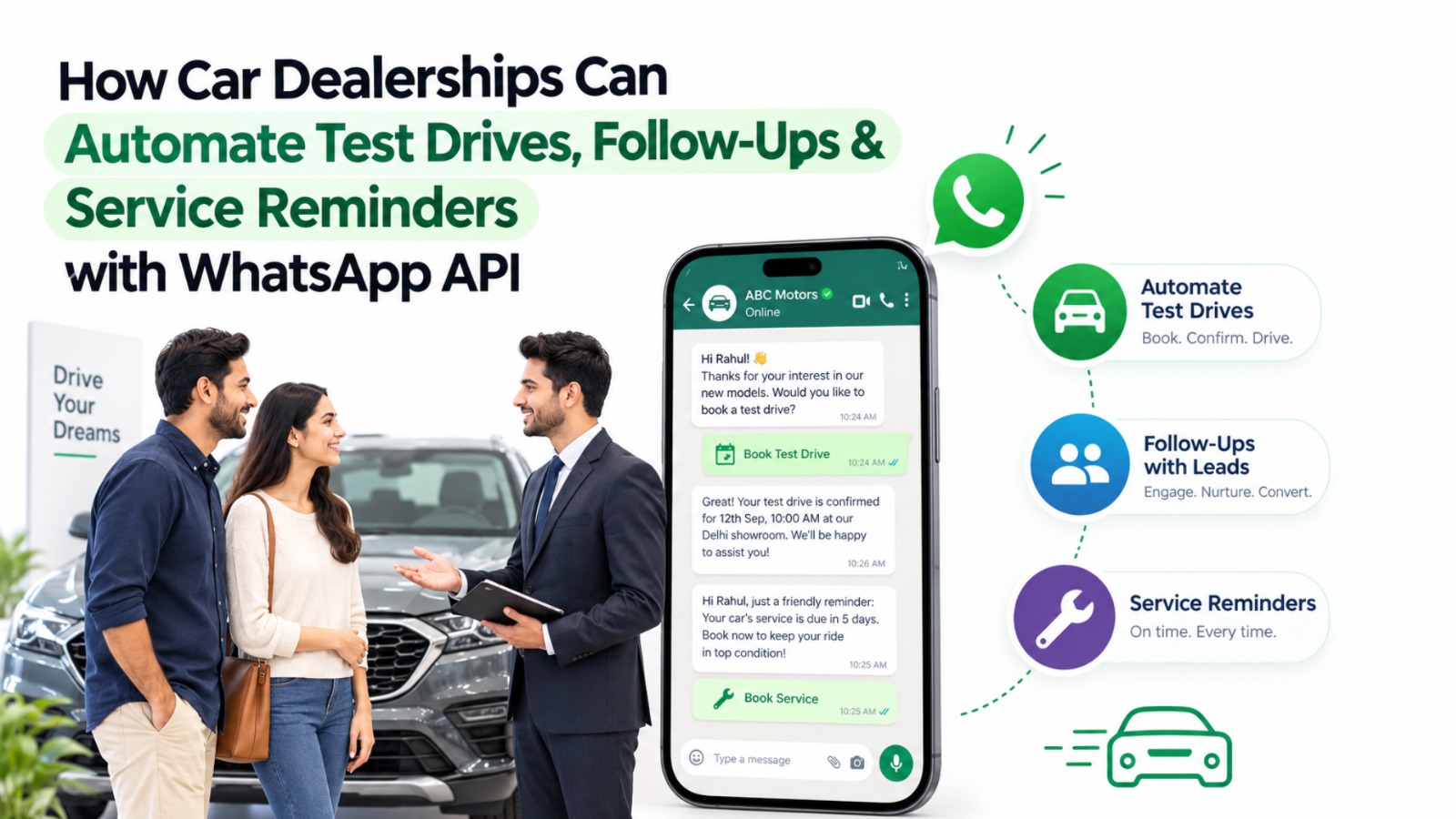
For example, a prospect may click “Book a Test Drive” on a dealership website.
Instead of waiting for a salesperson to call, the customer can immediately start a WhatsApp conversation.
The automated workflow can then ask:
Which model are you interested in?
Which variant would you like to explore?
Which dealership location is convenient for you?
What date would you prefer?
What time would you prefer?
Once the information is collected, the dealership can send a confirmation message.
For instance:
“Thanks for your interest in our SUV. Your test-drive request has been received. Please select your preferred date and time.”
As a result, customers get a faster and simpler booking experience.
At the same time, sales teams receive useful information before speaking with the prospect.
2. Send Automated Test Drive Reminders
Booking a test drive is important.
However, getting the customer to attend the appointment matters just as much.
People can forget appointments because of work, travel, family commitments, or unexpected plans. Therefore, automated reminders can help reduce missed appointments.
A dealership can create a simple reminder sequence.
24 Hours Before
“Your test drive is scheduled for tomorrow at 11:00 AM. We look forward to seeing you.”
2 Hours Before
“Reminder: Your test drive is scheduled today at 11:00 AM. Need to reschedule? Reply to this message.”
After receiving the reminder, the customer can confirm or reschedule the appointment.
Consequently, the dealership can improve appointment communication without requiring salespeople to make every reminder call.
3. Automate Lead Follow-Ups
Lead follow-up remains one of the biggest challenges for automotive businesses.
Not every customer is ready to purchase immediately. Some prospects need time to compare models, discuss financing, speak with family members, or evaluate different dealerships.
Therefore, an unanswered enquiry should not automatically become a lost lead.
With WhatsApp automation for car dealers, dealerships can create follow-up sequences based on customer behaviour.
For example, the first message could say:
“Hi Rahul, thank you for enquiring about the XYZ SUV. Would you like information about pricing, variants, or features?”
After a few days, another message could follow:
“Still considering the XYZ SUV? You can book a test drive at a convenient time.”
Later, the dealership could send:
“Would you like help with financing, exchange options, or the next steps?”
This approach keeps the conversation active.
More importantly, salespeople do not need to remember every follow-up manually.
4. Qualify Car Buyers Automatically
Every lead has a different level of purchase intent.
Some people are simply researching. Others may be ready to buy within a few weeks.
Consequently, sales teams need a simple way to identify high-intent prospects.
WhatsApp automation can help collect useful information.
For example, a chatbot can ask:
- Which model are you interested in?
- When are you planning to purchase?
- Would you like a test drive?
- Which dealership location do you prefer?
- Are you interested in finance options?
Based on the answers, the dealership can categorize leads.
For instance:
- Hot Lead: Ready to purchase soon
- Warm Lead: Comparing options
- Cold Lead: Researching for future purchase
As a result, sales teams can prioritize conversations more effectively.
At the same time, automated qualification keeps the initial customer interaction quick and convenient.
5. Answer Common Vehicle Questions Instantly
Customers often ask similar questions before visiting a dealership.
They may want information about:
- Vehicle features
- Variants
- Pricing
- Colours
- Mileage
- Specifications
- Finance options
- Exchange programs
- Test-drive availability
- Dealership locations
Sales teams can spend a lot of time answering these repetitive questions.
Fortunately, WhatsApp automation can handle many basic enquiries instantly.
For example, customers can choose:
1. Explore Models
2. View Features
3. Book Test Drive
4. Finance Options
5. Talk to Sales
This creates a simpler conversation.
Moreover, automated responses can keep prospects engaged when sales representatives are busy or unavailable.
6. Automate Car Service Reminders
The customer relationship does not end after a vehicle sale.
In fact, after-sales service is an important part of the dealership experience.
Customers need regular servicing, maintenance, inspections, repairs, and other support. Yet vehicle owners can easily forget their next service date.
Therefore, car service reminder automation can help dealerships stay connected with existing customers.
A dealership can send automated WhatsApp reminders based on service schedules.
30 Days Before Service
“Your vehicle’s scheduled service is approaching. Would you like to book an appointment?”
7 Days Before Service
“Your vehicle service is due soon. Select a convenient date to book your appointment.”
1 Day Before Service
“Reminder: Your service appointment is scheduled for tomorrow at 10:00 AM.”
Customers can then choose to book, reschedule, or contact the service team.
As a result, dealerships can make service communication more convenient while encouraging customers to return for scheduled maintenance.
7. Keep Customers Updated During Vehicle Service
Service communication should not stop at reminders.
Instead, dealerships can use WhatsApp to provide useful updates throughout the service process.
For example:
“Your vehicle has been received by our service centre.”
Next, the dealership can send:
“Your vehicle inspection is complete. Our team is working on the recommended service.”
Later, another update can confirm:
“Your vehicle is ready for pickup.”
This approach reduces uncertainty.
Furthermore, customers do not need to call the service centre repeatedly to check the status of their vehicle.
Consequently, dealerships can create a more transparent and convenient service experience.
8. Re-Engage Inactive Leads
Some prospects stop responding after their first enquiry.
However, silence does not always mean that the customer has lost interest.
The prospect may still be comparing vehicles, waiting for the right time, or discussing the purchase with family members.
Therefore, dealerships can use WhatsApp re-engagement campaigns.
For example:
“Hi Rahul, are you still exploring options for your next car? We can help you compare models, book a test drive, or explore finance options.”
A relevant message can reopen the conversation.
Additionally, dealerships can segment inactive leads according to their previous interests.
For instance, someone who previously asked about an SUV can receive SUV-related information instead of a generic promotion.
This makes WhatsApp lead follow-up more relevant and useful.
9. Connect WhatsApp with CRM Systems
Many dealerships already use CRM systems to manage customer information.
However, communication becomes more effective when CRM and WhatsApp workflows work together.
For example, a new lead enters the CRM after submitting a website enquiry.
Next, the system can trigger a WhatsApp welcome message.
The customer can then provide vehicle preferences and purchase requirements.
After that, the dealership can trigger a test-drive invitation or sales follow-up.
This creates a connected process:
Lead Capture → WhatsApp → Qualification → Test Drive → Follow-Up → Purchase
As a result, dealerships can manage customer interactions more systematically.
Instead of treating every enquiry as a separate conversation, teams can build a complete customer journey.
10. Turn Digital Marketing Leads into Conversations
Digital marketing can bring potential customers to a dealership.
However, clicks alone do not generate sales.
The real opportunity begins when visitors take action.
For example:
Google Search → Website → WhatsApp → Lead Qualification → Test Drive → Sales Follow-Up
Similarly:
Instagram Ad → WhatsApp → Vehicle Information → Test Drive → Purchase
Therefore, digital marketing and WhatsApp automation can work together.
Step4Growth can help dealerships develop strategies across SEO, Google Ads, Meta Ads, social media, and content marketing.
Meanwhile, WhatsApp can become the communication layer that helps move prospects from interest toward action.
This creates a stronger connection between marketing and sales.
11. Personalize Automotive WhatsApp Marketing
Automation does not mean every customer should receive the same message.
Instead, dealerships can personalize communication based on customer information.
For example, messages can use:
- Customer name
- Vehicle model
- Variant
- Preferred dealership
- Test-drive date
- Purchase timeline
- Service date
- Previous interaction
A customer interested in an SUV can receive relevant SUV information.
Meanwhile, an existing vehicle owner can receive service-related updates.
Similarly, someone who has completed a test drive can receive a personalized follow-up.
As a result, automated communication can feel more relevant and useful.
12. Reduce Repetitive Work for Sales Teams
Salespeople should spend more time selling and less time handling repetitive administrative tasks.
Yet dealership teams often spend hours:
- Calling new leads
- Sending follow-ups
- Confirming test drives
- Sending appointment reminders
- Answering basic questions
- Sending service reminders
- Checking appointment status
WhatsApp automation can handle many routine interactions.
Consequently, sales teams can focus on conversations that require human expertise.
For example, automation can manage initial lead qualification.
Then, a salesperson can handle pricing negotiations, financing discussions, vehicle comparisons, objections, and purchase decisions.
This creates a better balance between automation and human support.
13. Build a Complete Car Dealership Customer Journey
The biggest advantage of the WhatsApp API for car dealerships is the ability to connect multiple stages of communication.
A complete journey can look like this:
Step 1: Generate the Lead
A prospect discovers the dealership through Google, social media, an advertisement, or the website.
Step 2: Start a WhatsApp Conversation
The prospect clicks a WhatsApp CTA and begins a conversation.
Step 3: Qualify the Prospect
The system collects vehicle preferences and buying requirements.
Step 4: Book the Test Drive
The prospect selects a preferred date and time.
Step 5: Confirm the Appointment
WhatsApp sends the booking confirmation.
Step 6: Send a Reminder
The customer receives an automated reminder before the appointment.
Step 7: Follow Up After the Test Drive
The dealership contacts the customer and answers additional questions.
Step 8: Move Toward Purchase
The sales team continues the conversation toward booking and delivery.
Step 9: Continue After-Sales Communication
The dealership sends service reminders and maintenance updates.
Step 10: Build Customer Retention
Finally, the dealership can continue communication around future services, upgrades, offers, and referrals.
Therefore, WhatsApp can support the customer relationship beyond the initial enquiry.
WhatsApp API vs Manual Dealership Communication
| Manual Communication | WhatsApp API Automation |
|---|---|
| Salespeople manually follow up | Automated follow-up workflows |
| Appointment calls | WhatsApp confirmations |
| Manual service reminders | Automated service notifications |
| Repetitive customer questions | Automated responses |
| Follow-ups can be forgotten | Scheduled communication |
| Difficult to handle large lead volumes | Structured lead workflows |
| Generic communication | Personalized messaging |
| Sales teams handle routine tasks | Teams focus on qualified prospects |
The objective is not to replace the sales team.
Instead, the goal is to make the team more productive.
As a result, employees can spend more time building relationships and closing opportunities.
How CampaignPlus Can Support Dealership WhatsApp Automation
Campaign Plus can become part of a dealership’s WhatsApp communication strategy by supporting structured messaging and automation workflows.
For example, a dealership can create:
New Lead → Welcome Message → Vehicle Selection → Qualification → Test Drive → Reminder → Sales Follow-Up
Another workflow can focus on existing customers:
Service Due → WhatsApp Reminder → Appointment Booking → Confirmation → Service Update → Feedback
Such workflows can help dealerships communicate consistently with prospects and existing customers.
Moreover, businesses can combine different workflows based on customer activity.
For example, a person who books a test drive can enter one workflow. Meanwhile, an existing vehicle owner can enter a service reminder workflow.
Therefore, communication becomes more relevant to each customer.
Businesses should also follow applicable WhatsApp policies, consent requirements, and messaging best practices when implementing automated communication.
How Step4Growth Can Connect Marketing and WhatsApp
Generating leads is important.
However, converting those leads is even more important.
Step4Growth can help dealerships think beyond individual marketing channels and create a connected customer journey.
For example:
SEO → Website → WhatsApp → Lead Qualification → Test Drive → Follow-Up → Sale
Or:
Meta Ads → Landing Page → WhatsApp → Conversation → Test Drive → Conversion
This approach helps dealerships measure more than clicks.
Instead, businesses can evaluate the complete journey:
- How many people saw the campaign?
- How many clicked?
- How many started a WhatsApp conversation?
- How many became qualified leads?
- How many booked test drives?
- How many completed test drives?
- How many purchased?
- How many returned for service?
As a result, dealerships gain better visibility into their marketing and sales funnel.
Why Trending Bulb Recommends WhatsApp Automation for Dealerships
At Trending Bulb, digital marketing should go beyond generating visibility.
The goal should be to create meaningful customer journeys.
For car dealerships, WhatsApp can connect marketing, sales, and after-sales communication through one familiar messaging channel.
A well-planned strategy can help dealerships:
- Respond faster
- Capture more enquiries
- Qualify leads
- Book test drives
- Send reminders
- Follow up consistently
- Re-engage inactive prospects
- Automate service reminders
- Improve customer support
- Reduce repetitive work
- Strengthen after-sales engagement
Moreover, automation can help dealerships create consistent communication without adding unnecessary manual work.
Therefore, WhatsApp automation can become an important part of a modern automotive marketing strategy.
Best Practices for WhatsApp Automation for Car Dealerships
Before launching an automated WhatsApp strategy, dealerships should follow a few important practices.
Keep Messages Short
Customers prefer simple and direct communication.
Therefore, focus on one message and one action at a time.
Use Clear Calls to Action
Make the next step obvious.
For example:
Book Test Drive
View Models
Check Finance Options
Book Service
Talk to Sales
Clear CTAs make conversations easier to navigate.
Personalize Communication
Use relevant customer information whenever appropriate.
As a result, messages can feel more useful than generic promotions.
Provide Human Support
Automation should make communication easier.
However, customers should still have a clear way to connect with a salesperson or service representative when they need human assistance.
Segment Customers
New leads, test-drive prospects, buyers, and existing vehicle owners have different requirements.
Therefore, create separate communication journeys for different customer groups.
Track Performance
Monitor important metrics such as:
- Leads generated
- WhatsApp conversations
- Qualified leads
- Test-drive bookings
- Test-drive attendance
- Follow-up responses
- Service bookings
- Customer engagement
- Conversions
Then, use these insights to improve your workflows.
Respect Customer Preferences
Businesses should use appropriate consent-based communication.
In addition, they should follow applicable WhatsApp business messaging policies.
Automation works best when customers find the messages useful rather than intrusive.
Frequently Asked Questions
What is WhatsApp API for car dealerships?
The WhatsApp API for car dealerships allows businesses to build structured WhatsApp communication workflows. These workflows can support lead generation, customer support, test-drive bookings, follow-ups, service reminders, notifications, and other business communication.
How can car dealerships use WhatsApp automation?
Dealerships can use WhatsApp automation to respond to enquiries, qualify leads, book test drives, send appointment reminders, follow up with prospects, share vehicle information, and remind customers about upcoming services.
Can WhatsApp automate test-drive bookings?
Yes. A dealership can create a WhatsApp workflow that collects a customer’s preferred model, dealership location, date, and time. Afterward, the system can send booking confirmations and reminders.
Can WhatsApp help car dealerships follow up with leads?
Yes. Automated follow-up workflows can help dealerships stay connected with prospects after an enquiry, test drive, or previous conversation. Consequently, sales teams can focus on high-intent leads.
How can WhatsApp help with car service reminders?
Dealerships can use automated WhatsApp messages to remind customers when vehicle service is due. Customers can then be guided toward booking or rescheduling an appointment.
Can WhatsApp API connect with a dealership CRM?
Depending on the technology setup, WhatsApp can be integrated with CRM systems and other business tools. This can help dealerships manage customer information and create connected communication workflows.
Is WhatsApp automation useful for automotive marketing?
Yes. WhatsApp automation can complement digital marketing by turning website visitors and advertising leads into direct conversations. As a result, dealerships can create a smoother journey from lead generation to test drive and purchase.
Final Thoughts
The automotive industry is becoming increasingly digital.
Customers no longer depend only on showroom visits to begin their car-buying journey. Instead, they discover vehicles online, compare models, ask questions, book test drives, explore financing, and communicate with dealerships digitally.
Therefore, dealerships need a communication strategy that matches these changing expectations.
The WhatsApp API for car dealerships provides an opportunity to automate important parts of that journey.
From the first enquiry to test-drive booking, and from lead follow-ups to service reminders, WhatsApp automation can help dealerships create faster and more consistent customer communication.
More importantly, it can connect digital marketing with sales.
A customer can discover a dealership through Google or social media. Next, that customer can click a WhatsApp CTA and receive instant assistance. Afterward, the prospect can book a test drive, receive reminders, speak with a salesperson, and continue receiving useful after-sales communication.
That is the real value of automation.
It is not simply about sending more messages.
Instead, it is about sending the right message at the right stage of the customer journey.
With Campaign Plus, dealerships can explore WhatsApp-powered communication and automation workflows. Meanwhile, Step4Growth can help connect digital marketing with lead generation and conversion strategies.
Through Trending Bulb, businesses can also discover practical digital marketing ideas designed to attract, engage, and convert customers.
For modern car dealerships, the opportunity is clear:
Generate the lead. Start the conversation. Automate the follow-up. Book the test drive. Stay connected after the sale.
That is how WhatsApp automation can help turn dealership conversations into long-term customer relationships.