Customers expect businesses to respond quickly. They also want simple conversations, instant updates, personalized communication, and reliable support.
Because of these changing expectations, businesses are looking for better ways to communicate with customers. WhatsApp Business API has become an important solution for companies that want to automate and scale customer conversations.
But which business can use WhatsApp Business API?
The answer is broader than many businesses expect.
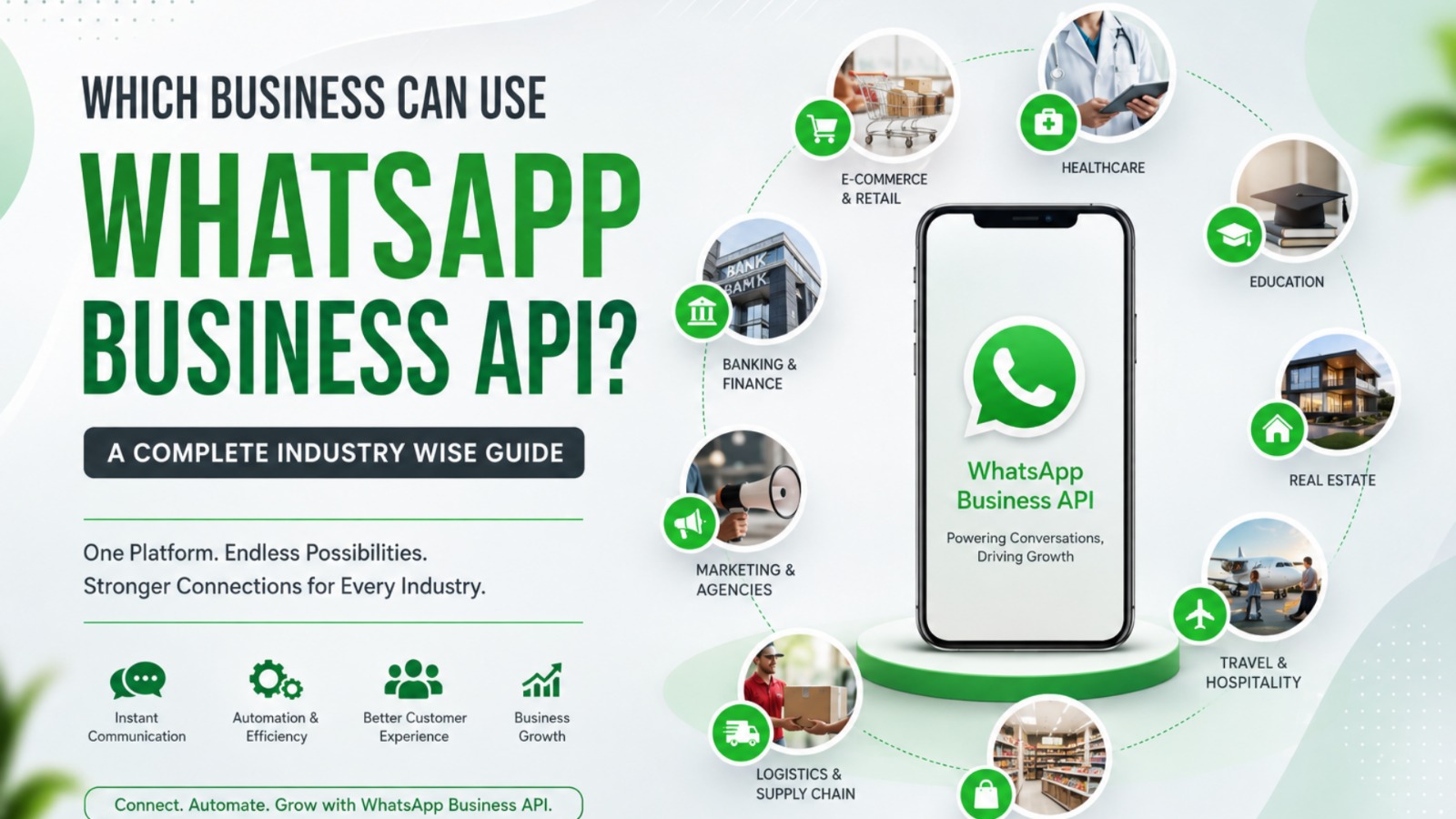
E-commerce brands, retailers, hospitals, educational institutes, real estate companies, financial services, restaurants, travel businesses, logistics companies, and many other industries can use WhatsApp Business API.
Moreover, businesses can use it for much more than sending messages. They can automate customer support, qualify leads, send notifications, manage appointments, share updates, and support sales conversations.
In this complete industry-wise guide, we will explore which business can use WhatsApp Business API, how different industries can use it, and why WhatsApp automation can become an important part of a modern digital marketing strategy.
What Is WhatsApp Business API?
WhatsApp Business API is designed for businesses that need to manage customer conversations at scale.
Unlike a basic business messaging setup, the API can connect WhatsApp with business tools, automation systems, CRM platforms, chatbots, and customer workflows.
As a result, companies can create structured communication journeys instead of handling every conversation manually.
For example, a customer may submit an enquiry through a website.
Immediately afterward, the business can send a WhatsApp message. The automated conversation can then ask a few questions, collect customer requirements, and route the lead to the sales team.
Therefore, WhatsApp Business API can connect marketing, sales, and customer support.
Businesses can use it for:
- Lead generation
- Lead qualification
- Customer support
- Order notifications
- Appointment reminders
- Payment reminders
- Delivery updates
- Booking confirmations
- Promotional campaigns
- Customer feedback
- Chatbot conversations
- Sales follow-ups
- Product enquiries
- Customer retention
Most importantly, businesses can build these use cases around their specific customer journey.
Which Business Can Use WhatsApp Business API?
Almost any business that communicates regularly with customers can explore WhatsApp Business API.
However, the right use case depends on the business model.
For example, an e-commerce company may focus on order updates and cart recovery. Meanwhile, a healthcare provider may focus on appointment reminders and patient communication.
Similarly, a real estate company may prioritize lead qualification and site-visit scheduling.
Here are the major industries that can benefit from WhatsApp Business API.
1. E-Commerce Businesses
E-commerce is one of the strongest use cases for WhatsApp Business API.
Online shoppers expect information throughout the buying journey. Therefore, brands need to communicate before, during, and after a purchase.
With WhatsApp automation, an online store can send useful messages at the right stage.
How e-commerce businesses can use WhatsApp API
- Order confirmations
- Payment confirmations
- Shipping updates
- Delivery notifications
- Return updates
- Customer support
- Product enquiries
- Cart recovery
- Feedback requests
- Promotional campaigns
- Product recommendations
For instance, a customer places an order through an online store.
First, the business can send an order confirmation. Next, it can share shipping information. Later, the customer can receive a delivery update.
As a result, customers stay informed without repeatedly contacting support.
Furthermore, e-commerce brands can connect WhatsApp with their lead-generation campaigns.
A customer might discover a product through Instagram or Facebook. After clicking a WhatsApp CTA, the customer can start a conversation immediately.
This creates a smoother path from advertisement to conversation to purchase.
2. Retail and Wholesale Businesses
Retailers and wholesalers can also use WhatsApp Business API to improve customer communication.
Fashion stores, electronics retailers, furniture businesses, jewellery brands, supermarkets, and wholesalers can use WhatsApp to answer enquiries and share relevant updates.
For example, a retail brand can announce a new collection through an approved promotional message.
Afterward, interested customers can ask about products, prices, availability, or store locations.
Retail businesses can use WhatsApp API for:
- New product announcements
- Product enquiries
- Offers and promotions
- Inventory enquiries
- Customer support
- Store information
- Appointment bookings
- Order updates
- Feedback collection
- Repeat-purchase reminders
Additionally, retailers can connect Meta Ads with WhatsApp conversations.
A potential customer sees an advertisement. Then, the customer clicks the WhatsApp button. Next, an automated message starts the conversation.
Consequently, the business can move customers from ad discovery to direct communication much faster.
3. Healthcare and Clinics
Healthcare organizations also have many communication tasks that can benefit from automation.
Hospitals, clinics, dental practices, diagnostic centres, and wellness businesses regularly send appointment-related messages.
Therefore, WhatsApp Business API can help simplify routine communication.
Healthcare use cases include:
- Appointment confirmations
- Appointment reminders
- Rescheduling requests
- Follow-up reminders
- Report notifications
- Clinic information
- Doctor availability
- Patient communication
- Feedback collection
For example, a patient books an appointment online.
The clinic can immediately send a confirmation through WhatsApp. Later, another message can remind the patient about the upcoming appointment.
As a result, staff can spend less time making routine reminder calls.
However, healthcare businesses should always design their messaging workflows around applicable privacy, consent, and regulatory requirements.
4. Education and Coaching Institutes
Schools, colleges, coaching centres, training institutes, and online education businesses can use WhatsApp Business API to simplify communication.
Education businesses often manage large numbers of enquiries.
Therefore, automated WhatsApp conversations can help organize these interactions.
Education businesses can use WhatsApp API for:
- Admission enquiries
- Course information
- Application updates
- Class reminders
- Exam notifications
- Fee reminders
- Webinar invitations
- Counselling follow-ups
- Student communication
- Feedback collection
Consider a student who submits an admission enquiry.
Instead of waiting for a counsellor, the student can receive an immediate WhatsApp response.
The chatbot can then ask about the preferred course, location, or learning mode.
After that, the system can send qualified leads to the admissions team.
Thus, WhatsApp can support both student communication and admission lead generation.
5. Real Estate Businesses
Real estate is another industry where WhatsApp Business API can make a major difference.
Property buyers often need several conversations before making a decision.
Because of this, fast responses and consistent follow-ups are important.
Real estate businesses can use WhatsApp automation throughout the sales journey.
Real estate WhatsApp API use cases
- Property enquiries
- Project information
- Brochure sharing
- Lead qualification
- Site-visit scheduling
- Booking confirmations
- Price enquiries
- Follow-ups
- Project updates
- Customer support
For instance, a potential buyer clicks a real estate advertisement.
The customer starts a WhatsApp conversation and receives an automated welcome message.
Next, the chatbot can ask about budget, property type, preferred location, and purchase timeline.
Once the lead meets the required criteria, the sales team can take over.
Therefore, automation can help sales teams focus on more qualified conversations.
6. Banking and Financial Services
Financial businesses can use WhatsApp for selected customer communication and service workflows, subject to applicable regulations and security requirements.
Customers often need timely updates about applications, transactions, payments, and services.
Consequently, WhatsApp can provide a convenient communication channel.
Potential use cases include:
- Transaction alerts
- Application updates
- Payment reminders
- Customer support
- Service notifications
- Document-related communication
- Account-related alerts
- Financial product enquiries
For example, a customer may need an update about an application.
Instead of waiting for a phone call, the customer can receive an appropriate notification through WhatsApp.
However, financial businesses should apply strong security and compliance controls.
Sensitive information should also be handled according to applicable regulations and organizational policies.
7. Travel and Hospitality Businesses
Travel agencies, hotels, resorts, tour operators, and hospitality businesses need constant customer communication.
A traveller may need booking information before the trip and support during the stay.
Therefore, WhatsApp Business API can support the complete travel communication journey.
Travel and hospitality businesses can automate:
- Booking confirmations
- Itinerary updates
- Hotel confirmations
- Check-in information
- Travel reminders
- Customer support
- Special offers
- Feedback requests
- Cancellation communication
Imagine a customer books a hotel.
First, the business sends a booking confirmation. Then, it can provide check-in details closer to the travel date.
After the stay, the company can request feedback.
As a result, WhatsApp becomes part of the overall customer experience instead of being used only for promotions.
8. Restaurants and Food Businesses
Restaurants, cloud kitchens, catering companies, and food delivery businesses can also use WhatsApp Business API.
Customers frequently ask about menus, reservations, delivery status, offers, and availability.
Fortunately, many of these interactions can be automated.
Restaurants can use WhatsApp API for:
- Table reservations
- Order confirmations
- Delivery updates
- Menu enquiries
- Special offers
- Customer support
- Feedback collection
- Repeat-order reminders
For example, a customer books a table through WhatsApp.
The system can confirm the reservation immediately.
Later, the restaurant can send a reminder before the booking time.
Similarly, an online food business can send order updates without requiring staff to respond manually.
9. Logistics and Courier Businesses
Logistics companies handle a high volume of shipment-related communication.
Customers want to know where their package is and when it will arrive.
Therefore, timely notifications can significantly improve the customer experience.
Logistics businesses can use WhatsApp API for:
- Shipment confirmations
- Tracking updates
- Delivery notifications
- Delivery reminders
- Failed delivery messages
- Customer support
- Address-related communication
Instead of calling customer support to ask about a package, customers can receive automated tracking updates.
Consequently, businesses can reduce repetitive enquiries while keeping customers informed.
10. Automotive Businesses
Automobile dealerships, service centres, vehicle rental companies, and spare-parts businesses can use WhatsApp Business API.
The automotive customer journey often includes enquiries, test drives, bookings, servicing, and follow-ups.
Therefore, WhatsApp can support multiple stages.
Automotive use cases include:
- Vehicle enquiries
- Test-drive bookings
- Service reminders
- Appointment confirmations
- Service updates
- Price enquiries
- Sales follow-ups
- Feedback collection
For example, a customer requests information about a new vehicle.
The dealership can respond immediately through WhatsApp.
Later, an automated reminder can encourage the customer to schedule a test drive.
Similarly, service centres can remind existing customers about upcoming maintenance.
11. Beauty, Salon and Wellness Businesses
Salons, spas, beauty clinics, fitness centres, and wellness businesses depend heavily on appointments and repeat customers.
Because of this, WhatsApp automation can simplify routine communication.
Common use cases include:
- Appointment booking
- Appointment reminders
- Rescheduling
- Membership reminders
- Service offers
- Customer feedback
- Follow-ups
- Service recommendations
For instance, a salon can send an appointment reminder one day before a scheduled visit.
Customers can then confirm or request a change.
As a result, staff spend less time managing routine calls.
12. Insurance Businesses
Insurance companies and insurance agents often need regular customer communication.
Policy renewals, service requests, application updates, and reminders can create repetitive workloads.
Therefore, WhatsApp Business API can help organize these processes.
Insurance use cases include:
- Renewal reminders
- Policy-related notifications
- Application updates
- Customer support
- Service requests
- Document communication
- Follow-up messages
For example, an insurance provider can remind a customer about an upcoming renewal.
The message can then guide the customer toward the next step.
However, businesses should ensure that their workflows follow applicable insurance, privacy, and communication regulations.
13. Marketing Agencies
Digital marketing agencies can use WhatsApp Business API as part of a broader lead-generation and conversion strategy.
This becomes especially useful when campaigns generate many enquiries.
Suppose a business runs a Meta Ads campaign.
Instead of sending every prospect to a long enquiry form, the campaign can encourage customers to start a WhatsApp conversation.
Then, automation can collect basic requirements.
Finally, qualified prospects can reach the sales team.
Marketing agencies can use WhatsApp API for:
- Lead generation
- Lead qualification
- Campaign follow-ups
- Consultation bookings
- Webinar registrations
- Event reminders
- Customer support
- Sales follow-ups
For Trending Bulb and Step4Growth, this approach can strengthen the connection between digital marketing and customer communication.
At the same time, Campaign Plus can support the WhatsApp Business API layer and automation requirements.
Therefore, the strategy becomes:
Attract → Engage → Qualify → Follow Up → Convert
14. B2B Companies
WhatsApp Business API can also support B2B communication.
Manufacturers, distributors, suppliers, SaaS companies, and professional service providers often manage enquiries through multiple channels.
WhatsApp can make these conversations more direct.
B2B use cases include:
- Product enquiries
- Demo bookings
- Sales enquiries
- Lead qualification
- Distributor communication
- Order updates
- Customer support
- Sales follow-ups
For example, a business buyer requests product information.
An automated WhatsApp conversation can collect company details and requirements.
Afterward, the sales representative can continue with a more relevant conversation.
Thus, WhatsApp can help shorten the early stage of the B2B sales journey.
15. Event Management Businesses
Event companies need to keep attendees updated before, during, and after an event.
Therefore, WhatsApp Business API can become a useful communication channel.
Event businesses can use WhatsApp for:
- Registration confirmations
- Ticket information
- Event reminders
- Venue details
- Schedule updates
- Speaker announcements
- Feedback collection
- Post-event communication
For example, someone registers for an event.
The business can immediately confirm the registration.
Later, it can send venue and timing information.
Consequently, attendees receive important information without searching through multiple emails.
How Different Industries Benefit From WhatsApp Business API
Although these industries are very different, their communication challenges often look similar.
Most businesses want to:
- Respond faster
- Capture more leads
- Reduce manual work
- Improve customer support
- Automate follow-ups
- Increase conversions
- Personalize communication
- Improve customer retention
WhatsApp Business API can support these goals through automation and integrations.
Moreover, businesses can build different workflows based on their specific objectives.
WhatsApp Business API for Lead Generation
Lead generation is one of the most valuable WhatsApp use cases.
Imagine someone sees your advertisement on Instagram.
The person clicks the WhatsApp CTA.
Instead of completing a long form, the prospect can begin a conversation.
Next, an automated workflow can ask useful questions.
For example:
What product are you interested in?
What is your preferred budget?
When would you like to purchase?
Would you like to speak with our sales team?
These questions can help identify customer intent.
Afterward, qualified leads can move to a sales representative.
As a result, marketing and sales can work together more efficiently.
WhatsApp Automation Can Reduce Lead Response Time
Speed matters when a prospect shows purchase intent.
A customer who receives no response may quickly move to another competitor.
Therefore, businesses should avoid unnecessary delays.
A WhatsApp chatbot can acknowledge a new enquiry immediately.
Furthermore, it can provide basic information while the sales team prepares a personal response.
As a result, customers receive an instant first response even when the sales team is busy.
This does not mean automation should replace people.
Instead, automation should handle repetitive tasks while sales and support teams focus on conversations that need human attention.
WhatsApp Business API and Digital Marketing
WhatsApp becomes even more powerful when connected with digital marketing.
A customer may discover a business through:
- Google Search
- SEO
- Meta Ads
- YouTube
- Content marketing
- Email marketing
However, getting attention is only the first step.
The customer still needs a simple way to take action.
That is where WhatsApp can help.
A strong customer journey can look like this:
Google Search / Social Media → Website → WhatsApp CTA → Automated Conversation → Lead Qualification → Sales Team → Conversion
For example, a customer discovers a product through a Meta Ad.
The customer clicks WhatsApp.
Immediately, an automated welcome message appears.
Next, the chatbot collects requirements.
Then, the qualified lead reaches the sales team.
Finally, the sales representative continues the conversation.
This approach connects marketing and sales instead of treating them as separate activities.
WhatsApp Business API for Small Businesses
Small businesses sometimes assume that WhatsApp Business API is only useful for large enterprises.
However, that is not always true.
A growing business may start with manual communication.
Eventually, enquiry volume increases.
At that stage, staff may struggle to respond to every customer on time.
For example, a small real estate company may receive dozens of enquiries every week.
Similarly, a coaching institute may receive hundreds of admission questions.
An online store may need to send frequent order updates.
In each case, automation can reduce repetitive work.
Therefore, small and medium-sized businesses can consider WhatsApp Business API when communication volume begins affecting response times and customer experience.
What Makes WhatsApp Business API Different?
A standard business messaging setup may work for basic communication.
However, growing businesses often need more advanced capabilities.
WhatsApp Business API can support:
- Automated workflows
- Chatbots
- Multiple-agent communication
- CRM integration
- Customer notifications
- Lead management
- Scalable messaging
- Business process automation
Moreover, businesses can design workflows around their sales and support processes.
The exact features, message types, and requirements depend on the implementation and applicable WhatsApp and Meta policies.
Therefore, businesses should choose their API provider and implementation strategy carefully.
How to Choose the Right WhatsApp API Strategy
Before implementing WhatsApp Business API, identify the business problem first.
Want more leads?
Build a WhatsApp lead-generation and qualification workflow.
Need faster customer support?
Create automated FAQs and human-agent escalation.
Want more sales?
Connect digital advertising with WhatsApp conversations.
Have too many repetitive tasks?
Automate reminders, confirmations, notifications, and common questions.
Want stronger customer retention?
Use relevant, permission-based follow-ups and personalized communication.
In other words, technology should solve a real business problem.
It should not simply become another disconnected marketing tool.
Best Practices for WhatsApp Business API
Successful WhatsApp communication is not about sending the highest number of messages.
Instead, businesses should focus on relevance, timing, consent, and value.
1. Collect Proper Consent
First, use appropriate opt-in practices before sending business messages.
2. Keep Messages Relevant
Next, send information that matches the customer’s interaction or interest.
3. Personalize Communication
Whenever appropriate, use customer information responsibly to make conversations more relevant.
4. Keep Messages Short
Moreover, customers should understand the purpose of a message quickly.
5. Automate Repetitive Tasks
Use automation for routine questions, reminders, confirmations, and notifications.
6. Provide Human Support
At the same time, customers should have a path to a human representative when required.
7. Track Performance
Monitor conversations, qualified leads, response rates, and conversions.
8. Follow WhatsApp Policies
Finally, businesses should follow applicable WhatsApp and Meta policies as well as relevant industry regulations.
Is WhatsApp Business API Right for Your Business?
If your company regularly communicates with customers, WhatsApp Business API may be worth exploring.
It can be especially useful if your business:
- Receives many enquiries
- Needs faster responses
- Has repetitive communication tasks
- Runs digital advertising campaigns
- Wants automated follow-ups
- Needs scalable customer support
- Wants to qualify leads automatically
- Sends frequent notifications
- Has multiple sales representatives
- Wants to improve customer experience
Therefore, the best starting point is to identify where communication delays are costing your business time, leads, or sales.
The Future of Business Communication Is Conversational
Customer expectations continue to change.
People want quick answers.
They also want convenient communication.
Most importantly, customers expect businesses to understand their needs.
Because of this, conversational communication has become increasingly important.
WhatsApp Business API allows businesses to combine messaging, automation, customer support, marketing, and sales within a familiar communication environment.
For example, an e-commerce company can send delivery updates.
Meanwhile, a real estate company can qualify property leads.
A healthcare provider can manage appointment reminders.
Similarly, an education institute can handle admission enquiries.
A restaurant can manage reservations.
A logistics company can provide shipment updates.
Therefore, the use cases extend across almost every customer-facing industry.
Conclusion: Which Business Can Use WhatsApp Business API?
So, which business can use WhatsApp Business API?
The answer includes almost every business that depends on customer communication.
E-commerce, retail, healthcare, education, real estate, finance, travel, hospitality, restaurants, logistics, automotive, beauty, insurance, B2B, events, and marketing agencies can all find valuable WhatsApp API use cases.
However, simply adopting the technology is not enough.
Businesses need a clear communication strategy.
They also need the right automation workflows.
Furthermore, messaging should remain relevant, timely, and permission-based.
Most importantly, WhatsApp should connect with the broader digital marketing and sales journey.
That is where Trending Bulb, Step4Growth, and Campaign Plus can fit into a complete growth strategy.
Digital marketing can attract the right audience.
WhatsApp can start the conversation.
Automation can qualify the lead.
Sales teams can build relationships.
Finally, the business can turn conversations into conversions.
The winning formula is simple:
Attract with Digital Marketing.
Engage through WhatsApp.
Qualify with Automation.
Follow Up Faster.
Convert More Leads.
Grow Your Business.
WhatsApp Business API is more than a messaging solution.
When businesses use it strategically, it can become an important part of their customer communication, lead-generation, sales, and support ecosystem.
For modern businesses, the real opportunity is not simply to send messages.
It is to build better conversations that help customers move from interest to action and from action to long-term relationships.