Introduction: The Journey Does Not End With a Click
Getting someone to click an advertisement is a great first step.
However, the click itself does not create a sale. Instead, it creates an opportunity to start a conversation.
Today, customers expect quick answers and simple communication. They also want relevant information before making a purchase. Because of this, businesses need to think beyond traffic and impressions.
This is where WhatsApp API in modern marketing becomes valuable.
Rather than sending every visitor through a long sales journey, businesses can connect advertising campaigns with WhatsApp. As a result, interested customers can start conversations almost instantly.
The journey becomes:
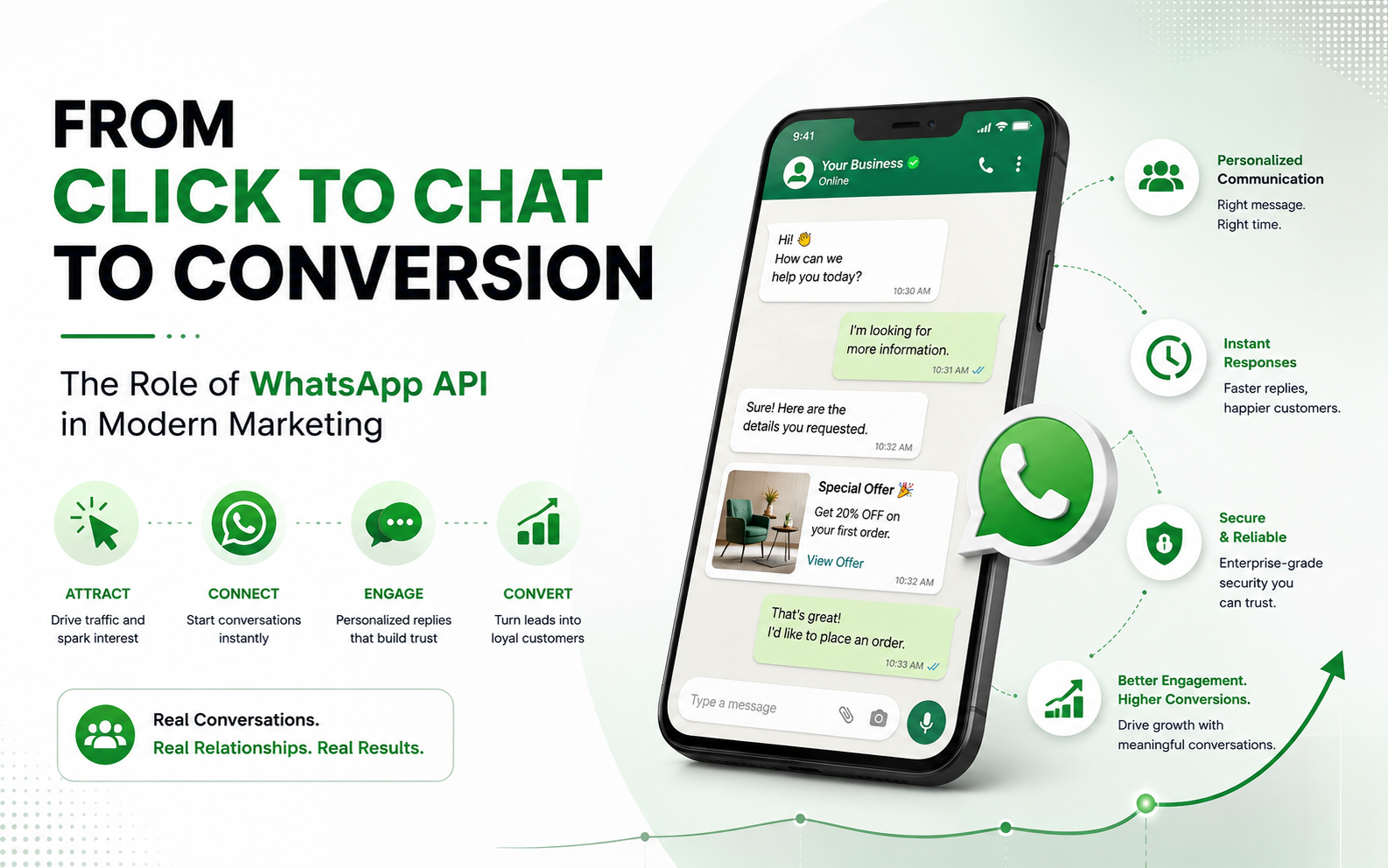
Click → Chat → Engage → Qualify → Convert → Retain
This approach connects marketing with sales and customer service.
At Trending Bulb, the focus is not simply on generating clicks. Instead, the goal is to create digital journeys that turn attention into action. With Campaign Plus and Step4Growth, businesses can combine digital marketing, WhatsApp automation, lead management, and customer communication into one connected strategy.
What Is WhatsApp API in Modern Marketing?
The WhatsApp Business Platform, commonly known as WhatsApp API, allows businesses to communicate with customers at scale.
Unlike a basic WhatsApp account, an API-based setup can connect with CRM systems, chatbots, automation platforms, and business software.
Therefore, companies can create structured communication journeys instead of depending entirely on manual replies.
For example, imagine a customer sees an advertisement for a festive jewellery collection.
The customer clicks the WhatsApp button.
Immediately, an automated message can welcome the customer and present relevant options.
A simple message could say:
“Hi! 👋 Welcome to our festive collection. What would you like to explore today?”
The customer can select an option and continue the conversation.
Meanwhile, the system can collect useful information and pass qualified leads to the sales team.
Consequently, WhatsApp becomes more than a messaging channel. It becomes part of the marketing and sales journey.
Why Modern Marketing Needs More Than Clicks
Clicks are important.
Nevertheless, they do not tell the complete story.
A customer may click an advertisement because they are curious. Another visitor may be comparing prices. Someone else may already be ready to buy.
Therefore, businesses need to understand what happens after the click.
Consider a simple example.
A company spends money on Meta Ads and generates thousands of clicks. However, many visitors leave without making an enquiry.
Now imagine that interested visitors can start a WhatsApp conversation immediately.
They can ask questions, request product information, compare options, and speak with a sales representative.
As a result, the business has another opportunity to convert the interest generated by its advertising campaign.
The difference is simple:
Advertising captures attention.
WhatsApp starts the conversation.
Sales converts the opportunity.
From Click to Chat: The New Customer Journey
The traditional digital marketing funnel often looks like this:
Ad → Website → Form → Sales Team → Follow-Up → Purchase
Although this model can work, it can also create friction.
For instance, customers may not want to complete a long form. They might also prefer instant answers instead of waiting for a callback.
WhatsApp can reduce these barriers.
The modern journey can therefore look like:
Ad → WhatsApp → Automated Response → Qualification → Sales Conversation → Conversion
This journey is more direct.
Moreover, customers can communicate through a platform they already understand.
The result is a smoother path between marketing and sales.
How WhatsApp API Turns Clicks Into Conversations
A digital advertisement creates interest.
The next challenge is keeping that interest alive.
Suppose someone clicks an advertisement for a product. That person may have a genuine buying intention. Yet, if the website is confusing or the required information is difficult to find, the customer may leave.
A WhatsApp conversation can provide a simpler alternative.
For example, the customer might ask:
“What is the price?”
The business can provide the answer immediately.
Similarly, another customer might ask:
“Do you deliver to my city?”
Automation can provide the relevant information.
If the customer has a complex question, the conversation can move to a human representative.
Therefore, businesses can combine:
Automation for speed + Human support for complex conversations
1. Instant Responses Can Protect Customer Interest
Speed matters in digital marketing.
When someone responds to an advertisement, their interest may be strongest at that moment.
Unfortunately, a delayed response can give competitors an opportunity.
WhatsApp automation can solve part of this problem by sending an immediate first response.
For example:
“Thanks for contacting us! How can we help you today?”
After that, customers can select an option or type their question.
As a result, the business can acknowledge the enquiry without making the customer wait.
2. Automated Lead Qualification Saves Time
Not every enquiry represents the same sales opportunity.
Some customers are ready to buy. Others are still researching. Meanwhile, some prospects have specific requirements.
WhatsApp automation can ask qualifying questions before sending the lead to the sales team.
Consider a real estate company.
The chatbot could ask:
- Which location are you interested in?
- What type of property do you need?
- What is your approximate budget?
- When are you planning to purchase?
- Would you like to schedule a site visit?
These questions provide valuable context.
Consequently, the salesperson receives a more informed lead.
Instead of repeating basic questions, the representative can focus on the customer’s actual requirement.
3. Personalization Makes Conversations More Relevant
Customers want relevant communication.
Generic messages can feel impersonal. On the other hand, personalized messages can make the customer journey more useful.
For example, an e-commerce customer interested in jewellery can receive information about relevant collections.
Similarly, a real estate prospect searching for a 2BHK property can receive suitable project information.
In addition, customer information can help businesses create more relevant follow-ups.
Therefore, WhatsApp API in modern marketing can support communication that feels more connected to each customer’s needs.
4. Automated FAQs Improve Customer Experience
Businesses receive many repetitive questions every day.
Customers may ask:
- What is the price?
- Is the product available?
- What are the delivery charges?
- Where are you located?
- What payment options are available?
- How can I book an appointment?
- When will my order arrive?
Instead of answering every basic question manually, businesses can automate common responses.
This saves time for employees.
At the same time, customers receive information faster.
Moreover, sales representatives can spend more time on conversations that actually require human attention.
WhatsApp API + CRM Integration: Connecting Data With Sales
WhatsApp becomes even more powerful when it connects with a CRM.
Without integration, customer details can remain scattered across conversations.
With CRM integration, businesses can organize information and track the customer journey.
A connected process can look like this:
Ad Click → WhatsApp Chat → Qualification → CRM → Follow-Up → Sale
The CRM can help teams track:
- Lead source
- Customer requirements
- Conversation history
- Sales stage
- Follow-up status
- Purchase history
- Customer preferences
Therefore, sales representatives can work with better information.
Furthermore, the team can continue conversations without asking customers to repeat everything.
This creates a smoother experience for both the customer and the business.
With CampaignPlus, businesses can explore WhatsApp API solutions that support structured communication and automation workflows.
WhatsApp API + Meta Ads: Turning Advertising Into Conversation
Meta Ads can generate awareness and traffic.
However, businesses can make the customer journey more direct by connecting campaigns with WhatsApp.
Here is how the journey can work:
Step 1: A customer sees a Meta Ad.
Step 2: The customer clicks the WhatsApp CTA.
Step 3: An automated welcome message appears.
Step 4: The chatbot asks relevant questions.
Step 5: The system qualifies the lead.
Step 6: A sales representative takes over when required.
Step 7: The customer receives relevant information.
Step 8: The sales team works toward conversion.
As a result, advertising and sales communication become part of one journey.
Instead of measuring only clicks, businesses can also evaluate conversations, qualified leads, and conversions.
That makes the marketing strategy more outcome-focused.
WhatsApp API for E-Commerce
E-commerce brands can use WhatsApp across several stages of the customer journey.
For example, businesses can use it for:
- Product enquiries
- Product recommendations
- Order confirmations
- Shipping updates
- Delivery notifications
- Payment reminders
- Customer support
- Abandoned-cart communication
- Promotional campaigns
- Post-purchase engagement
Suppose a customer adds a product to the cart but does not complete the purchase.
A relevant WhatsApp reminder can help bring that customer back to the buying journey, subject to applicable policies and customer consent.
After the purchase, the same channel can provide order updates.
Later, appropriate communication can support retention.
Therefore, WhatsApp can contribute to both acquisition and customer retention.
WhatsApp API for Real Estate
Real estate involves high-value decisions.
Customers often need detailed information before taking the next step.
They may ask about:
- Location
- Price
- Amenities
- Floor plans
- Possession
- Financing
- Site visits
WhatsApp automation can collect these requirements.
For example:
Customer: “I need a 2BHK.”
Bot: “Which location are you interested in?”
The customer selects a location.
Next, the chatbot can ask about budget and preferred possession timeline.
After qualification, the lead can move to a salesperson.
Consequently, the sales representative receives useful information before starting the conversation.
This can make the sales process more focused.
WhatsApp API for Education Businesses
Education companies receive a high volume of enquiries.
Students may want information about:
- Courses
- Fees
- Eligibility
- Duration
- Timings
- Certifications
- Admission dates
A WhatsApp chatbot can answer common questions instantly.
Furthermore, it can collect information about the student’s interests.
For example, the chatbot can ask:
“Which course are you interested in?”
The student selects a course.
Next, the system can ask about preferred batch timing.
Finally, the enquiry can move to an admissions counsellor.
This approach can reduce repetitive work while improving response speed.
WhatsApp API for Service Businesses
Service businesses can also benefit from WhatsApp automation.
Consider a digital marketing agency.
A potential client sees an advertisement offering a consultation.
After clicking the WhatsApp CTA, the prospect enters a conversation.
The chatbot can ask:
- What type of business do you operate?
- Which service are you interested in?
- What is your main business objective?
- Are you currently running ads?
- What is your approximate monthly marketing budget?
The answers give the sales team useful context.
As a result, the first human conversation can focus on the business challenge instead of basic information gathering.
The same strategy can work for consultants, agencies, travel companies, automotive businesses, beauty brands, educational institutions, and local service providers.
AI Chatbots + WhatsApp Automation
AI is adding another layer to customer communication.
Traditional chatbots generally follow predefined flows.
AI-powered systems can handle natural-language questions within their configured capabilities.
For example, a customer might write:
“I need a Diwali gift under ₹5,000.”
An AI-enabled system can understand the basic requirement and guide the customer toward relevant options.
However, automation should not replace human support completely.
Complex complaints may need a person.
High-value negotiations may also require a salesperson.
Likewise, sensitive customer situations should receive appropriate human attention.
Therefore, the strongest approach is often:
AI + Automation + Human Support
WhatsApp API for Lead Follow-Up
Generating a lead is only the beginning of the sales process.
Many prospects do not purchase during their first conversation.
They may want to compare options. Alternatively, they may need more time to make a decision.
A structured follow-up strategy can keep the conversation moving.
For example:
Day 1: Share requested information.
Day 3: Answer common questions.
Day 5: Share useful product or service details.
Day 7: Offer additional assistance.
However, businesses should avoid excessive messaging.
Instead, communication should remain relevant and useful.
Most importantly, businesses should follow applicable WhatsApp messaging policies, consent requirements, and user preferences.
WhatsApp API for Customer Retention
The customer journey does not end after a purchase.
In fact, the post-purchase stage can create valuable opportunities.
Businesses can use WhatsApp for:
- Order updates
- Appointment reminders
- Service notifications
- Feedback requests
- Renewal reminders
- Customer support
- Relevant offers
- Loyalty communication
For example, a customer can receive useful information after purchasing a product.
Later, the business can send relevant communication based on the customer’s relationship with the brand.
Consequently, WhatsApp can support long-term engagement rather than only one-time sales.
The Role of Trending Bulb in Modern Digital Marketing
At Trending Bulb, digital marketing should focus on the complete customer journey.
Likes and impressions can provide useful insights.
However, businesses also need to understand what happens after a customer interacts with an advertisement.
That is why a connected strategy can include:
SEO → Content → Meta Ads → Website → WhatsApp → CRM → Sales → Retention
Each channel has a role.
SEO can attract people who actively search for solutions.
Content can educate and build trust.
Meta Ads can reach targeted audiences.
WhatsApp can start direct conversations.
CRM systems can organize customer information.
Sales teams can convert qualified opportunities.
Finally, retention campaigns can encourage repeat engagement.
As a result, marketing becomes a connected growth system rather than a collection of separate activities.
Step4Growth: Connecting Marketing With Growth
Step4Growth focuses on an important principle: marketing should support measurable business growth.
Traffic matters.
Leads matter.
Yet, conversions and revenue remain critical business outcomes.
Therefore, businesses need to reduce the gap between marketing and sales.
A customer who clicks an advertisement should have a simple next step.
A qualified lead should reach the right sales representative.
Likewise, a prospect who needs follow-up should not disappear from the pipeline.
After a purchase, customers should continue receiving useful support.
WhatsApp automation can contribute to each of these stages.
As a result, businesses can move from basic lead generation toward a more structured growth engine.
CampaignPlus and WhatsApp API Automation
Campaign Plus can help businesses use WhatsApp API as part of a broader communication strategy.
Instead of treating WhatsApp as another messaging application, businesses can connect it with marketing, sales, automation, and customer support.
For example, the journey can look like:
Campaign → Click → WhatsApp → Automation → Qualification → CRM → Sales → Conversion
Each stage serves a clear purpose.
First, marketing creates awareness.
Next, the WhatsApp CTA starts the conversation.
Then, automation provides an instant response.
Afterward, qualification identifies relevant opportunities.
The CRM organizes the customer data.
Finally, the sales team works toward conversion.
This connected process can make customer communication more organized and measurable.
How to Measure WhatsApp Marketing Performance
A successful WhatsApp strategy should not focus only on message volume.
Instead, businesses should measure the complete customer journey.
Click-to-Chat Rate
This metric shows how effectively campaigns encourage customers to start WhatsApp conversations.
Response Rate
Next, businesses can measure how many customers continue the conversation.
Lead Qualification Rate
This metric shows how many conversations become genuine business opportunities.
Conversion Rate
Afterward, the business can measure how many qualified leads become customers.
Cost Per Lead
This shows how much advertising spend is required to generate each lead.
Cost Per Acquisition
Similarly, this metric shows the cost of acquiring a customer.
Customer Retention
Finally, businesses can measure how many customers return or continue engaging.
These metrics provide a clearer view of campaign performance.
For example, a campaign may generate many clicks but very few chats.
In that situation, the CTA or offer may need improvement.
Similarly, a campaign may generate many conversations but few qualified leads.
That result could indicate an audience-targeting or qualification issue.
Therefore, businesses should measure every important stage.
Common WhatsApp Marketing Mistakes
Focusing Only on Clicks
Clicks are useful, but they do not tell the entire story.
Instead, track conversations, qualified leads, conversions, and revenue.
Delaying Responses
A slow response can reduce customer interest.
Therefore, use automation to acknowledge enquiries quickly.
Sending Generic Messages
Generic communication can feel disconnected.
Instead, use relevant information whenever possible.
Over-Automating Conversations
Automation is useful for repetitive tasks.
However, customers should still have access to human support.
Ignoring CRM Integration
Without proper lead management, valuable information can become difficult to track.
Therefore, connect conversations with the systems your sales team already uses.
Sending Too Many Promotional Messages
More messages do not automatically mean more sales.
Instead, focus on relevance, timing, consent, and value.
Ignoring Conversion Tracking
A high number of chats does not guarantee business success.
For that reason, connect WhatsApp activity with your sales and conversion data wherever possible.
From Marketing Funnel to Conversation Funnel
The traditional marketing funnel is changing.
Customers can discover a business through Instagram, Facebook, Google, YouTube, influencers, websites, or paid advertising.
After discovery, they often want answers.
For that reason, conversations are becoming an important part of the customer journey.
The modern funnel can look like:
Discover → Click → Chat → Ask → Compare → Decide → Buy → Return
WhatsApp can connect several of these stages.
Meanwhile, AI, CRM systems, automation, and advertising platforms can work together to create a more connected experience.
The objective is not to make the journey complicated.
Instead, businesses should make the next step easier for the customer.
Why WhatsApp API Is Important for Modern Marketing
Customer expectations are changing.
People want fast answers.
They also expect convenient communication.
In addition, customers increasingly value relevant recommendations and personalized experiences.
WhatsApp can support these expectations through direct communication, automation, personalization, and integration.
At the same time, businesses can improve lead management and response speed.
Therefore, WhatsApp API in modern marketing is about much more than sending messages.
It is about creating a connected customer experience.
The Future of Click-to-Conversion Marketing
The future of digital marketing will not depend on one channel.
Instead, successful businesses will connect multiple touchpoints.
A customer might discover a brand on Instagram.
Later, that person may search for the company on Google.
Next, they could visit the website.
Then, the customer may start a WhatsApp conversation.
Afterward, the CRM can capture the lead.
An automated system can answer initial questions.
Finally, a salesperson can continue the conversation and work toward conversion.
This connected approach reduces friction.
More importantly, it gives businesses multiple opportunities to understand customer needs.
Therefore, the future customer journey can be summarized as:
Marketing attracts.
WhatsApp engages.
Automation responds.
CRM organizes.
Sales converts.
Retention builds lifetime value.
Conclusion: Turn Every Click Into an Opportunity
A click is only the beginning.
The real opportunity starts when that click becomes a conversation.
With WhatsApp API in modern marketing, businesses can create a direct path between advertising and customer communication.
First, a Meta Ad captures attention.
Next, WhatsApp starts the conversation.
Then, automation provides an instant response.
After that, AI can handle suitable repetitive questions.
Lead qualification can identify genuine opportunities.
Meanwhile, CRM integration can organize customer information.
Finally, sales representatives can take over when human interaction is needed.
This journey changes the way businesses measure marketing performance.
Instead of asking only:
“How many clicks did we get?”
Businesses should also ask:
“What happened after the click?”
Did the customer start a conversation?
Did the business respond quickly?
Was the lead qualified?
Did the sales team follow up?
Did the customer convert?
Did the customer return?
These questions reveal the true value of a connected marketing strategy.
At Trending Bulb, the goal is to help businesses connect marketing attention with meaningful customer action.
Through Campaign Plus, businesses can explore WhatsApp API and automation for customer communication.
With Step4Growth, digital marketing activities can be aligned with measurable business growth.
Ultimately, the modern customer journey is simple:
Get the Click.
Start the Chat.
Build the Relationship.
Drive the Conversion.
When businesses connect these stages effectively, every marketing interaction can become a valuable opportunity for growth.