Introduction: Your Leads Need More Than a Message
Getting a lead is only the beginning of the sales journey.
A customer may click your ad, visit your website, or submit an enquiry. However, the opportunity can disappear if your sales team does not respond at the right time.
That is why businesses need more than lead generation.
They need connected customer data, faster communication, smart follow-ups, and better sales visibility.
This is where CRM integration with WhatsApp API and RCS becomes powerful.
A CRM stores valuable customer information. WhatsApp API enables businesses to communicate with customers at scale. RCS can add rich and interactive messaging experiences where supported.
When these technologies work together, businesses can create a smoother sales journey.
For example, a customer can submit a form after seeing a Meta Ad. The CRM can capture the lead. Then, WhatsApp API can trigger an instant response.
The sales team can also see the customer’s details and previous interactions.
As a result, the team can respond with context instead of starting the conversation from scratch.
For businesses focused on digital growth, this connection can turn scattered conversations into a structured sales process.
At Trending Bulb, digital marketing is about more than attracting attention. It is also about creating meaningful customer journeys.
Similarly, Step4Growth focuses on strategies that help businesses attract, engage, nurture, and convert customers.
With Campaign Plus, businesses can also explore WhatsApp API-powered communication as part of their customer engagement strategy.
So, let’s understand how CRM integration makes WhatsApp API and RCS more powerful for sales.
What Is CRM Integration?
CRM stands for Customer Relationship Management.
A CRM system helps businesses organize customer information and manage sales activities.
It can store details such as:
- Customer name
- Phone number
- Lead source
- Previous interactions
- Product interest
- Purchase history
- Sales stage
- Follow-up date
- Customer preferences
- Sales team notes
However, a CRM becomes even more useful when it connects with communication channels.
That is where CRM integration comes in.
CRM integration connects your customer database with tools such as WhatsApp API, RCS, websites, advertising platforms, forms, and sales automation systems.
Therefore, customer data can move between different parts of the sales journey.
Instead of keeping information in separate systems, businesses can build a more connected workflow.
Why WhatsApp API and RCS Matter for Sales
Customers want quick answers.
They also expect convenient communication.
Traditional communication methods can sometimes create delays. Emails may remain unopened. Phone calls may go unanswered. Manual follow-ups can also take valuable time.
WhatsApp API provides a powerful way for businesses to communicate with customers through WhatsApp.
Businesses can use it for:
- Lead engagement
- Customer support
- Notifications
- Order updates
- Appointment reminders
- Follow-ups
- Product information
- Promotional communication, subject to applicable messaging rules
RCS adds another option for richer mobile messaging where supported.
Depending on device and market availability, RCS can support features such as images, buttons, suggested actions, and branded messaging experiences.
However, communication becomes even more valuable when it uses customer data.
That is exactly where CRM integration makes a difference.
How CRM Integration Makes WhatsApp API and RCS More Powerful for Sales
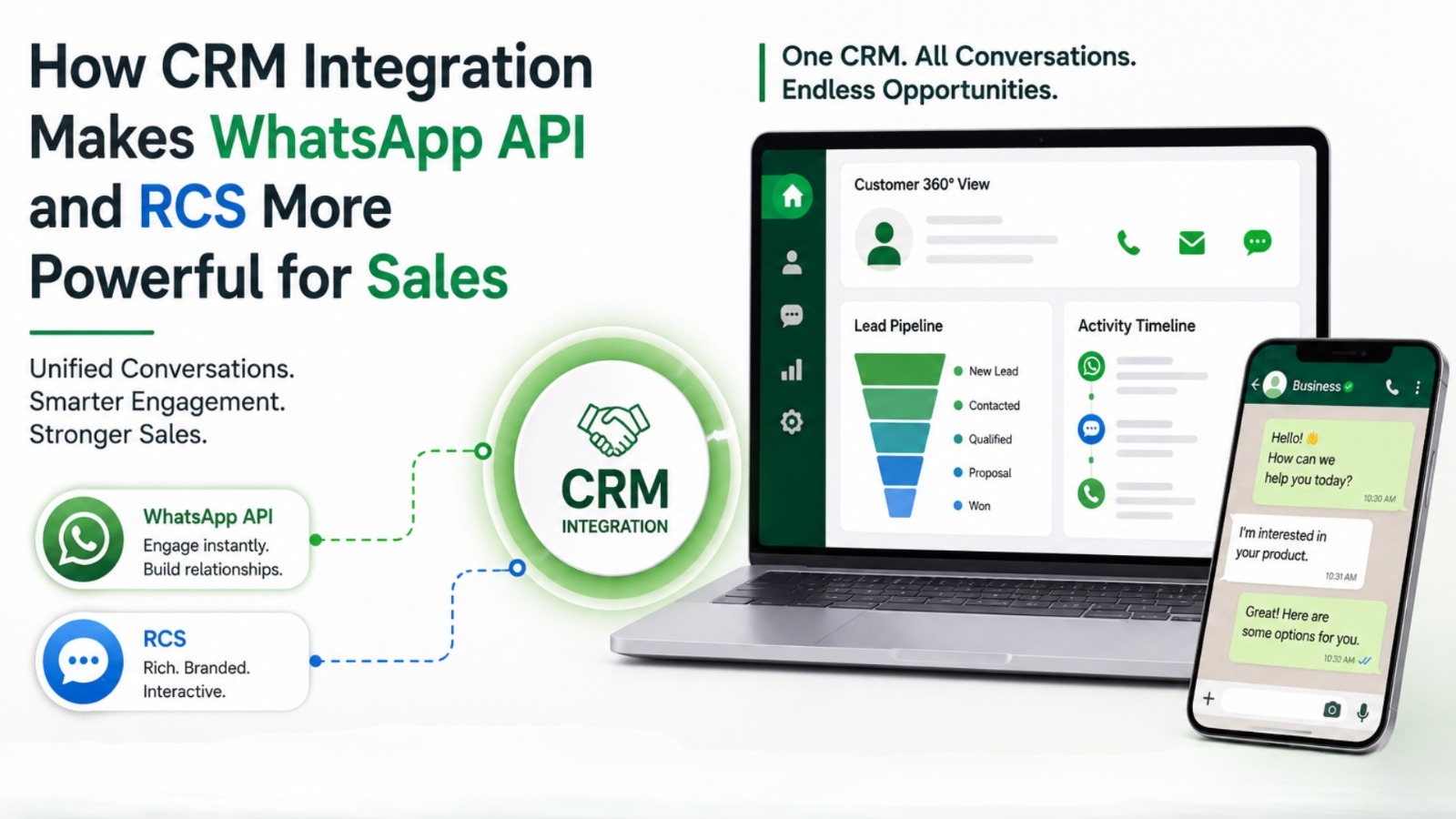
1. It Creates a 360-Degree Customer View
Sales teams need context.
A customer may have already interacted with your brand several times before speaking with a salesperson.
Without CRM integration, that history may remain scattered.
With integration, the team can see important information in one place.
For example, a salesperson may see:
Lead Source: Instagram Ad
Interest: Product Demo
Last Interaction: WhatsApp
Status: Qualified
Next Action: Sales Call
Now the salesperson understands the situation.
Therefore, the conversation becomes more relevant.
Instead of asking basic questions again, the salesperson can continue from the customer’s previous interaction.
That creates a smoother experience.
2. It Makes WhatsApp Conversations More Personalized
Generic messages often feel like advertisements.
Personalized messages feel more relevant.
CRM integration allows businesses to use customer information to create more targeted communication.
For example, an education company may have leads interested in different courses.
One customer may want a digital marketing course.
Another may want a graphic design course.
Instead of sending the same WhatsApp message to everyone, the business can create different communication journeys.
As a result, customers receive information that matches their interests.
Personalization can also help sales teams recommend the right products, services, offers, or next steps.
3. It Speeds Up Lead Response
Speed matters in sales.
A customer who shows interest today may choose another business tomorrow.
Therefore, businesses should respond quickly.
CRM integration can connect lead capture with automated communication.
Consider this simple journey:
Ad → Lead Form → CRM → WhatsApp API → Lead Qualification → Sales Team
A customer submits an enquiry.
The CRM captures the information.
Next, WhatsApp API can send an immediate acknowledgement.
The customer can then receive relevant questions or information.
Meanwhile, the sales team can receive the lead with the necessary context.
As a result, businesses can reduce delays between lead generation and first contact.
4. It Automates Follow-Ups
Many businesses lose leads because follow-ups happen too late.
A salesperson may forget to call.
Another lead may remain unanswered.
Someone else may never receive the promised quotation.
CRM integration can help organize these follow-ups.
For example:
Day 1: Welcome message
Day 2: Product information
Day 4: Follow-up message
Day 6: Customer testimonial
Day 8: Demo or consultation invitation
The exact journey should depend on customer behavior and business goals.
However, automation can make the process more consistent.
WhatsApp API can support automated communication, while the CRM can track lead status and follow-up activity.
Consequently, sales teams can spend more time on meaningful conversations.
5. It Helps Sales Teams Prioritize High-Intent Leads
Not every lead has the same buying intent.
Some customers are simply researching.
Others may be ready to make a purchase.
Therefore, sales teams need a way to identify high-intent prospects.
CRM data can help businesses track customer actions.
For example, a lead may:
- Ask for pricing
- Request a demo
- Click a product link
- Reply to a WhatsApp message
- Ask about availability
- Request a quotation
These actions can indicate stronger buying intent.
The sales team can then prioritize such leads.
As a result, sales representatives can focus their time where it matters most.
6. It Makes RCS More Relevant
RCS can create richer messaging experiences.
However, attractive content alone does not guarantee sales.
The message must also be relevant.
CRM data can help businesses understand customer interests.
For example, a fashion brand can identify customers who previously showed interest in a particular category.
The brand can then send an appropriate RCS experience where supported.
The message could include:
- Product images
- Product details
- Pricing
- Offers
- Suggested actions
- Shopping options
Therefore, CRM data can help turn RCS from a basic messaging channel into a more contextual customer experience.
7. It Connects Marketing With Sales
Marketing teams generate leads.
Sales teams convert them.
However, problems can occur when both teams work with different information.
CRM integration helps create a connection.
For example:
Google Ads → Landing Page → CRM → WhatsApp API → Sales Team
The customer first discovers the business through an advertisement.
Next, the customer visits a landing page.
The customer submits an enquiry.
The CRM captures the lead.
Then, WhatsApp API starts the communication journey.
The sales team can finally take over when human assistance becomes necessary.
This creates a connected path from marketing to sales.
8. It Reduces Missed Leads
Lead leakage can hurt revenue.
Imagine a business generates 500 enquiries in a month.
If the sales team cannot follow up with every lead, potential opportunities may disappear.
CRM integration can help organize those leads.
Each lead can have a stage.
For example:
New → Contacted → Qualified → Proposal → Negotiation → Won
The sales team can identify leads that need attention.
Meanwhile, automation can handle routine communication.
Therefore, fewer leads get forgotten.
9. It Gives Salespeople Better Conversation Context
Customers dislike repeating themselves.
Imagine a customer explains their requirement through WhatsApp.
Later, another salesperson joins the conversation.
If that salesperson has no context, they may ask the same questions again.
That creates friction.
With CRM integration, customer information can remain connected to the sales journey.
The salesperson can review previous activity.
Then, they can continue the conversation with better context.
As a result, customers receive a more professional experience.
10. It Supports Lead Qualification
Not every enquiry deserves the same sales approach.
Businesses can use automated questions to understand customer requirements.
For example, a real estate company could ask:
Which property type are you looking for?
The customer selects an option.
Next, the system can ask:
What is your preferred budget?
The CRM can capture these answers.
Then, the business can classify the lead.
A high-intent prospect can move to the sales team.
Meanwhile, another lead can enter a nurturing journey.
This approach helps sales teams work more efficiently.
11. It Helps Businesses Track Customer Journeys
A customer journey rarely happens through one channel.
A customer might:
- See an Instagram post.
- Click an advertisement.
- Visit a website.
- Submit an enquiry.
- Receive a WhatsApp message.
- Ask a question.
- Request a demo.
- Speak with a salesperson.
- Make a purchase.
Without integration, tracking this journey can become difficult.
With CRM integration, businesses can connect more of these interactions.
Therefore, teams gain a clearer picture of how customers move from awareness to conversion.
12. It Improves Sales Reporting
Good sales decisions require data.
CRM integration can help businesses track important metrics.
For example:
- Number of leads
- Qualified leads
- Response rates
- Follow-up activity
- Demo bookings
- Conversion rates
- Sales value
- Campaign performance
Businesses can then compare different lead sources and communication journeys.
For instance, a company may discover that leads from a particular campaign respond better on WhatsApp.
Another campaign may perform better with RCS where available.
These insights can guide future marketing decisions.
WhatsApp API + CRM vs WhatsApp API Alone
WhatsApp API provides powerful communication capabilities.
However, CRM integration adds customer intelligence and sales structure.
WhatsApp API Alone
- Business messaging
- Automated communication
- Customer support
- Notifications
- Follow-ups
WhatsApp API + CRM
- Customer profiles
- Lead tracking
- Conversation history
- Lead segmentation
- Personalized messages
- Automated follow-ups
- Sales pipeline visibility
- Performance tracking
Therefore, the combination creates a more complete sales system.
RCS + CRM: From Rich Messaging to Better Sales
RCS can make messages more engaging.
CRM can make those messages more relevant.
Together, they can support better customer journeys where RCS is available.
For example, a travel business can identify customers interested in a specific destination.
The business can then create a rich RCS message with:
Destination → Package → Price → Offer → Booking Action
The customer can explore the information without receiving a generic promotional message.
Furthermore, CRM data can help the business track customer activity and plan future communication.
CRM Integration Can Support AI-Powered Sales
AI can add another layer of intelligence to the customer journey.
For example, AI-powered systems can help businesses:
- Answer common questions
- Qualify leads
- Understand customer intent
- Recommend products
- Summarize conversations
- Suggest responses
- Route leads
- Support sales teams
Consider a customer asking about product pricing on WhatsApp.
An automated assistant can answer basic questions.
If the customer shows buying intent, the system can pass the conversation to a sales representative.
The CRM can then store the interaction.
As a result, automation handles repetitive tasks while sales teams focus on valuable opportunities.
How Campaign Plus Fits Into the Customer Communication Journey
Businesses need scalable communication when their lead volume grows.
Campaign Plus can form part of a WhatsApp API communication strategy for businesses that want to automate and manage customer interactions.
CRM integration can add another layer to this process.
For example:
Lead Capture → CRM → WhatsApp API → Qualification → Follow-Up → Sales
The CRM manages customer information.
WhatsApp API supports customer communication.
Automation handles repetitive steps.
Sales representatives handle conversations that require human attention.
Therefore, businesses can create a more organized communication process.
How Step4Growth Can Connect Digital Marketing With Sales
Digital marketing generates opportunities.
However, generating traffic alone does not guarantee revenue.
Businesses need a system that moves prospects forward.
That is where a growth-focused strategy becomes important.
A connected digital journey can include:
SEO → Google Ads → Meta Ads → Social Media → Landing Page → CRM → WhatsApp API → RCS → Sales
Each channel has a role.
SEO can attract users who are actively searching.
Google Ads can capture high-intent traffic.
Meta Ads can create targeted demand.
Social media can build awareness.
Landing pages can capture leads.
CRM can organize those leads.
WhatsApp API can support conversations.
RCS can add rich messaging experiences where supported.
Finally, sales teams can convert qualified opportunities.
Step4Growth can use this connected approach to help businesses think beyond individual campaigns.
The focus shifts from clicks to conversations.
Then, the focus moves from conversations to conversions.
Why Trending Bulb Focuses on Connected Digital Experiences
Modern customers move between channels.
They may discover a brand through social media.
Then, they may search Google for more information.
Later, they may visit the website.
Finally, they may contact the business through WhatsApp.
Therefore, businesses need consistent communication across the customer journey.
Trending Bulb can position this connected approach as an important part of modern digital marketing.
The objective is not simply to generate visibility.
Instead, the goal is to turn visibility into engagement and engagement into business results.
CRM, WhatsApp API, and RCS can support that journey.
CRM + WhatsApp API + RCS Across Different Industries
E-commerce
E-commerce businesses can use these technologies for:
- Product recommendations
- Order updates
- Abandoned-cart follow-ups
- Customer support
- Offers
- Repeat purchases
CRM data can help personalize the customer journey.
Real Estate
Real estate businesses can manage:
- Property enquiries
- Buyer preferences
- Budget information
- Site visits
- Follow-ups
- Sales pipeline stages
WhatsApp API can support fast communication with prospects.
Education
Education businesses can use messaging for:
- Course enquiries
- Counselling
- Application updates
- Admission reminders
- Course information
CRM data can help segment students by interest.
Travel
Travel companies can use customer data to support:
- Package enquiries
- Booking updates
- Itinerary communication
- Offers
- Follow-ups
RCS can add richer content where available.
Automotive
Automotive businesses can manage:
- Test-drive enquiries
- Vehicle information
- Service reminders
- Sales follow-ups
- Booking requests
CRM integration can help sales teams track every prospect.
Best Practices for CRM Integration With WhatsApp API and RCS
A successful integration requires more than connecting two platforms.
Businesses should follow a structured approach.
1. Keep Customer Data Accurate
Clean data improves personalization.
2. Segment Your Leads
Different customers need different communication.
3. Respond Quickly
Speed can influence the customer experience.
4. Automate Routine Tasks
Use automation for repetitive communication.
5. Keep Human Support Available
Sales representatives should step in when customers need personal assistance.
6. Track Customer Activity
Use CRM data to understand customer behavior.
7. Measure Conversions
Do not measure success only through message volume.
Track actual business outcomes.
8. Respect Customer Preferences
Follow applicable privacy rules, consent requirements, messaging regulations, and platform policies.
9. Test and Optimize
Review campaign performance and improve the journey continuously.
The Complete CRM + WhatsApp API + RCS Sales Funnel
A connected sales funnel can look like this:
Stage 1: Attract
Use SEO, Google Ads, Meta Ads, and social media.
Stage 2: Capture
Send interested users to a landing page or enquiry form.
Stage 3: Store
Capture the lead inside the CRM.
Stage 4: Engage
Start a relevant WhatsApp API or RCS conversation.
Stage 5: Qualify
Use automation and customer responses to understand intent.
Stage 6: Nurture
Send useful follow-ups based on customer needs.
Stage 7: Convert
Move qualified prospects to the sales team.
Stage 8: Retain
Continue customer communication after the sale.
This approach creates a complete customer journey.
Why CRM Integration Is the Future of Omnichannel Sales
Customers do not think in terms of marketing channels.
They simply expect a smooth experience.
They may discover your business on Instagram.
Then, they may search for your brand on Google.
After that, they may visit your website.
Finally, they may contact you through WhatsApp.
Therefore, businesses need to connect these touchpoints.
CRM integration helps bring customer information into one structured system.
WhatsApp API supports direct conversations.
RCS can provide richer interactions where available.
Digital marketing generates demand.
Sales teams close opportunities.
Together, these technologies can create a more connected omnichannel sales journey.
Final Thoughts
CRM integration can change the way businesses use WhatsApp API and RCS for sales.
Without integration, messaging remains a communication activity.
With integration, messaging becomes part of a connected sales process.
The CRM provides customer intelligence.
WhatsApp API provides direct communication.
RCS can provide richer messaging experiences where supported.
Digital marketing generates leads.
Sales teams convert qualified opportunities.
Together, these technologies can help businesses create faster, smarter, and more personalized customer journeys.
For Trending Bulb, the opportunity lies in connecting digital visibility with meaningful customer engagement.
For Step4Growth, the focus can move from simply generating leads to building a complete growth funnel.
With Campaign Plus, businesses can explore WhatsApp API-powered communication as part of that customer journey.
Ultimately, the formula is simple:
Attract the right audience.
Capture the right leads.
Connect the right data.
Start the right conversation.
Follow up at the right time.
Convert more opportunities.
That is why CRM integration with WhatsApp API and RCS is becoming an important part of modern sales strategies.
When customer data, communication, automation, and sales work together, businesses do not just send more messages.
They create better conversations, stronger relationships, and more opportunities to sell.