Introduction
Getting people to visit your website is important. However, website traffic alone does not create sales.
A visitor may explore your services, check your pricing, or read your blog. Yet, that same visitor can leave without sending an enquiry.
Why does this happen?
Often, the visitor has a question but cannot get an instant answer. Perhaps the contact form feels too long. Maybe the customer does not want to wait for an email reply.
As a result, the visitor may move to another website.
This is where WhatsApp automation can turn website visitors into customers. Instead of making visitors search for contact details, businesses can give them a direct path to a conversation.
With one WhatsApp button, a website visitor can ask a question, request information, book a demo, or speak with a sales team. Moreover, automation can respond immediately.
For Trending Bulb, this approach creates a stronger connection between digital marketing and customer conversion. Likewise, Step4Growth can help businesses build digital strategies that attract the right audience and guide that audience toward action.
Meanwhile, solutions such as Campaign Plus can support businesses that want to use WhatsApp communication for customer engagement and lead management.
Therefore, the journey becomes simple:
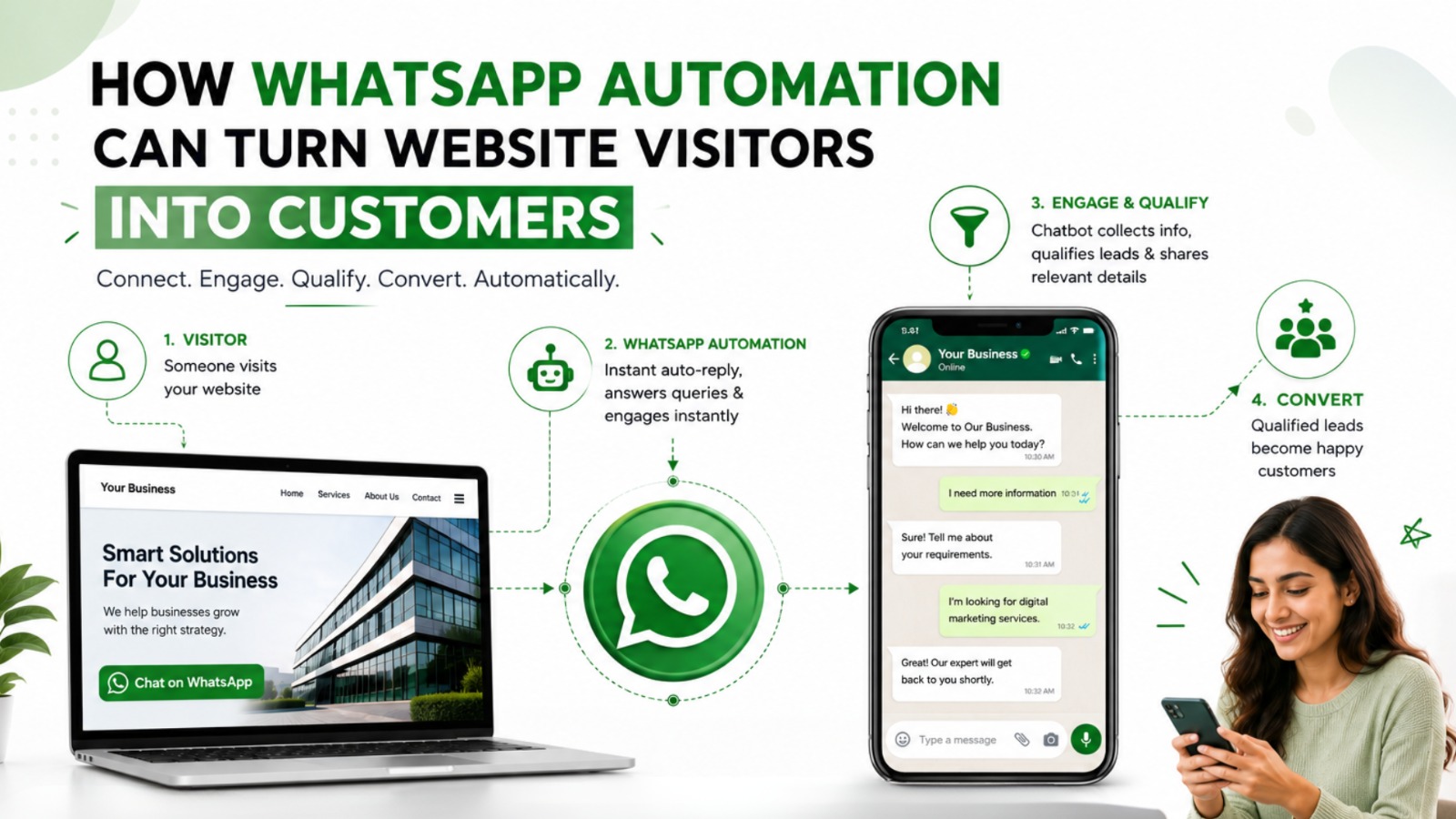
Website Visit → WhatsApp Chat → Lead Qualification → Sales Conversation → Customer.
Why Website Visitors Do Not Always Become Customers
Website traffic looks impressive on an analytics dashboard. However, traffic does not always mean buying intent.
Someone can visit your website for several reasons. They may want information, compare prices, check reviews, or explore your services.
Unfortunately, many visitors leave before starting a conversation.
One major reason is communication friction.
For example, a customer may need to complete a form before asking a simple question. Another visitor may need to wait several hours for a response.
Furthermore, some customers prefer messaging instead of filling out forms.
That is why businesses need to make communication easy.
A WhatsApp CTA can reduce the number of steps between interest and conversation. Consequently, visitors can contact the business while their interest is still fresh.
Instead of saying:
“Fill out the form and we will contact you.”
A business can say:
“Have a question? Chat with us on WhatsApp.”
This small change can create a smoother customer journey.
What Is WhatsApp Automation?
WhatsApp automation uses automated messages and workflows to manage customer conversations.
Instead of manually answering every basic enquiry, businesses can automate common parts of the conversation.
For example, a visitor clicks a WhatsApp button on your website. Immediately, an automated message can appear:
“Hi! Welcome to our business. How can we help you today?”
Next, the visitor can choose an option.
- Product enquiry
- Pricing
- Book a demo
- Request a callback
- Customer support
- Talk to sales
After that, the system can guide the visitor through the next steps.
As a result, businesses can respond faster while reducing repetitive manual work.
Most importantly, automation does not have to remove human interaction. Instead, it can handle the first part of the journey and bring a salesperson into the conversation when needed.
How WhatsApp Automation Can Turn Website Visitors Into Customers
The real value of WhatsApp automation appears when businesses connect it with their website and marketing funnel.
Here is how the process works.
1. Attract the Right Website Visitors
Every customer journey begins with awareness.
SEO can bring people from search engines. Google Ads can target users with strong search intent. Similarly, Meta Ads can introduce products and services to relevant audiences.
Social media adds another source of traffic. Meanwhile, blogs, videos, email campaigns, and referral marketing can bring additional visitors.
However, attracting visitors is only the beginning.
Once someone reaches your website, the next goal is engagement.
That is where WhatsApp can become a powerful conversion channel.
2. Add a Clear WhatsApp CTA
A website visitor should not have to search for a way to contact your business.
Instead, place a clear WhatsApp CTA in relevant areas.
For example:
Chat With Us on WhatsApp
Get a Free Quote
Talk to an Expert
Book a Demo
Ask About Pricing
The CTA can appear on the homepage, service pages, product pages, landing pages, and blog content.
For instance, a real estate website can add a WhatsApp button below each property listing.
Similarly, an education website can add a CTA below course information.
As a result, visitors can start a conversation at the exact moment they need help.
3. Respond Instantly
Speed can make a major difference in lead conversion.
Suppose someone visits your website at 10:30 PM. They have a question about your service.
Your sales team may not respond until the next morning.
By then, the customer may have contacted a competitor.
WhatsApp automation can solve this gap.
An instant message can acknowledge the enquiry:
“Thanks for contacting us! 👋 We’re here to help. What would you like to know?”
Therefore, the customer knows that the enquiry has reached your business.
Even when your team is unavailable, the automated flow can continue the initial conversation.
4. Understand Visitor Intent
Not every visitor wants the same thing.
One person may want pricing. Another may want product information. Someone else may want to schedule a meeting.
Therefore, the automation should identify intent early.
For example:
What can we help you with?
- Pricing
- Product details
- Demo
- Support
- Talk to sales
Once the visitor selects an option, the system can provide a relevant response.
This approach keeps the conversation focused.
Furthermore, it prevents visitors from receiving unnecessary information.
5. Qualify Leads Automatically
Lead qualification is another major benefit.
Sales teams often receive enquiries from different types of prospects. Some are ready to buy. Others are still researching.
WhatsApp automation can ask simple questions to understand the visitor.
For example:
“What service are you interested in?”
The next question could be:
“When are you planning to get started?”
Another question might ask:
“What is your approximate budget?”
The exact questions depend on the business.
For a real estate company, automation could ask about location and budget.
For a digital marketing agency, it could ask about business type, marketing goals, and monthly budget.
Consequently, the sales team receives better-qualified leads.
6. Personalize the Conversation
Automation does not mean sending the same message to everyone.
In fact, smart automation can create different paths for different customers.
Suppose a visitor selects “SEO Services.”
The system can provide SEO-related information.
Another visitor may select “Meta Ads.” That person can receive information about paid social campaigns instead.
Therefore, the conversation becomes more relevant.
Personalization also makes customers feel understood.
Instead of receiving a generic message, visitors receive information based on their selected needs.
As a result, the customer journey becomes more useful and engaging.
7. Answer Frequently Asked Questions
Customers often ask similar questions.
For example:
- What are your prices?
- How long does delivery take?
- Do you provide customization?
- Where are you located?
- How can I book a demo?
- What services do you offer?
- Do you provide support?
- What payment options are available?
A sales representative does not need to answer every basic question manually.
Instead, WhatsApp automation can handle common FAQs.
Therefore, customers receive answers faster.
At the same time, your sales team can focus on conversations that need human attention.
8. Send Qualified Leads to Sales
Automation should support your sales team rather than replace it.
Once the visitor provides the required information, the system can move the conversation to a sales representative.
For example:
Visitor: “I want to know about your premium digital marketing package.”
Automation: “Sure! We can connect you with our marketing specialist. Would you like a call or WhatsApp conversation?”
The customer chooses an option.
Then, the sales representative takes over.
Because the system has already collected important information, the salesperson can start with context.
This saves time.
More importantly, the customer does not need to repeat the same information.
9. Follow Up With Interested Visitors
Not every visitor will purchase during the first conversation.
Some customers need time.
Others may compare different options before making a decision.
Therefore, follow-up becomes important.
For example, a business can send useful follow-up messages after an enquiry.
First: Share the requested information.
Next: Answer any remaining questions.
Then: Share a relevant case study or product benefit.
Finally: Invite the customer to take the next step.
However, businesses should use responsible messaging practices and follow applicable WhatsApp rules and customer consent requirements.
The purpose should be helpful communication, not unwanted spam.
WhatsApp Automation and the Digital Marketing Funnel
Digital marketing attracts people.
WhatsApp automation helps businesses engage those people.
Together, they can create a complete conversion journey.
Awareness
SEO, Google Ads, Meta Ads, and social media attract potential customers.
Interest
The visitor reaches your website and explores your products or services.
Engagement
A WhatsApp CTA gives the visitor an easy way to ask questions.
Qualification
Automation collects useful information about the visitor.
Conversion
A sales representative handles the qualified conversation.
Retention
After the purchase, WhatsApp can support updates, reminders, customer service, and relationship building.
Therefore, WhatsApp automation should not exist separately from your marketing strategy.
Instead, it can connect your marketing activity with your sales process.
Benefits of WhatsApp Automation for Website Visitors
Faster Responses
Visitors can receive an instant acknowledgement instead of waiting for a team member.
As a result, businesses can respond while customer interest remains high.
24/7 Engagement
Automation can handle initial enquiries outside regular working hours.
Therefore, businesses can capture opportunities even when the sales team is offline.
Better Lead Qualification
Automated questions help identify visitor intent.
Consequently, sales teams can focus on prospects with stronger buying potential.
Less Friction
A WhatsApp conversation usually requires fewer steps than a lengthy enquiry process.
Therefore, customers can move from interest to communication faster.
Better Customer Experience
Visitors get a simple way to ask questions.
Moreover, automated responses can provide consistent information.
Improved Sales Productivity
Sales representatives do not need to answer every basic question manually.
Instead, they can spend more time on high-value conversations.
More Conversion Opportunities
Quick communication can prevent interested visitors from disappearing.
As a result, businesses have more opportunities to turn website traffic into customers.
How CampaignPlus Fits Into the WhatsApp Journey
Businesses that want to build structured WhatsApp communication can explore platforms such as Campaign Plus.
The idea is to connect customer acquisition with customer communication.
For example, a Meta Ad can bring a prospect to a landing page.
Next, the visitor clicks the WhatsApp CTA.
Then, automation welcomes the visitor and asks relevant questions.
After that, the system can qualify the lead and move the conversation toward the sales team.
This creates a connected process.
Instead of treating advertising, website traffic, WhatsApp communication, and sales as separate activities, businesses can connect them into one customer journey.
That approach becomes particularly useful when a business receives a high volume of enquiries.
How Step4Growth Can Use This Strategy
A successful digital marketing strategy should not stop at generating clicks.
Instead, businesses should consider what happens after the click.
For example, imagine a company launches a Meta Ads campaign.
The campaign generates hundreds of website visits.
However, visitors leave because they cannot get quick answers.
The business may then spend more money trying to generate additional traffic.
A better approach is to improve conversion opportunities first.
With WhatsApp automation, visitors can start a conversation immediately.
The system can ask about their needs. It can answer common questions. It can collect lead details.
Then, the sales team can take over.
Therefore, Step4Growth can use this type of strategy to connect digital marketing activity with lead conversion.
The Trending Bulb Approach: From Traffic to Conversations
At Trending Bulb, digital visibility should lead somewhere meaningful.
A website may receive thousands of visitors.
Social media may generate strong engagement.
Paid campaigns may produce clicks.
Nevertheless, the most important question remains:
What happens after the visitor shows interest?
WhatsApp automation provides an answer.
Instead of allowing visitors to leave without interaction, businesses can invite them to start a conversation.
That conversation can reveal their needs.
Furthermore, it can help qualify their interest and guide them toward the next step.
Consequently, businesses can build a stronger connection between attention and action.
Real-World Examples of WhatsApp Automation
E-commerce Businesses
A customer visits a product page.
They want to know whether a product is available in a particular size.
Instead of searching for support details, the customer clicks WhatsApp.
Automation can answer the question and guide the customer toward purchase.
Real Estate Businesses
A visitor views a property listing.
They click “Enquire on WhatsApp.”
Next, automation asks about budget, location, property type, and preferred visit time.
The sales team then receives a more qualified enquiry.
As a result, the agent can focus on serious prospects.
Education Businesses
A student visits a course page.
They want information about fees, eligibility, or course duration.
WhatsApp automation can provide basic information instantly.
Afterward, the system can offer a counselling call.
Thus, the student moves from website research to direct communication.
Travel Businesses
A visitor searches for a holiday package.
Instead of filling out a long form, they start a WhatsApp conversation.
Automation can ask about destination, travel dates, number of travellers, and budget.
Then, the travel consultant can create a more relevant proposal.
Service Businesses
A potential customer visits a service website.
They want to understand pricing and availability.
WhatsApp automation can answer basic questions first.
Later, a representative can discuss the customer’s exact requirement.
Therefore, the business can create a faster route from enquiry to consultation.
Best Practices for Website WhatsApp Automation
Keep the First Message Short
A long opening message can overwhelm visitors.
Instead, start with a simple greeting and one clear question.
Use Simple Choices
Buttons and predefined options can make the conversation easier.
Consequently, visitors can respond quickly.
Ask Relevant Questions
Do not ask for information that your team does not need.
Instead, collect details that help with qualification or sales.
Offer Human Support
Automation works best when customers can reach a real person when needed.
Therefore, include an easy human handoff.
Keep Messages Helpful
Every message should provide a clear purpose.
For example, answer a question, provide information, or guide the customer toward the next step.
Track Your Results
Measure the performance of your WhatsApp funnel.
Important metrics include:
- Website-to-WhatsApp clicks
- Conversations started
- Qualified leads
- Response time
- Appointment bookings
- Sales conversions
- Conversion rate
- Cost per qualified lead
These numbers can reveal where your funnel performs well.
They can also show where customers drop off.
Why WhatsApp Automation Matters for Modern Businesses
Customer expectations are changing quickly.
People want convenient communication.
They also expect faster responses.
At the same time, businesses need to manage growing numbers of enquiries without increasing manual work at the same rate.
WhatsApp automation can help solve both challenges.
Visitors receive faster communication.
Sales teams receive better-organized leads.
Businesses can also create consistent customer journeys.
Furthermore, automation can operate beyond normal working hours.
That means a website visitor does not have to wait until the next morning before receiving an initial response.
Instead, the conversation can begin immediately.
From Website Visitor to Customer: The Complete Journey
The process can be summarized in six simple stages.
Step 1: Attract
Digital marketing brings relevant visitors to your website.
Step 2: Engage
A WhatsApp CTA encourages interested visitors to start a conversation.
Step 3: Respond
Automation sends an instant welcome message.
Step 4: Qualify
The system asks questions and collects useful information.
Step 5: Connect
Qualified leads move to the right sales representative.
Step 6: Convert
The sales team uses the conversation context to move the prospect toward a purchase.
After conversion, the journey can continue.
WhatsApp can support order updates, reminders, customer service, feedback requests, and other relevant communications.
Therefore, the platform can support both conversion and retention.
Final Thoughts
Website traffic is valuable.
However, traffic becomes much more powerful when businesses know how to engage visitors.
WhatsApp automation can turn website visitors into customers by creating faster communication, reducing friction, qualifying leads, and connecting prospects with sales teams.
The strongest results come from combining multiple channels.
SEO can attract search traffic.
Google Ads can capture high-intent searches.
Meta Ads can generate targeted traffic.
Social media can build awareness.
Content marketing can establish trust.
Then, WhatsApp automation can turn that interest into a conversation.
For Trending Bulb, this creates an opportunity to connect digital visibility with measurable customer action.
Likewise, Step4Growth can use the same approach to help businesses think beyond clicks and focus on conversion.
With solutions such as Campaign Plus, businesses can build structured WhatsApp journeys that connect website visitors, automated conversations, lead qualification, and sales follow-up.
Ultimately, the goal is not simply to get more visitors.
The goal is to turn more visitors into conversations, more conversations into qualified leads, and more qualified leads into customers.
Ready to Turn Website Visitors Into Customers?
Your website is already attracting attention.
Now give those visitors an easier way to take action.
Connect your website with WhatsApp automation, respond faster, qualify leads, and create a smoother journey from:
Click → Conversation → Qualified Lead → Customer