INTRODUCTION
Imagine a potential customer visits your website, fills out a form, clicks a WhatsApp button, or responds to your advertisement. They are interested in what your business offers. More importantly, they are ready to start a conversation.
Then, nothing happens.
Your sales team takes hours to respond. Sometimes, the reply comes the next day. In some cases, the lead never receives a response at all.
So, what happens to a lead when your sales team doesn’t reply on time?
The answer is simple: the lead starts losing interest.
In today’s competitive digital market, customers have more choices than ever. Therefore, they do not always wait for one business to respond. Instead, they can contact a competitor within minutes.
For businesses using digital marketing to generate leads, this creates a serious problem. You may spend money on SEO, Google Ads, Meta Ads, social media campaigns, and content marketing. However, if your sales team does not respond quickly, those leads can disappear.
This is where WhatsApp automation can make a major difference.
With the right automation strategy, businesses can acknowledge new leads instantly, answer common questions, collect information, qualify prospects, and notify sales teams. As a result, businesses can reduce response delays and improve the customer journey.
For brands working with Trending Bulb, Step4Growth, and Campaign Plus, the goal should not simply be generating more leads. The goal should be turning those leads into meaningful conversations and customers.
Why Speed Matters in Lead Conversion
A lead is not equally valuable at every moment.
When someone first shows interest, their buying intent can be high. They may be comparing products, checking prices, looking for availability, or searching for a solution to an immediate problem.
At that moment, your business has an opportunity.
However, that opportunity can become weaker when the response takes too long.
For example, imagine someone searches Google for a digital marketing agency. They visit your website and submit an enquiry. At the same time, they are probably looking at several other agencies.
If your business responds within minutes, you can start the conversation while their interest is still fresh.
On the other hand, if you respond after six hours, the customer may have already spoken with another agency.
Therefore, speed is not simply a customer-service benefit. It can directly influence conversion rates.
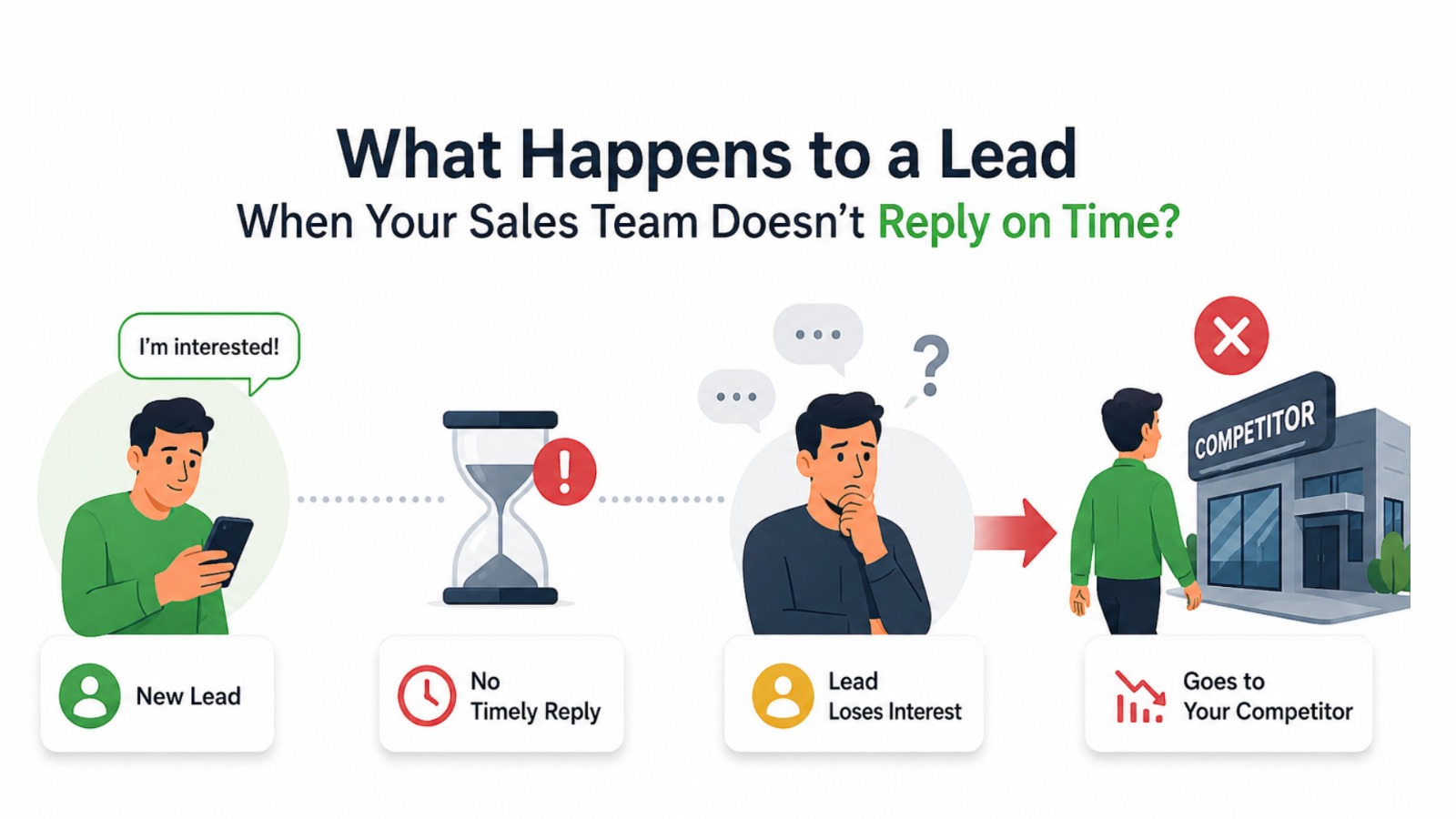
What Happens to a Lead When Your Sales Team Doesn’t Reply on Time?
When a sales team delays its response, the impact can happen in several stages.
1. The Lead Starts Losing Interest
Initially, the prospect is interested.
They have taken an action. Perhaps they completed a form, requested a quotation, clicked a WhatsApp button, or asked for product information.
However, silence creates uncertainty.
The customer may start wondering whether your business is active. They may also assume that your support will be slow after purchase.
Consequently, their confidence can decrease.
A lead that was ready to talk can slowly become a cold lead.
2. The Customer Contacts a Competitor
This is one of the biggest risks.
Customers rarely stop searching after contacting one company.
Instead, they may open Google and search for alternatives. They may also click another advertisement or message another business on WhatsApp.
If your competitor responds first, that competitor gets the opportunity to understand the customer’s needs.
Therefore, the fastest business may get the conversation before the best business does.
This is especially important in industries such as real estate, education, healthcare, travel, financial services, automotive, e-commerce, and professional services.
3. The Lead Forgets About Your Business
People receive dozens of notifications every day.
Because of this, even an interested prospect can forget why they contacted your business.
A delayed response makes that problem worse.
For instance, a customer might enquire about a product at 10 AM. If the sales team replies at 7 PM, the customer may no longer remember the exact product or requirement.
As a result, your sales representative has to restart the conversation.
That wastes time and reduces the momentum of the original enquiry.
4. Buying Intent Can Drop
Not every lead stays ready to buy forever.
A prospect may have high buying intent when they first contact you. However, that intent can decline as time passes.
Consider a customer who wants to book a service today.
If nobody responds, they may solve the problem elsewhere.
Similarly, someone looking for a limited-time offer may purchase from another business before your team replies.
Therefore, delayed responses can turn high-intent leads into low-intent prospects.
5. Your Advertising Money Gets Wasted
Generating leads costs money.
Businesses invest in Google Ads, Meta Ads, SEO, social media marketing, influencer campaigns, landing pages, content marketing, and other channels.
However, generating a lead is only the first step.
Suppose a company spends ₹50,000 on a campaign and generates hundreds of enquiries. If the sales team responds slowly, many of those opportunities can be lost.
In that situation, the marketing campaign may appear ineffective.
Yet the real problem may not be lead generation.
The problem could be lead follow-up speed.
This is why marketing and sales need to work together.
The Lead Generation Funnel Does Not End With a Form Submission
Many businesses treat a form submission as the final goal of marketing.
Actually, it is the beginning of the sales journey.
A typical digital customer journey looks like this:
Ad or Search → Website → Landing Page → Lead Form → WhatsApp/Call → Sales Conversation → Qualification → Follow-Up → Conversion
Every step matters.
If the customer reaches the sales conversation but receives no response, the funnel breaks.
Consequently, businesses need to focus not only on attracting leads but also on responding to them quickly.
Why Manual Lead Follow-Up Often Fails
Sales teams have many responsibilities.
They need to attend calls, conduct meetings, prepare quotations, update CRM records, answer existing customers, follow up with prospects, and close deals.
Therefore, expecting sales representatives to respond instantly to every new lead can be difficult.
Several problems can appear.
Leads Arrive Outside Working Hours
A customer may submit an enquiry at 11 PM.
Your sales team might not be available.
Without automation, the customer receives nothing until the next working day.
By then, the customer could have already contacted competitors.
Multiple Leads Arrive Together
Marketing campaigns can generate sudden spikes in enquiries.
For example, a successful Meta campaign may generate 100 leads in a few hours.
A small sales team may struggle to respond to every person quickly.
Consequently, some leads receive attention while others remain unanswered.
Sales Representatives Miss Notifications
Messages can be missed.
Emails can get buried.
CRM notifications can be overlooked.
Even phone calls can go unanswered.
Therefore, relying entirely on manual processes creates unnecessary gaps.
How WhatsApp Automation Helps Businesses Respond Faster
This is where WhatsApp automation becomes valuable.
Instead of waiting for a salesperson to start every conversation, automation can immediately acknowledge a new enquiry.
For example, a customer sends:
“Hi, I want to know the price.”
An automated WhatsApp system can respond:
“Hi! Thanks for contacting us. We would be happy to help. Please choose an option below.”
Then, the customer can select:
- Product Information
- Pricing
- Demo
- Appointment
- Talk to Sales
The conversation can continue automatically.
Meanwhile, the sales team can receive the lead details and take over when human assistance is required.
As a result, the customer is not left waiting.
WhatsApp Automation Can Qualify Leads
Not every lead has the same value.
Some prospects are ready to buy. Others are simply researching.
Sales teams can waste significant time manually identifying which prospects deserve immediate attention.
WhatsApp automation can help collect important information.
For example, a chatbot can ask:
What service are you interested in?
What is your budget range?
When are you planning to purchase?
Which location are you interested in?
Would you like a demo?
The answers can help businesses understand the prospect before a salesperson enters the conversation.
Therefore, sales representatives can prioritize high-intent leads.
Automation Keeps the Conversation Moving
A major advantage of automation is continuity.
Imagine a customer asks for pricing.
The automated system provides the information and then asks whether they would like a demo.
The customer selects “Yes.”
The system can then collect their preferred date and contact information.
Finally, the sales representative receives the qualified enquiry.
This creates a smooth journey.
Instead of saying:
Lead → Waiting → Waiting → Sales Reply
the journey becomes:
Lead → Instant Response → Qualification → Sales Handoff → Follow-Up
That difference can significantly improve the customer experience.
How Campaign Plus Can Support Faster Lead Engagement
Campaign Plus can be positioned as part of a business’s WhatsApp communication and automation strategy.
Businesses can use WhatsApp automation to create structured conversations instead of depending completely on manual replies.
For example, Campaign Plus can be incorporated into a workflow where:
- A lead comes from an advertisement.
- The lead enters WhatsApp.
- An automated welcome message is sent.
- The chatbot asks qualifying questions.
- Customer requirements are collected.
- The lead is categorized.
- The sales team receives the information.
- A human representative continues the conversation.
- Follow-ups can be triggered when appropriate.
This approach helps businesses reduce response gaps.
More importantly, it allows sales teams to spend more time on meaningful conversations instead of repeatedly answering the same basic questions.
Trending Bulb: Why Businesses Should Connect Marketing With Sales
At Trending Bulb, the focus should not stop at visibility.
Digital marketing can bring attention to a business. However, attention alone does not generate revenue.
The customer needs a clear path from discovery to conversation.
That is why businesses should connect:
Digital Marketing + WhatsApp Automation + Sales Follow-Up
SEO can bring organic traffic.
Google Ads can capture search intent.
Meta Ads can create demand.
Social media can build engagement.
Content marketing can educate customers.
However, WhatsApp can help move those prospects into direct conversations.
Therefore, businesses should treat WhatsApp as an important part of the conversion process rather than simply another messaging channel.
Step4Growth: Turning Leads Into Business Opportunities
Step4Growth represents the idea that business growth requires more than generating traffic.
A company can have thousands of website visitors and still generate limited revenue.
Likewise, a company can generate hundreds of leads but lose many of them because of poor follow-up.
The solution is to build a complete customer journey.
That journey should include:
Attract → Engage → Qualify → Follow Up → Convert → Retain
WhatsApp automation can support several of these stages.
For example, it can engage customers instantly, qualify prospects, answer common questions, send reminders, and route conversations to the right team.
Consequently, businesses can build a more efficient sales process.
What a Fast Lead Response Journey Looks Like
Let’s compare two customer experiences.
Without Fast Response
A customer sees an advertisement.
They visit the website.
They submit an enquiry.
Nothing happens.
The customer waits.
They search for another company.
The competitor responds.
The customer buys elsewhere.
Result: Lost opportunity.
With WhatsApp Automation
A customer sees an advertisement.
They click the WhatsApp button.
An automated message appears immediately.
The customer selects their requirement.
The chatbot collects important information.
The lead is qualified.
The sales team receives the details.
A salesperson continues the conversation.
The customer gets a faster experience.
Result: Higher opportunity to convert.
The difference is not necessarily the quality of the product.
The difference is often the speed and structure of communication.
How Businesses Can Prevent Leads From Going Cold
Businesses can take several practical steps.
Set a Clear Response-Time Goal
Define how quickly a new lead should receive a response.
For high-intent leads, faster is usually better.
Use automation to cover periods when sales representatives are unavailable.
Connect Lead Sources With WhatsApp
Make it easy for customers to move from your marketing channels into a conversation.
For example:
Instagram → WhatsApp
Facebook Ads → WhatsApp
Website → WhatsApp
Google Ads → Landing Page → WhatsApp
This reduces friction.
Automate Frequently Asked Questions
Customers often ask similar questions about:
- Pricing
- Services
- Availability
- Locations
- Delivery
- Product specifications
- Appointments
- Payment options
Automating these questions can reduce the workload for sales teams.
Prioritize High-Intent Leads
Use qualifying questions to identify customers who are more likely to purchase.
Then, route those leads to sales representatives quickly.
Create Follow-Up Workflows
One response is not always enough.
Some prospects need additional information or reminders.
Therefore, businesses should create structured follow-up processes while respecting customer preferences and applicable messaging rules.
The Cost of a Slow Sales Response
A slow response can create several hidden costs.
First, businesses lose potential revenue.
Second, advertising ROI can decrease.
Third, sales representatives spend more time chasing cold leads.
Fourth, customer satisfaction can suffer.
Finally, competitors gain an advantage.
The important point is that these costs can remain invisible.
A business may see that it generated 500 leads.
However, the more useful question is:
How many of those leads received a timely response?
That metric can reveal problems that a basic lead count cannot.
Important Metrics to Track
If your business wants to improve lead conversion, track more than the number of leads generated.
Monitor:
First Response Time
How long does it take for a new lead to receive the first response?
Lead-to-Conversation Rate
How many leads actually start a meaningful conversation?
Lead Qualification Rate
How many leads match your target customer profile?
Follow-Up Rate
How many prospects receive the required follow-up?
Conversion Rate
How many leads eventually become customers?
Cost Per Converted Customer
How much does the business spend to acquire an actual customer?
These metrics provide a clearer picture of marketing and sales performance.
Why Immediate Response Does Not Mean Replacing Sales Teams
Some businesses worry that automation will replace sales representatives.
That is not the right way to look at it.
Automation should support sales teams.
A chatbot can handle repetitive questions.
However, a salesperson can handle complex objections, negotiations, custom requirements, and high-value conversations.
Therefore, the best approach combines automation with human interaction.
Automation handles speed.
Sales teams handle relationships.
Together, they create a stronger customer experience.
WhatsApp Automation and Personalization
Fast communication is important.
However, speed alone is not enough.
Customers also expect relevant communication.
Instead of sending the same generic message to everyone, businesses can create different conversation flows.
For example:
A real estate lead can receive property-related questions.
An education lead can receive course information.
A travel lead can receive destination and booking questions.
An e-commerce customer can receive product and order assistance.
As a result, the conversation becomes more relevant.
This can improve engagement while reducing unnecessary communication.
The Future of Lead Management Is Faster and Smarter
Customer expectations continue to change.
People increasingly expect businesses to be available across digital channels.
They want quick answers.
They also want convenient communication.
Furthermore, they prefer not to repeat the same information multiple times.
Therefore, businesses need systems that connect marketing, sales, and customer communication.
WhatsApp automation can play an important role in that system.
When combined with CRM integration, chatbots, lead qualification, automated follow-ups, and human sales support, it can create a more efficient lead-management process.
Final Thoughts
So, what happens to a lead when your sales team doesn’t reply on time?
The lead can lose interest.
The customer may contact a competitor.
Buying intent can decrease.
Your advertising investment can deliver lower returns.
Most importantly, a valuable business opportunity can disappear simply because nobody responded quickly enough.
However, businesses can reduce this problem.
With WhatsApp automation, new leads can receive immediate engagement even when sales representatives are busy or unavailable. Automated conversations can answer common questions, collect customer information, qualify prospects, and route important conversations to sales teams.
For Trending Bulb, this highlights an important digital marketing lesson: generating leads is only one part of growth.
For Step4Growth, the bigger opportunity is creating a system that moves those leads toward conversion.
Meanwhile, Campaign Plus can become an important part of the WhatsApp automation strategy by helping businesses build faster and more organized customer conversations.
The goal is not simply to get more leads.
The goal is to respond faster, engage better, qualify smarter, and convert more opportunities.
Because when a customer is ready to talk, every minute can matter.