Introduction
Today, customers expect quick answers.
They do not always contact a business during office hours. Instead, they may search for products at night. They may also compare services during weekends. As a result, businesses can lose valuable leads when nobody responds.
This is where WhatsApp Business API can help.
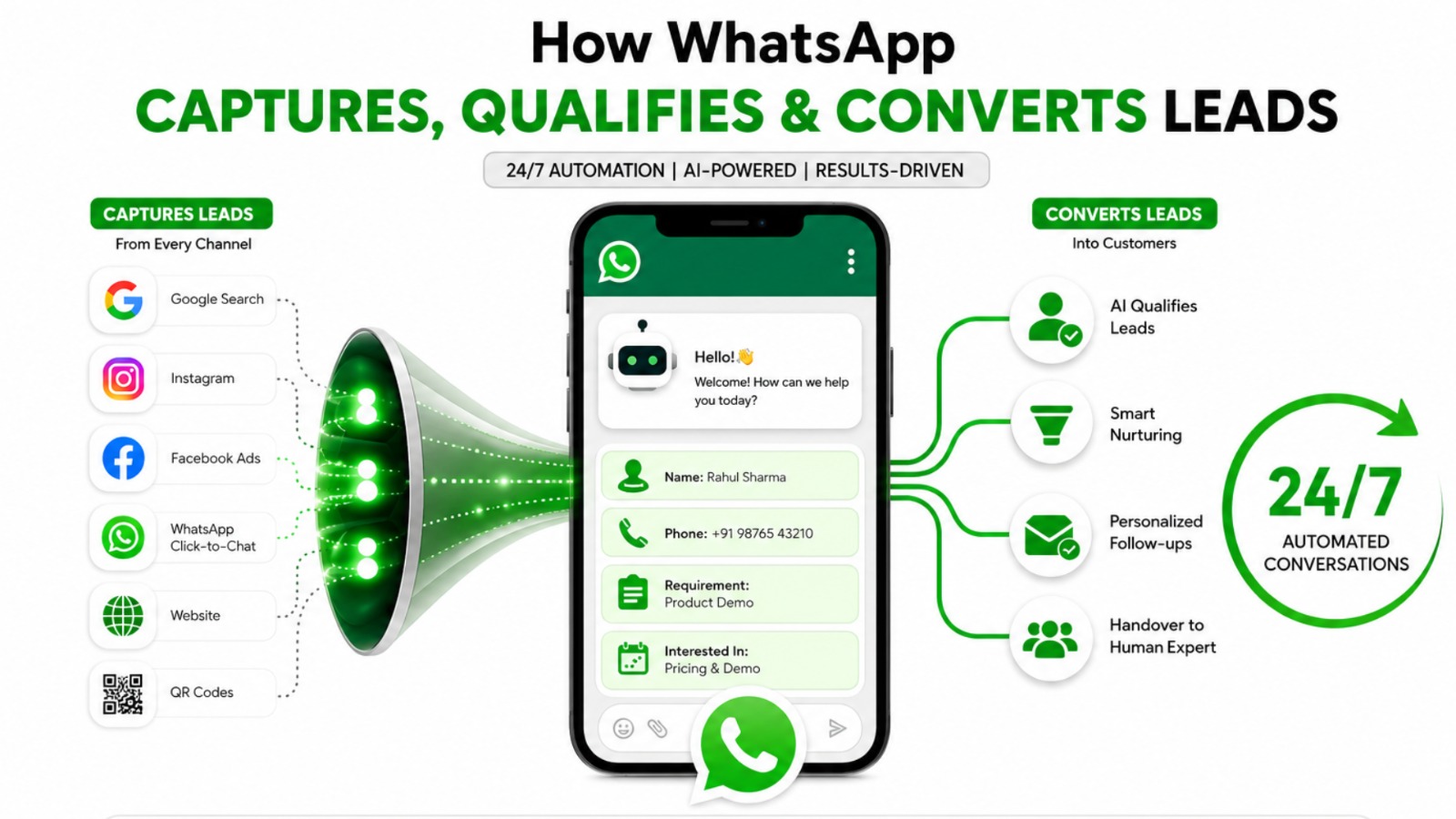
With the right automation, WhatsApp captures, qualifies and converts leads 24/7. It can respond to enquiries, collect customer details, answer common questions, qualify prospects, and connect serious buyers with sales teams.
Moreover, WhatsApp can connect with digital marketing campaigns. Therefore, businesses can create a smoother journey from advertisement to conversion.
For example, a customer may discover a business through Google Search. Next, the customer visits the website. Then, they click a WhatsApp button. After that, an automated conversation starts.
The journey can continue even when the sales team is offline.
That makes WhatsApp more than a messaging channel. Instead, it can become an important part of the modern lead generation and sales funnel.
For businesses working with CampaignPlus, Step4Growth, and TrendingBulb, this approach can create a stronger connection between digital marketing, automation, and customer conversion.
What Does “WhatsApp Captures, Qualifies and Converts Leads” Mean?
The customer journey usually has three important stages.
First, businesses need to capture leads.
Next, they need to qualify leads.
Finally, they need to convert leads.
WhatsApp can support all three stages.
1. WhatsApp Captures Leads
Lead capture starts when a potential customer begins a conversation.
For instance, a customer can click a WhatsApp button on a website. Similarly, the customer can scan a QR code. They can also start a chat after seeing a social media advertisement.
Therefore, businesses can capture leads from several channels.
These channels can include:
- Google Search
- Google Ads
- Meta Ads
- Websites
- Landing pages
- Email campaigns
- QR codes
- Social media posts
- Offline advertising
Instead of filling out a long form, the customer can simply start a conversation.
As a result, the lead capture process becomes easier.
2. WhatsApp Qualifies Leads
Not every lead has the same level of buying intent.
Some people only want information. Others may want pricing. Meanwhile, some prospects may be ready to purchase.
Therefore, businesses need to understand each lead.
WhatsApp automation can ask simple questions.
For example, a real estate business can ask:
- Which location do you prefer?
- What is your budget?
- Which property type do you need?
- When do you want to buy?
Similarly, an education company can ask:
- Which course interests you?
- What is your qualification?
- When do you want to start?
- Do you prefer online or classroom learning?
These answers help businesses understand customer needs.
Consequently, sales teams can focus on better-qualified opportunities.
3. WhatsApp Converts Leads
Lead qualification is not the final step.
After qualification, businesses need to move the prospect toward an action.
That action could be a:
- Product purchase
- Demo booking
- Consultation
- Site visit
- Appointment
- Quote request
- Course registration
- Service enquiry
Therefore, WhatsApp can support the customer until the next conversion step.
Why 24/7 Lead Conversion Matters
Customer behaviour has changed.
People do not follow traditional business hours anymore.
For example, someone may search for a product at 10 PM. Another customer may enquire early in the morning. Likewise, a prospect may contact a business on Sunday.
However, most sales teams work fixed hours.
This creates a problem.
The customer is ready to talk. Unfortunately, the business is unavailable.
As a result, the customer may contact another company.
WhatsApp automation can reduce this gap.
An automated message can greet the customer immediately. It can also answer basic questions. Furthermore, it can collect important information.
Therefore, the lead remains engaged until a sales representative becomes available.
How WhatsApp Captures Leads 24/7
Lead capture becomes easier when businesses remove unnecessary steps.
A customer should not have to search for a phone number. They should not have to complete a complicated form either.
Instead, businesses can provide a direct WhatsApp option.
Website WhatsApp Buttons
A website visitor can see a simple CTA.
For example:
“Have a question? Chat with us on WhatsApp.”
The visitor clicks the button.
Then, WhatsApp opens.
Next, an automated message starts the conversation.
This process reduces friction.
Moreover, businesses can place WhatsApp CTAs on:
- Product pages
- Service pages
- Landing pages
- Blog posts
- Pricing pages
- Contact pages
Therefore, website traffic can turn into direct conversations.
Social Media Can Send Leads to WhatsApp
Social media creates another opportunity.
A customer may see a business post on Instagram. Later, the customer may become interested in the service.
Instead of sending the customer through several pages, businesses can use a WhatsApp CTA.
The customer clicks.
Then, the WhatsApp conversation begins.
This creates a simple journey:
Social Media → WhatsApp → Qualification → Sales
Similarly, paid campaigns can use WhatsApp as a conversion destination.
For example:
Meta Ad → WhatsApp → Automated Chat → Qualified Lead
Consequently, businesses can reduce the distance between advertising and sales.
QR Codes Can Capture Offline Leads
WhatsApp lead generation does not have to remain online.
Businesses can also use QR codes.
For instance, a retail store can place a WhatsApp QR code near the billing counter. Likewise, a real estate company can place a QR code on property brochures.
Customers simply scan the code.
Then, WhatsApp opens.
After that, the automated conversation begins.
Businesses can use QR codes on:
- Brochures
- Business cards
- Product packaging
- Posters
- Store displays
- Event banners
- Menus
- Property advertisements
Therefore, offline marketing can connect directly with digital communication.
How WhatsApp Qualifies Leads Automatically
Capturing leads is only the beginning.
The next challenge is qualification.
Sales teams often waste time asking basic questions. Consequently, they have less time for serious prospects.
WhatsApp automation can handle the first stage.
For example, a digital marketing agency can ask:
“Which service do you need?”
The customer can select:
SEO
Google Ads
Social Media Marketing
WhatsApp API
Next, the chatbot can ask:
“What is your estimated monthly marketing budget?”
Then, it can ask:
“When would you like to start?”
These questions create a basic lead profile.
As a result, sales representatives can understand the prospect before starting a call.
Lead Scoring Makes Sales Follow-Up Easier
Not every prospect requires the same follow-up.
Therefore, businesses can use lead scoring.
For example:
Hot Lead: Ready to purchase
Warm Lead: Interested but needs more information
Cold Lead: Researching for the future
A business can then prioritize hot leads.
Meanwhile, warm leads can receive additional information.
Finally, cold leads can enter a suitable nurturing journey.
This approach improves sales efficiency.
Moreover, it prevents sales teams from spending too much time on low-intent enquiries.
WhatsApp Chatbots Keep Conversations Active
Customers expect immediate responses.
However, sales teams cannot answer every message instantly.
A chatbot can handle common questions instead.
For example, a customer may ask:
“What are your services?”
The chatbot can provide a list.
Another customer may ask:
“Can I book a demo?”
The chatbot can collect the required details.
Similarly, customers may ask about:
- Pricing
- Product availability
- Business hours
- Locations
- Services
- Features
- Appointment slots
- Delivery
- Order status
Therefore, chatbots can handle repetitive conversations.
At the same time, human agents can focus on complex discussions.
Human Handoff Is Still Important
Automation should not replace people completely.
Instead, businesses should combine automation with human support.
For example, a customer may have a specific requirement.
The chatbot can recognize the situation.
Then, it can provide an option such as:
“Would you like to speak with our sales team?”
The customer selects the option.
Next, the conversation moves to a sales representative.
This creates a smooth handoff.
Furthermore, the sales representative can review the previous conversation.
As a result, the customer does not need to repeat every detail.
WhatsApp Can Nurture Leads That Are Not Ready
Not every prospect is ready to buy today.
Some customers need more time.
Others may need approval from their manager. Similarly, some customers may want to compare different options.
Therefore, businesses should not immediately abandon these leads.
Instead, they can nurture them.
For example:
Day 1: Send useful information.
Day 3: Share relevant benefits.
Day 7: Provide a case study.
Day 14: Invite the customer to a consultation.
However, businesses should avoid excessive messaging.
Messages should remain relevant.
They should also follow applicable WhatsApp messaging rules and customer consent requirements.
As a result, lead nurturing can remain useful without becoming intrusive.
Personalization Can Improve Customer Engagement
Generic messages often feel impersonal.
For example:
“Dear Customer, check our latest offer.”
This message may not create much interest.
A more relevant message could say:
“Hi Rahul, you recently asked about our digital marketing services. Would you like to discuss your requirements with our team?”
The second message feels more connected to the customer’s journey.
Businesses can personalize communication using relevant information such as:
- Customer name
- Product interest
- Service interest
- Previous enquiry
- Location
- Lead stage
- Preferred language
Therefore, personalization can make conversations more useful.
WhatsApp and CRM Integration
Businesses often store customer information inside CRM systems.
However, customer conversations may happen somewhere else.
This can create disconnected data.
CRM integration can help solve this issue.
For example, a new WhatsApp enquiry can create a lead record.
Then, the CRM can store:
- Customer name
- Phone number
- Lead source
- Customer requirement
- Qualification status
- Sales stage
- Assigned salesperson
- Follow-up date
Consequently, sales teams can access important information in one place.
Furthermore, managers can monitor the lead pipeline more effectively.
WhatsApp Connects Marketing With Sales
Marketing creates awareness.
However, sales creates revenue.
Between these two stages, businesses need a strong communication channel.
WhatsApp can fill that gap.
For example:
Google Search → Website → WhatsApp → Qualification → Sales → Conversion
Another example is:
Instagram Ad → WhatsApp → Product Information → Follow-Up → Purchase
Therefore, WhatsApp can connect customer acquisition with customer conversion.
This makes the digital marketing funnel more effective.
CampaignPlus and 24/7 WhatsApp Lead Automation
Businesses that want to build structured WhatsApp communication can explore platforms such as CampaignPlus.
A WhatsApp automation platform can help businesses organize conversations and create lead workflows.
For example, a business can design a flow like this:
Lead Generation
↓
WhatsApp Conversation
↓
Welcome Message
↓
Customer Questions
↓
Lead Qualification
↓
Lead Segmentation
↓
Sales Handoff
↓
Follow-Up
↓
Conversion
This structure creates a more organized customer journey.
Furthermore, automation can reduce repetitive manual work.
Therefore, businesses can focus more attention on qualified prospects.
Step4Growth and the Digital Marketing Funnel
WhatsApp works best when businesses connect it with digital marketing.
That is where Step4Growth can play an important role in a broader growth strategy.
For example, SEO can attract people who are already searching for a solution.
Google Ads can target high-intent searches.
Meta Ads can reach specific audiences.
Social media can build brand awareness.
Content marketing can educate potential customers.
Then, WhatsApp can turn that attention into conversations.
Therefore, businesses can create this complete journey:
Attract → Engage → Capture → Qualify → Nurture → Convert
This approach focuses on the entire funnel.
It does not focus only on clicks.
Instead, it focuses on business results.
TrendingBulb and WhatsApp Business Growth
At TrendingBulb, businesses can explore digital marketing strategies that focus on customer acquisition and growth.
WhatsApp Business API can become an important part of that strategy.
However, businesses should not use WhatsApp without a clear purpose.
First, they should identify where leads come from.
Next, they should define the qualification process.
Then, they should decide when automation should hand over the conversation.
Finally, they should measure conversions.
This creates a structured system.
Moreover, it helps businesses understand which marketing channels generate better opportunities.
How Different Industries Can Use WhatsApp Lead Automation
WhatsApp lead automation can work across different industries.
Real Estate
Real estate companies can ask customers about:
- Location
- Budget
- Property type
- Purchase timeline
Then, the system can help schedule a site visit.
Therefore, agents can focus on serious buyers.
Education
Educational businesses can collect:
- Course preference
- Qualification
- Location
- Admission timeline
After that, qualified students can speak with counsellors.
Travel
Travel companies can ask about:
- Destination
- Travel dates
- Number of travellers
- Budget
- Package preference
Consequently, travel consultants receive better-qualified enquiries.
E-commerce
E-commerce businesses can use WhatsApp for:
- Product enquiries
- Order updates
- Customer support
- Product recommendations
- Promotional communication
As a result, customers can receive support throughout the buying journey.
Healthcare
Healthcare businesses can use WhatsApp for appointment-related communication, reminders, service information, and basic enquiries.
However, sensitive or complex matters should move to appropriate professional support.
A Simple 24/7 WhatsApp Lead Conversion Workflow
Businesses can start with a simple workflow.
Step 1: Attract the Customer
Use SEO, Google Ads, Meta Ads, social media, content, or other marketing channels.
Step 2: Offer a WhatsApp CTA
Give the customer a simple way to start a conversation.
Step 3: Send an Instant Welcome
Acknowledge the enquiry immediately.
Step 4: Ask the First Question
Find out what the customer needs.
Step 5: Continue Qualification
Ask relevant questions based on the customer’s answers.
Step 6: Categorize the Lead
Identify hot, warm, and cold prospects.
Step 7: Provide Relevant Information
Share useful information based on the customer’s requirement.
Step 8: Follow Up
Continue the conversation when appropriate.
Step 9: Connect With Sales
Transfer qualified leads to the right salesperson.
Step 10: Convert the Opportunity
Guide the customer toward the next action.
Therefore, the process can continue even after normal working hours.
Benefits of WhatsApp Lead Automation
A properly designed WhatsApp strategy can provide several benefits.
Faster Responses
Customers receive an immediate response.
As a result, businesses can reduce delays.
Better Lead Qualification
Automated questions help identify customer intent.
Therefore, sales teams can prioritize better opportunities.
Less Manual Work
Chatbots can answer repetitive questions.
Consequently, employees can focus on higher-value tasks.
Better Customer Experience
Customers receive quick and convenient communication.
Moreover, they can communicate through a familiar channel.
More Consistent Follow-Up
Automation can help businesses maintain structured follow-up processes.
Therefore, fewer opportunities may be forgotten.
Shorter Conversion Journeys
Customers can move directly from advertisements to WhatsApp.
As a result, businesses can reduce unnecessary steps.
Better Marketing and Sales Alignment
Marketing can generate the lead.
WhatsApp can capture and qualify it.
Finally, sales can close it.
Thus, every team becomes part of the same customer journey.
Best Practices for WhatsApp Lead Conversion
Automation works best when businesses keep the experience simple.
Ask Short Questions
Do not ask many questions at once.
Instead, ask one question and wait for the answer.
This makes the conversation easier.
Use Clear Buttons
Give customers simple choices.
For example:
Get Pricing
Book Demo
Talk to Sales
Product Information
Therefore, customers know what to do next.
Provide Human Support
Always create a clear path to a human agent when necessary.
This builds trust.
Keep Messages Relevant
Customers do not want unnecessary messages.
Therefore, send information that matches their interests and stage.
Track Important Metrics
Businesses should measure:
- Leads captured
- Qualification rate
- Response rate
- Sales handoffs
- Appointments
- Conversions
- Cost per lead
- Revenue
Consequently, businesses can identify areas that need improvement.
How to Improve WhatsApp Lead Conversion
Simply installing WhatsApp automation is not enough.
Businesses should continuously improve the funnel.
First, review where leads come from.
Next, identify which campaigns generate qualified prospects.
Then, review chatbot conversations.
After that, find where customers stop responding.
Finally, improve those stages.
For example, if many customers leave after the first question, the question may be too complicated.
Similarly, if many qualified leads fail to book a demo, the CTA may need improvement.
Therefore, regular optimization can improve the entire customer journey.
WhatsApp Is More Than a Messaging App
Many businesses still think of WhatsApp as a support tool.
However, its role can be much bigger.
It can support lead generation.
It can also support lead qualification.
Furthermore, it can help with nurturing.
Finally, it can support sales conversion.
This creates a complete journey:
Marketing → WhatsApp → Automation → Qualification → Sales → Conversion
As a result, businesses can connect multiple stages of the customer journey through one communication channel.
The Future of 24/7 Lead Generation
Customer expectations will continue to change.
People will expect faster answers.
They will also expect more personalized communication.
At the same time, businesses will need to control costs and improve sales efficiency.
Therefore, automation will become increasingly important.
WhatsApp Business API can help businesses meet these expectations.
However, technology alone will not guarantee results.
Businesses need a clear strategy.
They need the right audience.
They need relevant messaging.
They need effective qualification questions.
They also need trained sales teams.
When these elements work together, WhatsApp can become a powerful part of the growth funnel.
Conclusion
Modern businesses cannot afford to ignore interested customers simply because the sales team is offline.
Customers may enquire at any time.
Therefore, businesses need systems that can respond quickly.
This is where WhatsApp captures, qualifies and converts leads 24/7.
First, WhatsApp captures leads through websites, advertisements, social media, QR codes, and other channels.
Next, automation qualifies those leads through simple questions.
Then, the system can segment prospects according to their needs and buying intent.
Afterward, businesses can nurture prospects with relevant communication.
Finally, qualified leads can move to sales teams for personal assistance and conversion.
However, WhatsApp should not operate alone.
Digital marketing attracts the audience.
Content builds awareness.
SEO creates organic visibility.
Paid advertising generates demand.
WhatsApp starts the conversation.
Automation qualifies the prospect.
Sales teams close the opportunity.
Therefore, the combination of digital marketing and WhatsApp Business API can create a stronger growth funnel.
With CampaignPlus, businesses can build structured WhatsApp communication and automation workflows.
With Step4Growth, businesses can connect digital marketing with broader growth strategies.
Meanwhile, TrendingBulb can help businesses discover practical digital marketing and customer engagement strategies.
The ultimate goal is simple.
Do not let a potential customer wait unnecessarily.
Instead, respond quickly.
Ask the right questions.
Understand the customer’s needs.
Provide relevant information.
Then, connect qualified prospects with the right sales person.
That is how businesses can turn clicks into conversations, conversations into qualified leads, and qualified leads into customers — 24/7.