In the world of WhatsApp marketing, open rates have traditionally been one of the most celebrated metrics. Businesses often focus on how many users opened a message and assume that higher open rates automatically translate into better campaign performance. However, as customer journeys become more sophisticated and businesses demand measurable outcomes, relying solely on open rates no longer provides the complete picture.
Today, organizations using the WhatsApp Business API need deeper insights into how users interact with conversations, engage with content, move through the sales funnel, and ultimately convert into customers. This is where advanced funnel metrics become essential.
For businesses leveraging Campaign Plus, a powerful WhatsApp Business API platform, tracking the right funnel metrics can unlock higher engagement, better customer experiences, increased conversions, and stronger ROI.
This guide explores the WhatsApp funnel metrics that truly matter beyond open rates and explains how businesses can use Campaign Plus to optimize every stage of the customer journey.
Why Open Rates Are No Longer Enough
WhatsApp consistently delivers some of the highest open rates among digital communication channels. In many industries, open rates exceed 90%, making WhatsApp a highly effective engagement platform.
While this statistic is impressive, it creates a challenge for marketers. If nearly everyone opens a message, open rates become less useful for distinguishing between successful and unsuccessful campaigns.
Consider this example:
- Campaign A achieves a 95% open rate but generates very few sales.
- Campaign B achieves a 92% open rate but generates significant revenue.
Looking only at open rates would suggest Campaign A performed better. In reality, Campaign B delivered far greater business value.
This highlights the importance of measuring metrics that indicate customer intent, engagement, and conversion rather than simply message visibility.
Understanding the WhatsApp Funnel
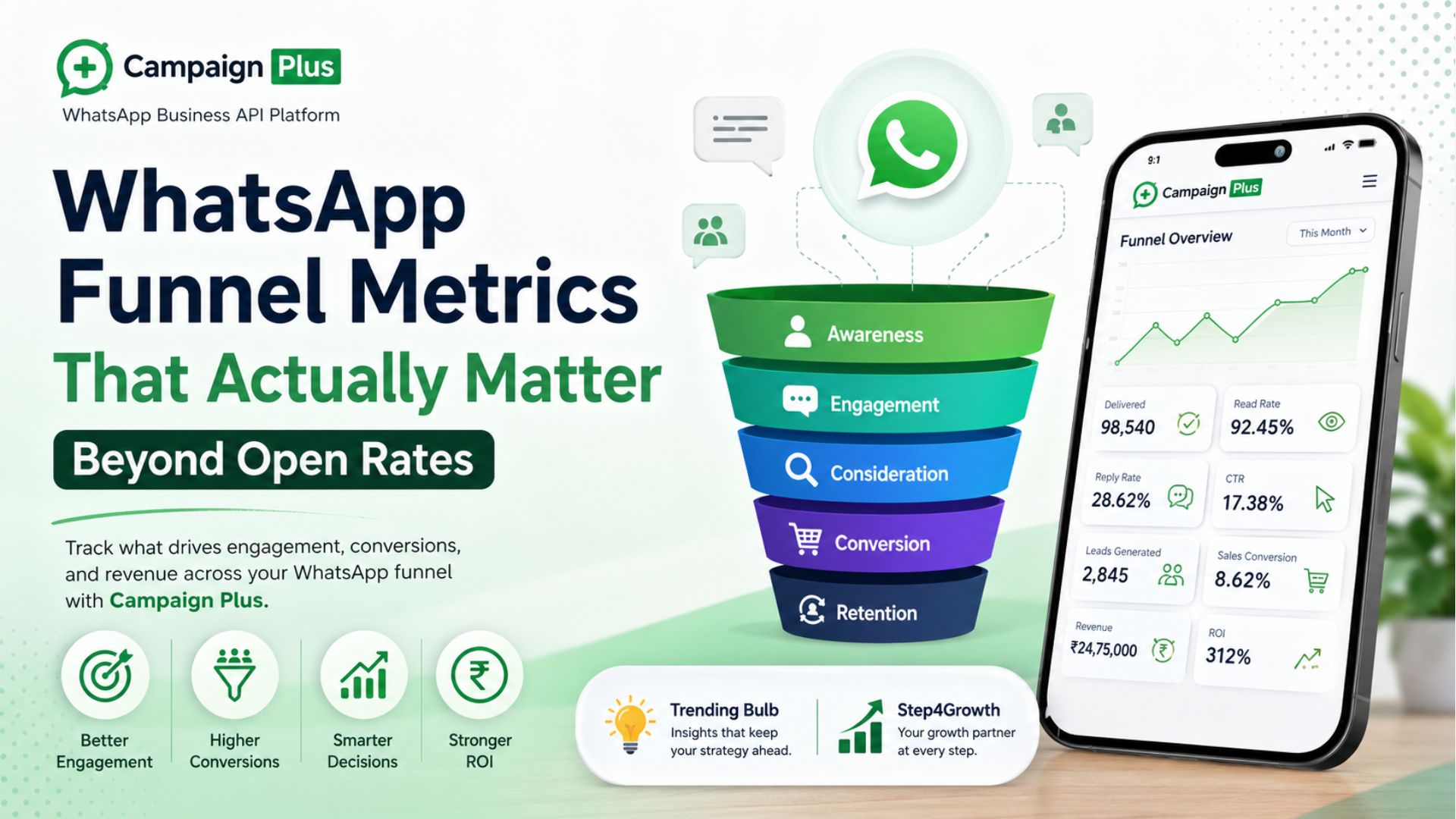
A WhatsApp funnel typically consists of several stages:
Awareness
The customer receives a message and becomes aware of your brand, product, or offer.
Engagement
The customer interacts with buttons, replies to messages, or explores content.
Consideration
The customer asks questions, requests information, or shows buying intent.
Conversion
The customer completes a desired action such as making a purchase, booking a demo, or submitting a lead form.
Retention
The customer remains engaged and continues interacting with your business.
Each stage generates valuable data that businesses can track using Campaign Plus and the WhatsApp Business API.
1. Delivery Rate
Before analyzing engagement, businesses must ensure messages are actually reaching users.
Formula
Delivery Rate = Delivered Messages ÷ Sent Messages × 100
A low delivery rate may indicate:
- Invalid phone numbers
- Poor contact list quality
- Compliance issues
- Messaging restrictions
High-performing WhatsApp campaigns begin with maintaining strong delivery rates.
Why It Matters
If messages never reach customers, all downstream metrics become meaningless.
Campaign Plus provides delivery tracking that helps businesses monitor message success and identify delivery bottlenecks quickly.
2. Read Rate
Although open rates are valuable, read rates offer more reliable engagement insights.
What It Measures
Read rate indicates how many delivered messages were actually viewed by recipients.
Why It Matters
A high read rate confirms message visibility, but it should be treated as an early-stage metric rather than the final measure of success.
Businesses should combine read rate data with interaction metrics to understand true campaign effectiveness.
3. Response Rate
One of the most powerful WhatsApp funnel metrics is response rate.
Formula
Response Rate = Total Replies ÷ Delivered Messages × 100
Why It Matters
A response indicates active customer participation.
Responses may include:
- Product inquiries
- Pricing questions
- Appointment requests
- Support requests
- Purchase intent
Customers who reply are significantly more engaged than those who merely read a message.
Campaign Plus Advantage
Campaign Plus enables automated conversation flows that encourage users to respond through interactive messaging experiences.
4. Click-Through Rate (CTR)
When messages contain links, buttons, or calls to action, CTR becomes critical.
Formula
CTR = Total Clicks ÷ Delivered Messages × 100
Why It Matters
Clicks demonstrate customer interest and movement toward conversion.
Examples include:
- Visiting product pages
- Viewing catalogs
- Exploring offers
- Registering for events
- Downloading resources
A strong CTR often signals effective messaging and compelling offers.
5. Button Interaction Rate
Interactive buttons are one of the most effective features available through the WhatsApp Business API.
Examples
- Buy Now
- Book Demo
- Talk to Sales
- Get Pricing
- Learn More
Why It Matters
Button interaction rate helps businesses understand:
- Which CTAs perform best
- What customers want
- Which funnel stage generates the most interest
Campaign Plus provides detailed interaction tracking for every button click and customer action.
6. Lead Conversion Rate
Lead generation is a major objective for many WhatsApp campaigns.
Formula
Lead Conversion Rate = Generated Leads ÷ Total Engaged Users × 100
Why It Matters
This metric measures how effectively engagement transforms into qualified leads.
Businesses can identify:
- High-performing campaigns
- Effective audience segments
- Strong messaging strategies
Lead conversion metrics directly impact revenue growth.
7. Sales Conversion Rate
For revenue-focused campaigns, sales conversion rate is among the most important KPIs.
Formula
Sales Conversion Rate = Purchases ÷ Engaged Users × 100
Why It Matters
This metric reveals whether your WhatsApp funnel actually generates revenue.
A campaign with moderate engagement but high conversion often outperforms campaigns with large engagement and low purchasing activity.
Campaign Plus helps businesses connect WhatsApp conversations to sales outcomes for clearer ROI measurement.
8. Conversation Completion Rate
Many businesses use automated chatbot journeys.
Examples include:
- Lead qualification
- Product recommendations
- Customer onboarding
- Appointment scheduling
Formula
Completion Rate = Completed Conversations ÷ Started Conversations × 100
Why It Matters
Low completion rates may indicate:
- Confusing workflows
- Too many questions
- Poor chatbot design
- Customer drop-off points
Monitoring this metric helps optimize customer experiences.
9. Customer Drop-Off Rate
Understanding where customers abandon conversations is equally important.
Why It Matters
Drop-off analysis helps identify:
- Weak messaging
- Complex processes
- Friction points
- Unclear instructions
By reducing drop-offs, businesses can significantly improve funnel performance.
Campaign Plus provides visibility into customer journeys, helping teams pinpoint exactly where engagement declines.
10. Time to First Response
Speed matters in conversational marketing.
What It Measures
The average time taken to respond to customer inquiries.
Why It Matters
Faster responses lead to:
- Better customer satisfaction
- Increased trust
- Higher conversion rates
Customers increasingly expect instant communication on WhatsApp.
Campaign Plus automation features help reduce response times and improve customer experiences.
11. Customer Satisfaction Score (CSAT)
Engagement alone does not guarantee customer satisfaction.
Why It Matters
CSAT surveys help businesses understand:
- Service quality
- Customer experience
- Support effectiveness
- Brand perception
Satisfied customers are more likely to return and recommend your business.
12. Customer Retention Rate
Retention is often more profitable than acquisition.
Formula
Retention Rate = Returning Customers ÷ Total Customers × 100
Why It Matters
A healthy retention rate indicates:
- Strong customer relationships
- Effective follow-up campaigns
- Long-term customer value
Campaign Plus enables businesses to maintain ongoing engagement through personalized WhatsApp communication.
13. Revenue Per Conversation
This metric connects conversations directly to business outcomes.
Formula
Revenue Per Conversation = Total Revenue ÷ Total Conversations
Why It Matters
It helps businesses evaluate:
- Campaign profitability
- Customer value
- Funnel efficiency
Revenue-focused metrics provide clearer insights than engagement metrics alone.
14. Return on Investment (ROI)
Ultimately, every business wants to know whether WhatsApp marketing generates profitable results.
Formula
ROI = (Revenue – Campaign Cost) ÷ Campaign Cost × 100
Why It Matters
ROI demonstrates the overall effectiveness of WhatsApp campaigns.
Businesses can compare:
- Different audience segments
- Various messaging strategies
- Promotional offers
- Customer journeys
Campaign Plus delivers the analytics needed to track ROI across multiple WhatsApp campaigns.
How Campaign Plus Helps Track WhatsApp Funnel Metrics
Businesses using the WhatsApp Business API require more than messaging capabilities. They need comprehensive analytics that transform conversations into actionable insights.
Campaign Plus helps organizations:
Monitor Funnel Performance
Track customer journeys from message delivery to final conversion.
Measure Engagement
Analyze responses, clicks, interactions, and conversation quality.
Optimize Campaigns
Identify high-performing content, CTAs, and audience segments.
Improve Customer Experience
Reduce response times and remove friction from conversations.
Increase Conversions
Use data-driven insights to improve lead generation and sales outcomes.
Generate Better ROI
Connect campaign activity directly to business results.
These capabilities make Campaign Plus an effective solution for businesses seeking measurable growth through WhatsApp marketing.
Best Practices for Measuring WhatsApp Funnel Success
Focus on Business Outcomes
Prioritize metrics tied to leads, sales, and customer retention.
Track the Entire Customer Journey
Measure every stage from delivery to conversion.
Use Interactive Messaging
Buttons, quick replies, and conversational flows increase engagement.
Segment Your Audience
Different customer groups often behave differently.
Continuously Test Campaigns
Experiment with messaging, CTAs, and automation workflows.
Monitor Drop-Off Points
Identify and fix friction areas quickly.
Connect Analytics to Revenue
Revenue-based metrics provide the clearest view of campaign performance.
The Future of WhatsApp Analytics
As conversational commerce continues to expand, businesses will increasingly rely on advanced funnel metrics rather than vanity metrics.
Future WhatsApp strategies will focus on:
- Customer intent signals
- Behavioral analytics
- AI-powered engagement insights
- Predictive conversion tracking
- Revenue attribution models
- Personalized customer journeys
Organizations that adopt data-driven WhatsApp marketing today will gain a significant competitive advantage tomorrow.
With platforms like Campaign Plus, businesses can move beyond simple open-rate reporting and build complete customer journey analytics that support sustainable growth.
Conclusion
Open rates may indicate whether customers saw your message, but they do not reveal whether your WhatsApp campaigns are driving meaningful business results. To truly understand performance, businesses must focus on funnel metrics such as response rates, click-through rates, lead conversions, sales conversions, retention rates, customer satisfaction, and ROI.
By leveraging the advanced analytics capabilities of Campaign Plus, businesses can gain complete visibility into every stage of the customer journey and make smarter marketing decisions. Tracking these metrics enables organizations to optimize engagement, improve customer experiences, and maximize revenue from their WhatsApp Business API initiatives.
As highlighted by Trending Bulb, the future of WhatsApp marketing lies in measuring outcomes rather than impressions. Businesses that embrace comprehensive funnel analytics through Campaign Plus and implement growth-focused strategies with Step4Growth will be better positioned to achieve long-term customer engagement, higher conversions, and sustainable business success.