Introduction
Businesses today need more than just good products and services to attract and retain customers. They also need strong customer relationships, effective communication, and consistent marketing strategies. However, managing customer information and running marketing campaigns manually can become challenging as a business grows.
This is where CRM and Marketing Automation become important.
Although many businesses use these terms interchangeably, both technologies serve different purposes. CRM focuses on managing customer relationships, whereas Marketing Automation helps businesses automate repetitive marketing activities, nurture leads, and improve customer engagement.
For instance, a company may use CRM software to store customer details, track sales activities, and manage conversations. On the other hand, it may use Marketing Automation to send personalised messages, schedule campaigns, and follow up with potential customers automatically.
Moreover, both technologies can support different stages of the customer journey. While CRM helps businesses organise customer information, Marketing Automation makes communication faster and more consistent.
In this guide, Trending Bulb explains CRM vs Marketing Automation, their key differences, benefits, use cases, and how businesses can use both technologies together. Additionally, we will explore how platforms like Campaign Plus and digital growth strategies from Step4Growth can support modern business communication and marketing.
What Is CRM (Customer Relationship Management)?
Customer Relationship Management, commonly known as CRM, is a technology that helps businesses manage customer information and interactions throughout the customer journey.
A CRM system stores important customer details in one central location. These details may include names, phone numbers, email addresses, purchase history, previous conversations, preferences, and sales information.
As a result, sales and customer support teams can access relevant information whenever they communicate with customers.
Moreover, CRM software helps businesses understand their customers better. Instead of searching through spreadsheets or different communication channels, employees can view customer information from a single dashboard.
Key Features of CRM Software
1. Customer Data Management
CRM software stores and organises customer information. Therefore, businesses can maintain accurate customer records and access important details whenever required.
2. Lead Management
A CRM system helps businesses capture, organise, and track potential customers. Furthermore, sales teams can identify which leads need attention and move them through different sales stages.
3. Sales Pipeline Management
CRM platforms allow businesses to monitor their sales processes. For example, teams can track enquiries, follow-ups, negotiations, and successful conversions.
4. Customer Interaction Tracking
Businesses can maintain records of customer conversations, meetings, emails, and previous interactions. Consequently, employees can provide more relevant and consistent communication.
5. Reporting and Analytics
CRM systems provide reports about sales performance, customer activity, and team productivity. Additionally, these insights help managers make better business decisions.
Example of CRM in Business
Imagine a real estate company receiving enquiries from 100 potential property buyers.
Without CRM software, the sales team may struggle to remember customer preferences, budgets, property requirements, and previous conversations.
However, with a CRM system, the company can store all this information in organised customer profiles.
Furthermore, sales representatives can track which customers have scheduled property visits, requested additional information, or shown interest in a particular property.
As a result, the company can manage customer enquiries more effectively and improve its overall sales process.
What Is Marketing Automation?
Marketing Automation refers to the use of technology to automate repetitive marketing activities. It helps businesses communicate with their audiences, nurture potential customers, and manage campaigns more efficiently.
Instead of manually sending every message or following up with every lead, businesses can create automated workflows based on customer actions, preferences, and behaviour.
For example, when someone submits an enquiry through a website, a business can automatically send a welcome email or WhatsApp message. Similarly, businesses can schedule promotional campaigns, share product updates, and send reminders.
Moreover, Marketing Automation helps businesses maintain consistent communication across different channels.
Key Features of Marketing Automation
1. Automated Campaign Management
Businesses can create and schedule marketing campaigns in advance. As a result, marketing teams can manage communication without manually sending every message.
2. Lead Nurturing
Marketing Automation helps businesses stay connected with potential customers through personalised messages, educational content, reminders, and follow-ups.
Furthermore, businesses can create different communication workflows according to customer interests and actions.
3. Email and WhatsApp Automation
Businesses can automate communication through supported channels such as email and WhatsApp. For instance, they can send welcome messages, enquiry confirmations, appointment reminders, and promotional updates.
4. Customer Segmentation
Automation platforms help businesses organise audiences based on interests, behaviour, preferences, and other available information.
Therefore, companies can send more relevant messages to different customer groups instead of sharing the same communication with everyone.
5. Performance Tracking
Marketing Automation tools provide campaign insights such as delivery, engagement, clicks, and conversions, depending on the platform and channel.
Consequently, marketers can understand campaign performance and improve their future strategies.
Example of Marketing Automation in Business
Consider an online clothing store that receives hundreds of customer enquiries every week.
Manually replying to every enquiry, sharing product information, and sending promotional updates can consume significant time.
However, with Marketing Automation, the store can create automated responses for common questions, send order updates, and schedule promotional campaigns.
Additionally, it can send follow-up messages to customers who have shown interest in specific products, where appropriate permissions and messaging rules allow it.
As a result, the business can maintain consistent communication while reducing repetitive work.
CRM vs Marketing Automation: What’s the Difference?
Although CRM and Marketing Automation support customer relationships and business growth, their primary functions are different.
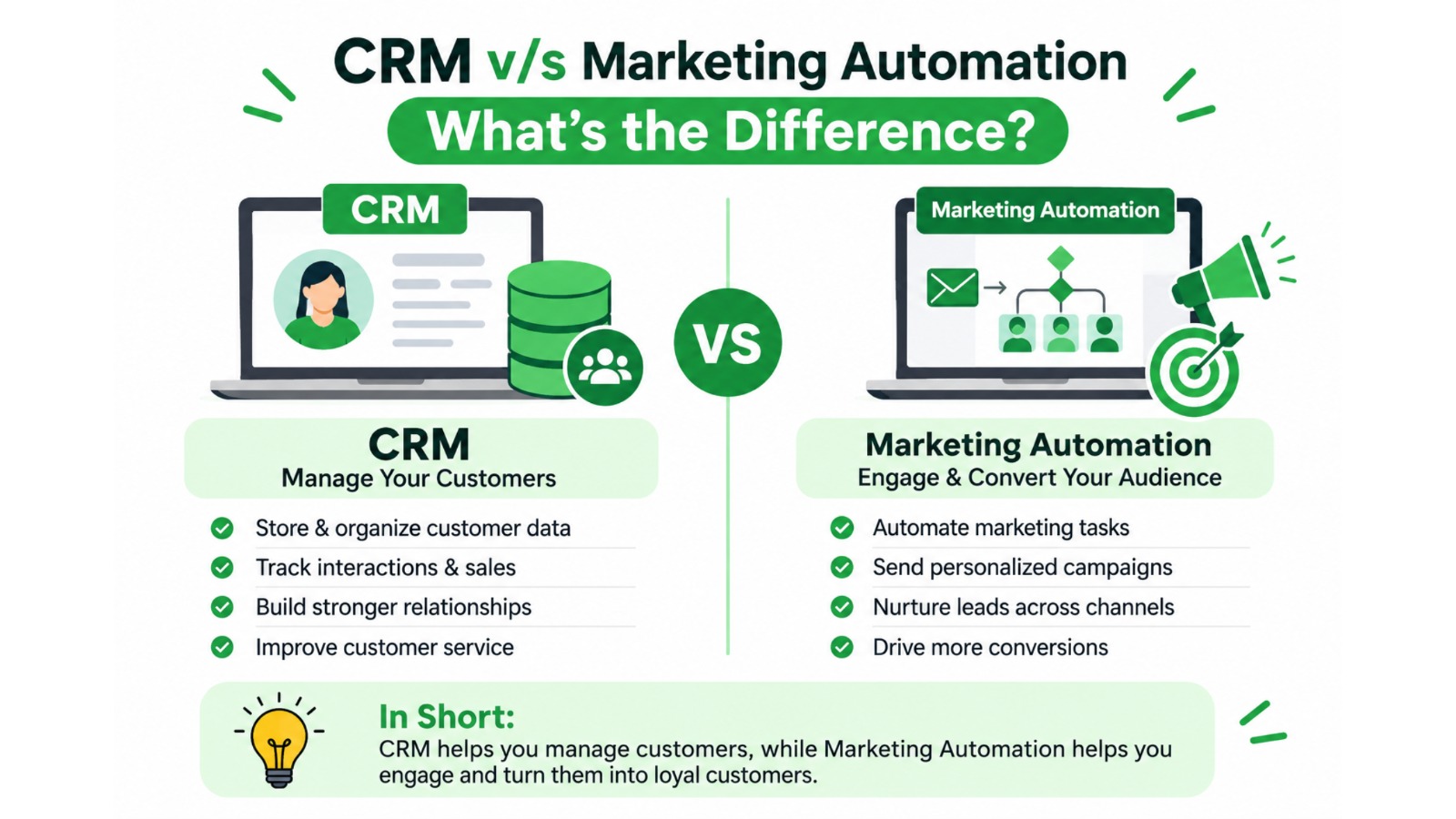
CRM focuses on managing customer information and interactions. In contrast, Marketing Automation focuses on automating marketing communication and campaigns.
To understand the difference more clearly, let’s compare their main features.
| Comparison | CRM | Marketing Automation |
|---|---|---|
| Main purpose | Manage customer relationships | Automate marketing activities |
| Primary users | Sales and customer support teams | Marketing teams |
| Main focus | Customer information and sales management | Campaigns and lead nurturing |
| Customer data | Stores customer profiles and interaction history | Uses audience data for targeted communication |
| Lead management | Tracks and manages sales leads | Nurtures leads through marketing workflows |
| Communication | Supports customer interaction tracking | Automates marketing messages |
| Sales activities | Tracks sales pipelines and opportunities | Supports lead generation and nurturing |
| Reporting | Sales and customer relationship reports | Campaign and engagement reports |
| Main objective | Improve customer relationships | Improve marketing efficiency and engagement |
1. Difference in Primary Purpose
The biggest difference between CRM and Marketing Automation is their purpose.
CRM helps businesses manage existing customer relationships and sales opportunities. Meanwhile, Marketing Automation helps businesses communicate with potential and existing customers through automated marketing activities.
For instance, CRM helps a sales representative understand a customer’s previous purchase history.
However, Marketing Automation can send a relevant product update or promotional message to an eligible audience.
Therefore, both technologies contribute to business growth, but they focus on different activities.
2. Difference in Target Teams
CRM software is commonly used by sales representatives, account managers, and customer support teams.
On the other hand, Marketing Automation is mainly used by digital marketers, marketing managers, and campaign teams.
Nevertheless, both systems can support multiple departments when businesses connect their workflows.
3. Difference in Customer Communication
CRM helps teams maintain a record of customer conversations and manage relationship-related activities.
In comparison, Marketing Automation takes communication further by automating messages based on predefined conditions.
For example, a business can use automation to send a welcome message after a customer submits an enquiry.
Similarly, it can use CRM to record the enquiry, assign it to a salesperson, and track the next follow-up.
Consequently, businesses can maintain better communication while ensuring that customer information remains organised.
4. Difference in Lead Management
CRM helps businesses organise leads and monitor their progress through the sales pipeline.
Meanwhile, Marketing Automation helps businesses nurture those leads with relevant communication.
For example, marketing teams can send educational content to potential customers who are still researching a product or service.
Once a customer shows buying interest, the sales team can use CRM to manage the opportunity.
Thus, both technologies contribute to lead management, but they handle different stages and activities.
5. Difference in Performance Measurement
CRM reports generally focus on sales performance, customer interactions, and pipeline progress.
In contrast, Marketing Automation reports focus on campaign engagement, message performance, lead nurturing, and marketing conversions.
By analysing both types of reports, businesses can understand how marketing activities influence sales results.
CRM vs Marketing Automation: Which One Does Your Business Need?
Choosing between CRM and Marketing Automation depends on your business requirements, customer journey, and growth objectives.
Not every business needs multiple software platforms immediately. However, understanding your biggest operational challenges can help you select the right solution.
When Should You Choose CRM?
CRM is a suitable choice if your business needs to:
- Organise customer information in one place.
- Track sales enquiries and potential customers.
- Manage sales pipelines and opportunities.
- Monitor customer interactions.
- Improve sales team coordination.
- Maintain customer purchase history.
- Manage customer relationships more effectively.
For example, real estate companies, educational institutions, financial service providers, and B2B businesses can benefit from CRM systems.
These businesses often handle multiple enquiries. Therefore, they need organised customer records and a reliable process for managing sales activities.
When Should You Choose Marketing Automation?
Marketing Automation is useful if your business wants to:
- Automate repetitive marketing activities.
- Send personalised marketing messages.
- Improve lead nurturing.
- Schedule promotional campaigns.
- Automate enquiry responses.
- Manage customer follow-ups.
- Improve marketing efficiency.
- Maintain consistent customer communication.
For instance, e-commerce stores, educational institutions, travel companies, and service-based businesses can use Marketing Automation to manage communication at scale.
Moreover, businesses that receive enquiries through websites, social media, and WhatsApp can benefit from automated communication workflows.
Consequently, Marketing Automation can help marketing teams save time while maintaining regular customer engagement.
Can CRM and Marketing Automation Work Together?
Yes! CRM and Marketing Automation can work together to create a more connected customer experience.
In fact, using both technologies can help businesses manage the entire customer journey more effectively.
CRM manages customer information, sales activities, and relationship history. Meanwhile, Marketing Automation helps businesses communicate with customers through timely and relevant campaigns.
When both systems integrate, customer information and marketing activities can support each other.
How Does CRM and Marketing Automation Integration Work?
Let’s understand this with a simple example.
Imagine a digital marketing company generating leads through Facebook and Instagram advertisements.
Step 1: Lead Generation
A potential customer clicks an advertisement and submits an enquiry form.
Step 2: Customer Information Collection
The customer’s details are collected and added to the CRM system. As a result, the sales team can access the enquiry without manually transferring information.
Step 3: Automated Response
A Marketing Automation workflow sends an appropriate acknowledgement message through an available communication channel.
Step 4: Lead Assignment
The CRM system assigns the lead to the relevant sales representative. Consequently, the team knows who is responsible for the enquiry.
Step 5: Lead Follow-Up
The sales team contacts the customer and updates the conversation status in the CRM.
Step 6: Lead Nurturing
If the customer needs more information, the business can send relevant educational content, reminders, or follow-up messages through its automation platform, subject to applicable consent and messaging rules.
Step 7: Conversion Tracking
Finally, the sales team updates the CRM when the lead converts into a customer.
As a result, the business gets better visibility into its marketing and sales activities.
The Role of WhatsApp Automation in Modern Marketing
Customer expectations have changed significantly. Today, people want quick responses, relevant information, and convenient communication.
As a result, WhatsApp has become an important business communication channel.
However, manually handling hundreds of customer conversations can become challenging. Businesses may miss enquiries, delay responses, or struggle to manage multiple conversations simultaneously.
This is where WhatsApp Business Platform and WhatsApp Automation can help.
With platforms such as Campaign Plus, businesses can simplify customer communication through WhatsApp automation and business messaging features.
How WhatsApp Automation Supports Business Growth
1. Automated Customer Replies
Businesses can configure automated responses for common customer enquiries. Consequently, customers can receive relevant information without waiting for a team member to respond manually.
2. WhatsApp Bulk Messaging
Businesses can send approved WhatsApp marketing messages to eligible audiences using supported templates and applicable consent requirements.
For example, companies can share product updates, offers, announcements, and important business information.
3. Automated Lead Follow-Ups
Businesses can create follow-up workflows to stay connected with potential customers.
For instance, an educational institute can send enquiry acknowledgements and relevant course information through an automated communication process.
4. Chatbot Integration
WhatsApp chatbots can answer frequently asked questions, share basic information, and guide customers towards the next step.
Furthermore, chatbots can help businesses manage repetitive conversations more efficiently.
5. Centralised Conversation Management
With suitable business messaging platforms, teams can manage customer conversations through a shared inbox and coordinate responses more effectively.
Campaign Plus helps businesses simplify WhatsApp communication with automation, chatbot capabilities, and business messaging solutions.
Therefore, businesses looking to improve customer communication can combine WhatsApp Automation with an appropriate CRM system to create a more organised lead management process.
How Step4Growth Helps Businesses Build a Strong Digital Marketing Strategy
Having CRM and Marketing Automation software is only one part of business growth.
Businesses also need a clear digital marketing strategy to attract the right audience, generate enquiries, and convert potential customers.
This is where Step4Growth focuses on helping businesses strengthen their digital presence through digital marketing and growth-oriented strategies.
A well-planned digital marketing approach can support CRM and Marketing Automation by generating relevant traffic and bringing potential customers into the sales funnel.
How Digital Marketing and Automation Work Together
1. Search Engine Optimisation (SEO)
SEO helps businesses improve their visibility on search engines. When potential customers search for relevant products or services, an optimised website can help them discover the business organically.
Moreover, useful website content can attract visitors who are actively looking for solutions.
2. Social Media Marketing
Platforms such as Instagram, Facebook, and LinkedIn help businesses connect with their target audiences.
Additionally, engaging content can encourage users to visit websites, enquire about services, and interact with brands.
3. Paid Advertising
Google Ads and Meta Ads can help businesses reach relevant audiences through targeted advertising campaigns.
However, generating leads is only the first step. Businesses also need an effective process to manage enquiries and follow up with potential customers.
4. Lead Generation Strategy
A structured lead generation strategy helps businesses attract potential customers through landing pages, enquiry forms, advertisements, and other digital channels.
Furthermore, businesses can use CRM systems to organise the enquiries generated through these activities.
5. Marketing Automation
Once businesses generate leads, automation can support timely communication and lead nurturing.
Consequently, combining digital marketing, CRM, and Marketing Automation creates a more connected approach to customer acquisition and retention.
CRM vs Marketing Automation: Real-World Business Use Cases
Different industries can use CRM and Marketing Automation according to their customer management and communication requirements.
To understand their practical value, let’s explore some common industry examples.
1. Real Estate Industry
Real estate companies receive enquiries from property portals, websites, social media, and advertisements.
CRM helps agents organise buyer information, property preferences, budgets, and site visit schedules.
Meanwhile, Marketing Automation can send enquiry acknowledgements, property updates, and appointment reminders.
As a result, real estate teams can manage customer enquiries more efficiently.
2. E-commerce Industry
Online stores interact with customers throughout the buying journey.
CRM helps businesses maintain customer profiles and purchase information.
On the other hand, Marketing Automation can support promotional campaigns, order notifications, and personalised product communication.
Therefore, businesses can improve the customer experience and encourage repeat purchases.
3. Education Industry
Educational institutions receive enquiries about courses, admissions, fees, and schedules.
CRM helps admission teams organise student information and track application progress.
Additionally, Marketing Automation can send course details, admission reminders, and event announcements.
Consequently, institutions can maintain consistent communication with prospective students.
4. Healthcare and Wellness Businesses
Healthcare and wellness businesses need organised customer communication.
CRM can help manage patient or client records and service-related interactions, subject to applicable privacy requirements.
Meanwhile, automation can support appointment confirmations, reminders, and general service communication.
However, businesses must handle sensitive information carefully and follow relevant privacy and regulatory requirements.
5. B2B Businesses
B2B companies often have longer sales cycles and multiple decision-makers.
CRM helps sales teams track business accounts, conversations, opportunities, and negotiations.
In comparison, Marketing Automation can support educational email campaigns, event invitations, and lead nurturing.
Together, these technologies help businesses manage longer customer journeys more effectively.
Common Mistakes Businesses Make When Choosing CRM and Marketing Automation
Although these technologies offer several advantages, businesses sometimes struggle to use them effectively.
Therefore, understanding common mistakes can help companies make better decisions.
1. Treating CRM and Marketing Automation as the Same Tool
CRM and Marketing Automation have different primary functions.
Therefore, businesses should understand their requirements before selecting a platform.
2. Choosing Software Without Identifying Business Needs
Not every business requires advanced automation features.
Instead, companies should identify their biggest challenges, such as lead management, customer communication, sales tracking, or campaign management.
As a result, they can select software that supports their actual business requirements.
3. Ignoring Customer Data Quality
Automation depends on accurate customer information.
If customer records contain outdated or incorrect details, campaigns may reach the wrong audience.
Consequently, businesses should regularly review and organise their data.
4. Sending Too Many Marketing Messages
Frequent promotional messages can negatively affect customer experience.
Instead, businesses should focus on relevant communication, appropriate frequency, and applicable consent requirements.
5. Not Tracking Results
Implementing CRM or Marketing Automation without measuring performance can limit business growth.
Therefore, businesses should regularly monitor relevant metrics and identify opportunities for improvement.
Future of CRM and Marketing Automation
Customer expectations and digital technologies continue to evolve. Consequently, businesses need smarter ways to manage relationships and communicate with their audiences.
CRM and Marketing Automation are also becoming more connected through artificial intelligence, advanced analytics, and omnichannel communication.
Here are some important developments shaping the future.
1. AI-Powered Customer Insights
Artificial intelligence can help businesses analyse customer information, identify patterns, and support more informed decisions.
2. Personalised Customer Experiences
Businesses can use customer preferences and available interaction data to deliver more relevant communication.
As a result, customers can receive information that better matches their interests.
3. Omnichannel Communication
Customers interact with brands through websites, social media, email, and messaging applications.
Therefore, businesses are increasingly focusing on consistent communication across multiple channels.
4. Smarter Chatbots
AI-powered chatbots can help businesses respond to common questions and guide customers through different stages of their journey.
Furthermore, these tools can support customer service teams by handling repetitive enquiries.
5. Automated Customer Journeys
Businesses can build workflows that respond to customer actions and deliver relevant communication at different stages.
Ultimately, these developments can help companies improve operational efficiency and customer engagement.
Conclusion: CRM and Marketing Automation Work Better Together
CRM and Marketing Automation are two important technologies that support modern business growth.
However, they serve different purposes.
CRM helps businesses organise customer information, track sales opportunities, and manage customer relationships. Meanwhile, Marketing Automation helps companies automate campaigns, nurture leads, and maintain consistent communication.
Although businesses can use these tools independently, combining them can create a more effective customer management strategy.
Furthermore, WhatsApp Automation through platforms such as Campaign Plus can help businesses simplify conversations, automate responses, and manage business communication more efficiently.
At the same time, Step4Growth supports the broader digital marketing approach by helping businesses strengthen their online presence and attract potential customers.
At Trending Bulb, we believe that successful digital growth requires the right combination of technology, marketing strategy, and customer communication.
The key takeaway is simple: CRM helps you manage customer relationships, while Marketing Automation helps you engage and nurture customers. Together, they can support a smarter and more connected business growth strategy.
Frequently Asked Questions (FAQs)
1. What is the main difference between CRM and Marketing Automation?
CRM focuses on managing customer information, relationships, and sales activities. In contrast, Marketing Automation focuses on automating marketing campaigns, customer communication, and lead nurturing.
2. Is CRM better than Marketing Automation?
Neither technology is universally better. CRM is useful for customer relationship and sales management, while Marketing Automation is useful for managing campaigns and automating marketing activities. Therefore, the right choice depends on business requirements.
3. Can CRM and Marketing Automation work together?
Yes. Businesses can integrate CRM and Marketing Automation to connect customer information with marketing activities. As a result, teams can manage leads, automate communication, and track customer journeys more effectively.
4. Is WhatsApp Automation a type of Marketing Automation?
WhatsApp Automation can be an important part of a broader Marketing Automation strategy. It helps businesses automate eligible customer messages, enquiry responses, notifications, and follow-ups through WhatsApp.
5. Do small businesses need CRM software?
Small businesses can benefit from CRM software when they need to organise customer details, manage enquiries, track sales activities, and improve follow-ups. However, they should choose a solution that matches their business size and requirements.
6. How does Marketing Automation help generate leads?
Marketing Automation supports lead generation and nurturing by automating enquiry responses, follow-up communication, and targeted campaigns. Consequently, it can help businesses engage potential customers and move them towards conversion.
7. Can WhatsApp Business Platform integrate with CRM?
Yes. Businesses can connect WhatsApp Business Platform with compatible CRM systems through supported integrations or APIs. This can help teams manage customer conversations and organise lead information.
8. Which is better for lead management: CRM or Marketing Automation?
CRM is generally used to organise and track leads throughout the sales pipeline. Meanwhile, Marketing Automation supports lead nurturing through relevant messages and campaigns. Therefore, using both together can improve lead management.
9. How can Campaign Plus help businesses?
Campaign Plus helps businesses simplify WhatsApp Business communication through WhatsApp Automation, chatbot capabilities, and business messaging solutions. Additionally, these features can support automated customer responses and more organised communication.
10. How can Step4Growth support business growth?
Step4Growth focuses on digital marketing and online growth strategies that help businesses improve their digital presence, attract relevant audiences, and generate potential customer enquiries.