Introduction
The furniture industry is changing rapidly. Today, customers do not simply visit furniture showrooms and make purchases. Instead, they explore products online, compare prices, check designs, ask questions, and expect quick responses before making a buying decision.
However, managing all these customer interactions can become challenging for furniture businesses. Customers may enquire about sofa designs, request product dimensions, compare wooden furniture, ask about delivery charges, or check existing order statuses. If businesses take too long to respond, potential buyers may choose another furniture brand.
This is where the WhatsApp API for Furniture Sales and Support becomes valuable.
With WhatsApp Business API, furniture retailers can communicate with customers, automate repetitive conversations, share product information, manage enquiries, and provide order updates through one convenient messaging channel.
Moreover, businesses can use WhatsApp automation to improve customer experiences while reducing manual work.
For example, Campaign Plus provides WhatsApp automation and chatbot solutions that help businesses manage customer conversations more efficiently. Similarly, Step4Growth helps businesses strengthen their digital marketing strategies and generate more opportunities through online channels.
In this guide, Trending Bulb explores how furniture businesses can use WhatsApp API to increase sales, simplify customer support, and build stronger customer relationships.
What Is WhatsApp API for Furniture Businesses?
WhatsApp Business API, also known as the WhatsApp Business Platform, allows businesses to communicate with customers through integrated messaging systems.
Unlike the regular WhatsApp Business application, the API supports advanced integrations, automated workflows, chatbots, multiple-agent communication, and large-scale customer messaging.
As a result, furniture companies can manage customer conversations more systematically.
For instance, imagine a customer visiting your website and showing interest in a wooden dining table. Instead of waiting for a salesperson to respond manually, an automated WhatsApp workflow can acknowledge the enquiry and collect basic information.
After that, the system can help the customer:
- Explore different dining table designs.
- Check available sizes and materials.
- Request product photographs and videos.
- Ask about pricing and discounts.
- Schedule a showroom visit.
- Connect with a sales representative.
Furthermore, businesses can use WhatsApp to communicate after the purchase. For example, they can share order confirmations, delivery updates, installation information, and customer support messages.
Therefore, WhatsApp API becomes more than a messaging tool. In fact, it becomes an important part of the furniture sales and customer service process.
Why Do Furniture Businesses Need WhatsApp Automation?
Furniture purchases often involve considerable research. Unlike smaller everyday products, customers usually consider several factors before buying furniture.
These include product quality, design, material, dimensions, durability, comfort, price, and delivery arrangements.
Consequently, customers may ask multiple questions before making a decision.
However, traditional communication methods can create problems. Furniture businesses may receive enquiries through Instagram, Facebook, websites, phone calls, and showroom visits. Managing every conversation separately can lead to delayed responses and missed opportunities.
Fortunately, WhatsApp automation helps solve these challenges. Moreover, it allows businesses to manage customer communication through a more organised process.
1. Customers Expect Quick Responses
Modern customers prefer convenient communication. They do not always want to call a showroom or wait for an email response.
Instead, they often prefer sending a WhatsApp message.
With automated replies, furniture businesses can acknowledge enquiries immediately, even outside regular working hours.
For example, an automated greeting could say:
“Hello! Welcome to ABC Furniture. Thank you for your interest. Are you looking for bedroom furniture, living room furniture, office furniture, or dining furniture?”
As a result, customers can begin exploring products without waiting for a salesperson. Additionally, sales representatives can focus on enquiries that require personal assistance.
2. Furniture Products Require Detailed Information
Customers often need more than a product name and price.
For example, someone purchasing a sofa may want to know about its fabric, seating capacity, dimensions, available colours, and maintenance requirements.
Therefore, businesses should make product information easily accessible.
WhatsApp allows businesses to share product images, videos, brochures, catalogues, and website links. Consequently, customers can explore available options without visiting the showroom immediately.
Furthermore, visual information can help customers compare different furniture designs more conveniently.
3. Businesses Need Better Lead Management
Furniture companies may receive hundreds of enquiries during seasonal promotions and festive campaigns.
However, not every enquiry represents an immediate purchase opportunity. Some customers are researching products, while others are ready to place an order.
With chatbot questions and CRM integrations, businesses can organise enquiries based on customer requirements, product interests, budgets, and purchase timelines.
As a result, sales teams can prioritise promising leads and provide more relevant assistance.
In addition, organised lead information makes customer follow-ups easier.
10 Ways to Use WhatsApp API for Furniture Sales and Support
WhatsApp API offers several opportunities for furniture retailers. More importantly, businesses can use its features at different stages of the customer journey.
Here are ten practical ways to improve furniture sales and customer communication.
1. Generate More Furniture Enquiries
WhatsApp can become an effective channel for generating product enquiries.
Furniture businesses can add WhatsApp buttons to their websites, landing pages, Facebook advertisements, and Instagram profiles.
For example, a customer viewing a bedroom furniture advertisement can click the WhatsApp button and directly contact the business.
Furthermore, click-to-WhatsApp advertisements can help customers move from discovering a product to starting a conversation.
Instead of asking customers to complete lengthy enquiry forms, businesses can encourage them to share their requirements through WhatsApp.
As a result, customers can connect with the sales team more conveniently. Meanwhile, businesses can collect useful information about customer interests.
2. Showcase Furniture Products Through WhatsApp Catalogues
Customers want to see what they are purchasing. Therefore, furniture businesses should use product catalogues and visual content to make product discovery easier.
A WhatsApp catalogue can display important product details, including:
- Product names.
- Furniture photographs.
- Product descriptions.
- Pricing, where supported.
- Product codes.
- Website links.
For example, a furniture retailer can organise products into categories such as:
- Sofas and recliners.
- Beds and wardrobes.
- Dining tables and chairs.
- Office desks and chairs.
- TV units and cabinets.
- Home décor and accessories.
Additionally, businesses with an appropriately connected Meta product catalogue can use supported catalogue and product messaging features.
This allows customers to explore products within WhatsApp, subject to applicable feature requirements.
Consequently, customers can discover products more conveniently. At the same time, sales teams spend less time sharing the same information repeatedly.
Moreover, an organised catalogue can make product selection easier for potential buyers.
3. Automate Customer Enquiries with WhatsApp Chatbots
A furniture business may receive similar questions every day.
For example:
- What is the price of this sofa?
- Do you offer customised furniture?
- What materials do you use?
- Is home delivery available?
- Can I visit your showroom?
- Do you provide installation services?
Answering every question manually takes time. However, WhatsApp chatbots can handle common questions automatically.
For instance, a chatbot can offer customers different options and guide them towards relevant information.
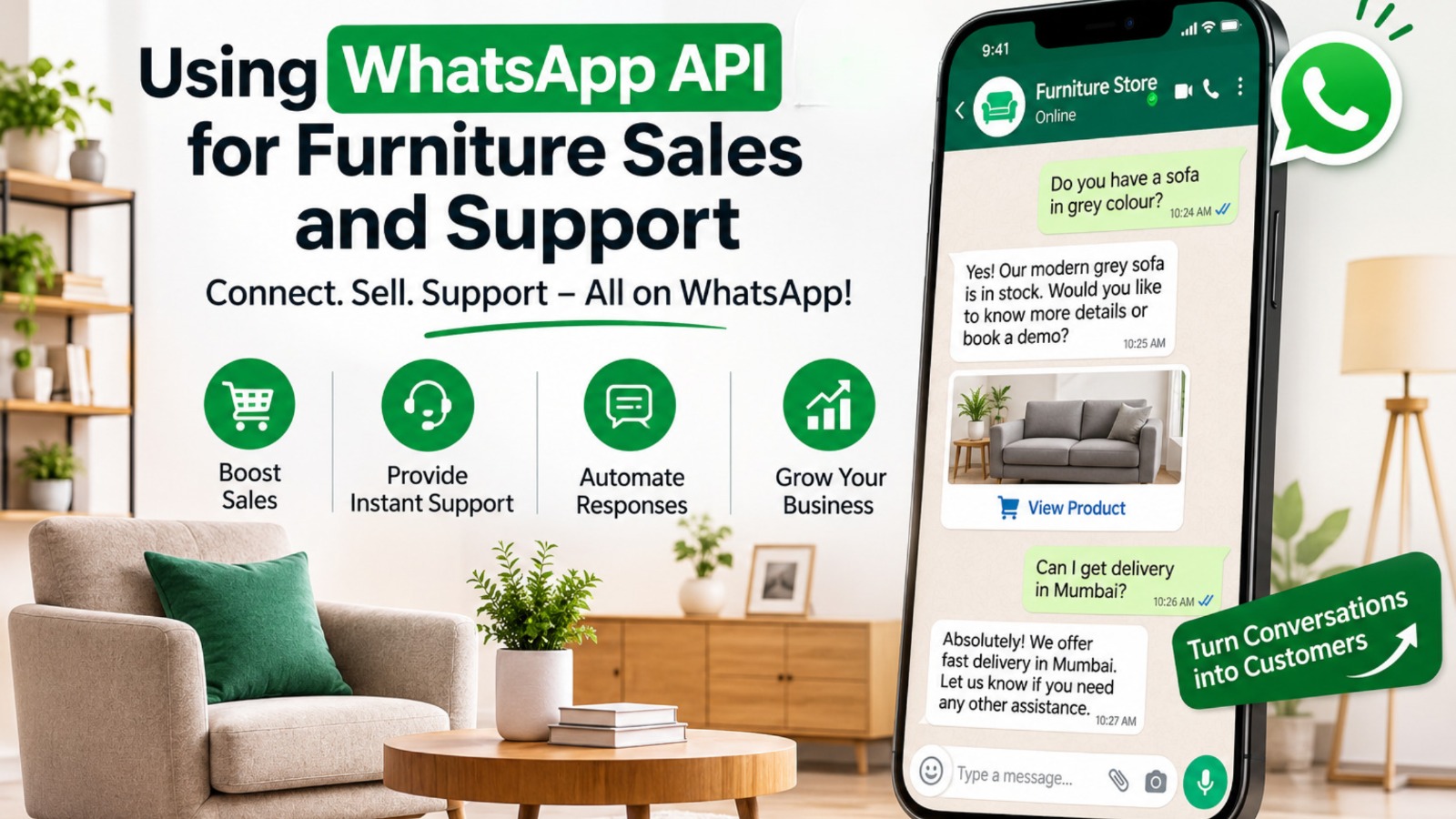
Example of a furniture chatbot conversation:
Customer: Hello, I am looking for a sofa.
Chatbot: Welcome! What type of sofa are you interested in?
- L-shaped sofa.
- Three-seater sofa.
- Recliner sofa.
- Customised sofa.
Customer: L-shaped sofa.
Chatbot: Great! What is your preferred budget?
- Below ₹25,000.
- ₹25,000–₹50,000.
- ₹50,000–₹1,00,000.
- Above ₹1,00,000.
After collecting these details, the chatbot can recommend relevant products or connect the customer with a sales executive.
As a result, businesses can organise enquiries and improve the buying experience.
Moreover, Campaign Plus provides WhatsApp automation and chatbot solutions that businesses can explore for creating structured customer communication workflows.
4. Share Product Images and Videos
Furniture is a visual product category. Customers want to understand how a sofa looks, how a wardrobe opens, or how a dining table fits into a modern home.
Therefore, sharing high-quality photographs and videos can improve product discovery.
Through WhatsApp, furniture businesses can share:
- Product photographs.
- Furniture demonstration videos.
- Material and fabric details.
- Product brochures.
- Room setup inspiration.
- Customisation examples.
For example, a customer interested in a modular kitchen can receive photographs showing different finishes, storage arrangements, and designs.
Moreover, businesses can share short videos demonstrating product features.
Consequently, customers can understand the product better before visiting a showroom or placing an order.
In addition, visual communication can help sales representatives explain product differences more effectively.
5. Send Automated Order Confirmations
Customer communication should not stop after a purchase. In fact, post-purchase communication plays an important role in building trust.
After a customer places an order, furniture businesses can send an order confirmation through an approved WhatsApp utility template where required.
The message can include:
- Order number.
- Purchased product.
- Order confirmation.
- Payment information.
- Expected delivery details.
- Customer support contact information.
For example:
“Hello Rahul! Your furniture order #FP1025 has been confirmed. Our team will share delivery updates as your order progresses. Thank you for choosing ABC Furniture!”
Additionally, businesses can integrate WhatsApp with their order management systems to automate relevant notifications.
As a result, customers receive important information without repeatedly contacting the showroom.
Furthermore, automated confirmations can reduce repetitive work for customer support teams.
6. Provide Delivery Updates
Furniture delivery can involve multiple stages, especially for customised products or large orders.
Consequently, customers may want to know whether their furniture is ready, dispatched, or scheduled for delivery.
Without proper communication, they may repeatedly call the business for updates.
Fortunately, WhatsApp automation can make this process easier.
Businesses can send relevant updates such as:
- Your order is being processed.
- Your furniture is under production.
- Your order is ready for dispatch.
- Your furniture has been shipped.
- Your delivery is scheduled.
- Your installation appointment is confirmed.
Furthermore, businesses can share tracking information or delivery contact details where available.
Therefore, customers stay informed throughout the delivery process. As a result, businesses can reduce unnecessary status enquiries.
7. Recover Potential Furniture Sales
Not every customer completes a purchase during their first interaction.
Some customers may enquire about a sofa but postpone the decision. Similarly, others may compare multiple furniture brands before choosing one.
Therefore, businesses need a structured follow-up strategy.
With WhatsApp API, furniture retailers can send relevant follow-up messages to customers who have provided the required consent.
For example:
“Hello Rahul! We noticed your interest in our premium L-shaped sofa. Would you like to explore available colours or speak with our product specialist?”
Additionally, businesses can create follow-up workflows based on customer interests and enquiry history.
As a result, interested customers can continue their buying journey without unnecessary delays.
However, businesses must follow WhatsApp messaging policies, obtain appropriate opt-ins, and use approved marketing templates when initiating conversations outside the customer service window.
8. Manage Customer Support Through a Shared Inbox
Furniture companies often have different employees handling sales, delivery, billing, and customer support.
However, if all employees use separate communication channels, important customer conversations can become difficult to track.
A shared WhatsApp team inbox can help authorised employees manage customer conversations through a central interface.
For example:
- Sales teams handle product enquiries.
- Support teams manage complaints.
- Delivery teams answer shipping questions.
- Service teams coordinate installation requests.
Moreover, team members can assign conversations, track their status, and coordinate responses.
Consequently, businesses can reduce communication gaps and provide more organised customer support.
In addition, managers can monitor team activity and identify conversations that need attention.
9. Collect Customer Feedback and Reviews
Customer feedback helps furniture brands understand their product quality and service experience.
However, many customers forget to leave reviews after purchasing furniture.
Therefore, WhatsApp can make feedback collection more convenient.
After a successful delivery, businesses can send a suitable feedback request.
For example:
“Hello Rahul! We hope you are enjoying your new sofa. We would love to hear about your experience. Please share your feedback using the link below.”
Additionally, businesses can ask customers about product quality, delivery experience, installation, and overall satisfaction.
Positive customer experiences may also encourage customers to share reviews on relevant platforms.
As a result, furniture brands can build credibility and identify areas for improvement.
10. Promote Seasonal Offers and New Furniture Collections
Furniture demand can increase during festivals, weddings, home renovations, and seasonal sales.
Therefore, businesses can use WhatsApp marketing to inform interested customers about relevant collections and offers.
For example, furniture retailers can promote:
- Diwali furniture offers.
- Wedding furniture collections.
- New sofa launches.
- Bedroom furniture discounts.
- Office furniture packages.
- Home renovation collections.
Furthermore, businesses can personalise messages based on customer interests.
A customer who previously enquired about dining tables may receive updates about a new dining collection rather than unrelated furniture promotions.
Consequently, marketing communication becomes more relevant. Additionally, customers can discover new products that match their preferences.
However, promotional messages require appropriate marketing opt-in and approved templates when initiated through the WhatsApp Business Platform.
How WhatsApp API Improves the Complete Furniture Customer Journey
A successful furniture business needs to communicate with customers at every stage of their buying journey.
Fortunately, WhatsApp API helps connect these stages through a single messaging channel.
Stage 1: Product Discovery
First, customers discover furniture through Instagram, Facebook, Google, advertisements, or websites.
At this stage, businesses can encourage visitors to start a WhatsApp conversation. For example, they can add WhatsApp enquiry buttons to product pages and advertisements.
Stage 2: Product Enquiry
After clicking the WhatsApp button, customers can ask about pricing, availability, product dimensions, and materials.
Meanwhile, automated chatbots can collect their requirements and guide them towards relevant information.
Stage 3: Product Selection
Next, sales teams can share relevant catalogues, photographs, videos, and product recommendations.
As a result, customers can compare available options more easily. Moreover, sales representatives can provide personalised recommendations.
Stage 4: Purchase Assistance
Once customers identify their preferred furniture, sales representatives can help with customisation, quotations, payment information, and showroom appointments.
Furthermore, personalised assistance can help resolve any remaining questions.
Stage 5: Order Updates
After purchase, businesses can share confirmation messages, production updates, and delivery information.
Consequently, customers remain informed about their orders. In addition, support teams can manage communication more efficiently.
Stage 6: Post-Purchase Support
Finally, businesses can provide installation assistance, collect feedback, and address customer concerns.
Therefore, WhatsApp becomes a useful communication channel throughout the customer lifecycle.
WhatsApp API vs Regular WhatsApp Business App for Furniture Retailers
Both tools support business communication. However, they serve different operational requirements.
| Feature | WhatsApp Business App | WhatsApp Business Platform |
|---|---|---|
| Basic customer messaging | Yes | Yes, through an integrated solution |
| Automated chatbots | Limited native automation | Advanced automation through integrations |
| Multiple-agent workflows | Limited linked-device support | Supports multi-agent solutions |
| CRM integration | Limited | Available through integrations |
| Automated notifications | Limited | Supported through approved workflows |
| Large-scale messaging | Limited | Supports scalable messaging subject to policies |
| Customer conversation management | Basic | Advanced through shared inbox solutions |
For a small furniture shop handling a limited number of enquiries, the regular WhatsApp Business app may be sufficient.
However, furniture brands managing multiple locations, sales teams, and high enquiry volumes may benefit from the WhatsApp Business Platform.
Ultimately, the right solution depends on business size, communication requirements, and automation needs.
How to Implement WhatsApp API in Your Furniture Business
Getting started with WhatsApp API does not need to be complicated. Instead, businesses can follow these practical steps.
Step 1: Define Your Business Goals
First, identify what you want to achieve through WhatsApp.
For example, your goals may include:
- Increasing furniture enquiries.
- Generating qualified sales leads.
- Automating customer support.
- Improving order communication.
- Promoting new furniture collections.
- Reducing repetitive manual work.
Clearly defined goals help you select the right automation workflows. Moreover, they make performance measurement easier.
Step 2: Choose a WhatsApp API Solution Provider
Next, select a suitable WhatsApp Business Platform solution or technology provider.
Look for features such as:
- WhatsApp chatbot builder.
- Shared team inbox.
- CRM integration.
- Automated notifications.
- Campaign management.
- Customer segmentation.
- Reporting and analytics.
For example, Campaign Plus offers WhatsApp automation and chatbot solutions that can help businesses manage customer conversations and communication workflows.
Step 3: Set Up Your WhatsApp Business Account
After selecting a suitable solution, complete the required business onboarding and phone number setup.
Depending on your account and provider, the process may involve business verification, phone number registration, and WhatsApp Business Account configuration.
Additionally, ensure that your business communication follows Meta’s applicable policies.
Step 4: Create Automated Chatbot Workflows
Next, build chatbot journeys around common furniture enquiries.
For example, create separate flows for sofas, beds, wardrobes, dining furniture, and office furniture.
Furthermore, include options that allow customers to connect with human representatives whenever they need personalised assistance.
As a result, customers can get quick answers while retaining access to personal support.
Step 5: Connect Your CRM and Sales Process
Integrating WhatsApp with a CRM or lead management system can help businesses organise customer information.
For instance, sales teams can track customer requirements, enquiry sources, follow-up status, and purchase progress.
Consequently, fewer sales opportunities get overlooked.
Moreover, managers can use organised information to understand customer behaviour and improve sales strategies.
Step 6: Test and Improve Your Automation
Before launching your workflows, test different customer journeys.
Check whether product information is correct, chatbot options work properly, and conversations reach the right team.
Moreover, monitor response times, enquiry quality, conversion rates, and customer feedback.
Continuous improvement helps businesses build a more effective WhatsApp communication strategy.
Best Practices for WhatsApp Marketing in the Furniture Industry
Using WhatsApp API effectively requires more than sending promotional messages.
Instead, businesses should focus on providing relevant information and a helpful customer experience.
Here are some important practices.
1. Collect Customer Consent: Always obtain appropriate permission before sending proactive messages. Furthermore, clearly explain what type of communication customers can expect.
2. Personalise Your Messages: Use customer preferences, previous enquiries, and product interests to make communication more relevant. As a result, customers receive information that matches their needs.
3. Use High-Quality Visuals: Share clear furniture photographs, product demonstrations, and useful brochures. This way, customers can understand products more easily.
4. Avoid Excessive Promotions: Too many marketing messages can frustrate customers. Therefore, maintain a reasonable messaging frequency.
5. Provide Human Assistance: Chatbots should simplify communication, not prevent customers from reaching a real representative.
6. Keep Product Information Updated: Ensure that prices, availability, dimensions, and delivery details remain accurate. Otherwise, incorrect information can create confusion.
7. Follow WhatsApp Policies: Use approved templates for business-initiated conversations and messages outside the 24-hour customer service window. Additionally, honour customer opt-out requests.
8. Track Performance: Measure enquiries, qualified leads, response times, sales conversions, and customer satisfaction. Consequently, you can identify opportunities for improvement.
By following these practices, furniture businesses can build stronger customer relationships while maintaining responsible communication.
Common Mistakes Furniture Businesses Should Avoid
Although WhatsApp automation offers several benefits, businesses should avoid certain mistakes.
Sending Unwanted Promotional Messages
Sending messages without appropriate consent can damage customer trust and create policy risks.
Instead, build an opt-in audience through websites, advertisements, and showroom interactions.
Furthermore, provide customers with a clear way to stop receiving promotional communication.
Using Generic Chatbot Responses
Customers purchasing furniture often have specific requirements.
Therefore, avoid chatbots that provide irrelevant answers or force customers through unnecessary questions.
Instead, create helpful conversation flows based on different furniture categories.
Ignoring Customer Follow-Ups
A customer who asks about a customised wardrobe may need additional information before making a purchase.
Consequently, businesses should establish clear follow-up processes and assign enquiries to the right sales representatives.
Sharing Poor-Quality Product Images
Furniture purchases depend heavily on visual presentation.
Thus, use clear photographs that accurately represent product colours, materials, and designs.
Moreover, include multiple product angles whenever possible.
Failing to Track Results
Without performance tracking, businesses cannot identify which communication activities generate valuable leads.
For this reason, regularly review campaign performance and customer interactions.
As a result, businesses can make better decisions and improve their marketing strategies.
How Campaign Plus and Step4Growth Can Support Furniture Businesses
Successful digital communication requires the right combination of technology and marketing strategy.
This is where Campaign Plus and Step4Growth can contribute.
Campaign Plus: WhatsApp Automation and Customer Communication
Campaign Plus provides WhatsApp automation, chatbot, and business messaging solutions.
Furniture businesses can explore WhatsApp automation to:
- Manage customer enquiries.
- Create automated chatbot journeys.
- Organise customer conversations.
- Share product information.
- Coordinate customer support.
- Manage relevant business messaging campaigns.
Furthermore, automation can reduce repetitive communication tasks and help sales teams focus on customers who need personalised assistance.
As a result, furniture businesses can create a more organised customer communication process.
Step4Growth: Digital Marketing and Business Growth
Technology works best when customers can discover the business through effective digital marketing.
Step4Growth focuses on digital marketing strategies that help businesses strengthen their online presence.
For furniture brands, an effective digital marketing approach may include:
- Search engine optimisation (SEO).
- Google Ads campaigns.
- Facebook and Instagram advertising.
- Social media marketing.
- Website optimisation.
- Lead generation strategies.
- Content marketing.
Moreover, businesses can connect their advertising campaigns with WhatsApp to create a smoother customer journey.
For example, a customer may discover a furniture brand through an Instagram advertisement, click the WhatsApp button, explore product options, and speak with a sales representative.
As a result, businesses can connect advertising, product enquiries, and sales assistance more effectively.
Trending Bulb brings these industry insights together to help businesses understand how technology and digital communication can support modern business growth.
How to Measure the Success of WhatsApp API for Furniture Sales
Implementing WhatsApp API is only the beginning. Businesses should also measure whether their communication strategy delivers meaningful results.
Here are some important performance indicators.
1. Total Enquiries: Track how many customers initiate conversations through WhatsApp. This helps you understand customer interest.
2. Qualified Leads: Measure how many enquiries match your target products, budget, and purchase requirements. Additionally, identify which campaigns generate the most relevant enquiries.
3. First Response Time: Monitor how quickly your team or chatbot responds to customer messages. Faster responses can improve the customer experience.
4. Lead-to-Sale Conversion Rate: Calculate how many qualified WhatsApp leads eventually become paying customers. Consequently, you can evaluate the effectiveness of your sales process.
5. Follow-Up Performance: Track how many customers respond to relevant follow-up messages. This helps you improve future communication.
6. Customer Satisfaction: Collect feedback to understand the quality of your support and delivery experience.
7. Campaign Performance: Monitor message delivery, customer responses, and conversions where relevant reporting data is available.
By reviewing these indicators regularly, furniture businesses can identify successful workflows and improve weaker areas.
Furthermore, consistent tracking helps businesses make informed decisions about future marketing activities.
Frequently Asked Questions (FAQs)
1. What is WhatsApp API for furniture businesses?
WhatsApp API is a business messaging solution that allows furniture retailers to automate conversations, manage customer enquiries, share product information, send order updates, and provide customer support through integrated platforms.
2. Can furniture businesses generate sales through WhatsApp API?
Yes. Furniture businesses can use WhatsApp to respond to product enquiries, share catalogues, recommend relevant products, provide quotations, and connect customers with sales representatives.
As a result, these activities can support the purchasing process and improve sales opportunities.
3. Can WhatsApp API automate furniture customer support?
Yes. Businesses can create chatbots to answer common questions about product availability, delivery, installation, showroom locations, and order status.
However, complex issues should have a clear option for human assistance. This ensures customers can receive personalised support whenever necessary.
4. Can I share furniture catalogues through WhatsApp?
Yes. Businesses can share product information, photographs, brochures, and links through WhatsApp.
Additionally, supported catalogue messaging features can allow customers to browse connected Meta product catalogues within WhatsApp.
5. Is WhatsApp API suitable for small furniture businesses?
Yes. Small furniture retailers can use WhatsApp automation to manage enquiries, share product information, and organise customer communication.
However, they should select a solution that matches their budget and operational requirements.
6. Can WhatsApp API send automated delivery notifications?
Yes. Businesses can integrate their order management systems with WhatsApp to send relevant order confirmations, dispatch updates, delivery notifications, and installation information using appropriate messaging workflows and templates.
Consequently, customers can stay informed without repeatedly contacting the showroom.
7. Is WhatsApp API better than the regular WhatsApp Business app?
It depends on business requirements.
The regular app works well for basic communication. However, the WhatsApp Business Platform offers advanced integrations, automation, and scalable team communication through supported solutions.
8. Can furniture businesses use WhatsApp chatbots for lead generation?
Absolutely. Chatbots can ask customers about furniture categories, budgets, preferred designs, and purchase timelines.
Consequently, sales teams can use these details to prioritise relevant enquiries and provide suitable recommendations.
9. How does Campaign Plus help furniture businesses?
Campaign Plus provides WhatsApp automation and chatbot solutions that can help furniture businesses manage enquiries, automate customer communication, and organise conversations through integrated business messaging workflows.
10. Why should furniture brands combine WhatsApp API with digital marketing?
Digital marketing helps customers discover furniture brands, while WhatsApp provides a convenient channel for enquiries, product information, and sales assistance.
Therefore, combining both approaches can create a more connected customer journey and help businesses manage potential customers more effectively.
Conclusion
The furniture industry is becoming increasingly customer-focused. Today’s buyers expect convenient product discovery, quick communication, detailed product information, and reliable post-purchase support.
Therefore, furniture businesses need communication systems that can manage these expectations efficiently.
The WhatsApp API for Furniture Sales and Support offers a practical way to connect product discovery, customer enquiries, automated conversations, order updates, and after-sales assistance.
Moreover, chatbots and shared inboxes can help businesses manage repetitive tasks while allowing sales teams to focus on personalised customer interactions.
With Campaign Plus, furniture brands can explore WhatsApp automation and chatbot solutions to improve business communication. Meanwhile, Step4Growth can help strengthen their digital marketing and lead generation efforts.
At Trending Bulb, we believe that combining smart technology with effective digital marketing can help businesses build better customer experiences.
Ready to improve your furniture sales and customer support with WhatsApp automation? Explore WhatsApp automation with Campaign Plus and strengthen your digital growth strategy with Step4Growth.